

Introduction
Cohen begins conceiving AARON in the late 1960s and names and develops it during the 1970s. Instead of learning from a massive image dataset, AARON encodes his knowledge of drawing, representation and composition as rules. It offers an important comparison: machine art need not depend on scraping or style appropriation, so contemporary anti-AI politics cannot simply be equated with opposition to all machine-made art.
 View full image ↗
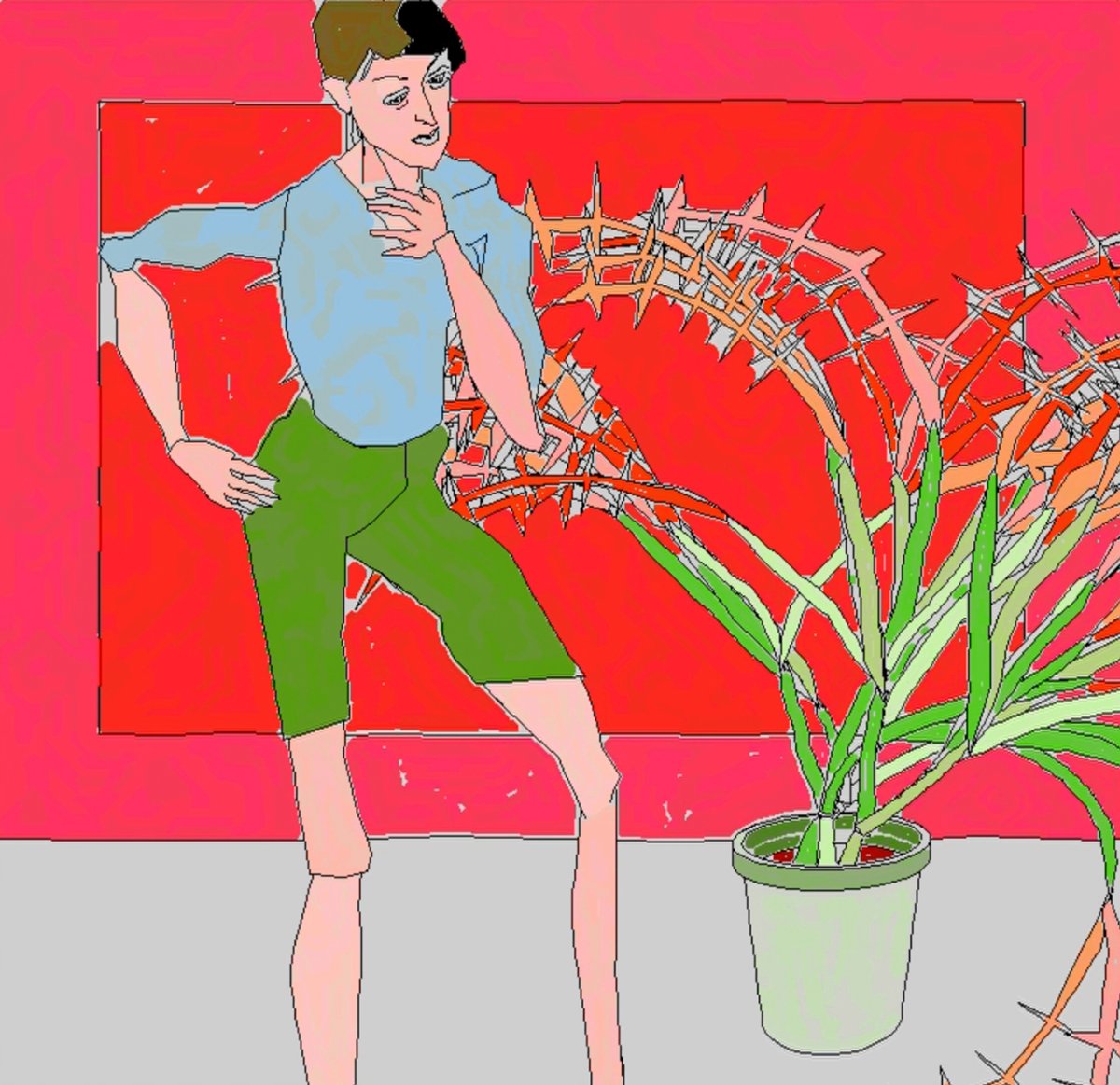
Harold Cohen, AARON KCAT (2001), software screenshot reproduced on Whitney’s retrospective page. It illustrates the continuing AARON practice, not an image from 1969.
© Harold Cohen Trust / Whitney Museum of American Art · Image rights remain with their respective holders; no open licence is asserted
Source · AARON ↗RESEARCH ACCOUNT
What does a drawing program need to know?
ANTI-AI ARCHIVE · Revised 2026-10-02
From the studio to the AI laboratory
AARON was a developing artistic project rather than a fixed product launched on one date. The Whitney traces its conception to Cohen’s work at the University of California, San Diego, in the late 1960s, followed by development at Stanford’s Artificial Intelligence Laboratory in 1973–75. Conception, naming and later implementations belong to different moments.
Section sources: Harold Cohen: AARON — Art & Artists · Harold Cohen: AARON
Encoding decisions about drawing
The program had to deal with closed contours, figure and ground, and the distribution of objects. The Whitney describes rules such as working from foreground to background, combined with random events that generate lines and shapes. The drawing emerges through successive decisions rather than the tracing of a stored finished picture.
Section sources: Harold Cohen: AARON — Art & Artists
A limitation Cohen described in 1982
In How to Make a Drawing, Cohen explains that the AARON he is discussing remembers a drawing in progress but does not accumulate experience from completed drawings. He also recalls colouring its line drawings himself and understanding his role as somewhere between teacher and collaborator. This is an account of a particular developmental stage, not a specification for every subsequent version.
Section sources: How to Make a Drawing
Drawings, devices and the running program
The 2024 Whitney exhibition brought together works on paper, screen-based software and working plotters. An Untitled work from 1982 is catalogued as watercolour and plotter pen on paper. The active machines were modern re-creations, and some early code was reconstructed from notebooks in Python. Installation photographs document that later presentation, not an untouched 1970s apparatus.
Section sources: Harold Cohen: AARON · Harold Cohen: AARON — Art & Artists
Where does authorship reside?
Editorial interpretation: AARON invites attention to who defines the system’s capacities and revises them. Writing rules, selecting outputs, applying colour and deciding how to exhibit the work locate creative labour at different stages. This makes authorship a more specific question, without settling permission or remuneration disputes surrounding contemporary large-scale training datasets.
Section sources: How to Make a Drawing · Harold Cohen: AARON
Sources for this account
Exhibition overview, object captions and 2024 exhibition dates
AARON’s Beginnings, Untitled 1982 and Active plotters
Lecture dated 17 December 1982, pages 1–5; not treated as a specification for all versions
Based on the artist’s account and museum documentation. AARON code was not executed or audited; descriptions from 1982 retain their historical scope. The account and translation are AI-assisted, pending independent human review. Section references identify evidence without claiming independent verification of every historical statement.
Continue with a comparative question
Compare another artist-defined system of rules; no direct influence is asserted.
Compare the relationship between programs, paper outputs and exhibitions.
AARON’s development and its institutional presentation at Tate are related but distinct historical events.
Dates & version record
Date displayed for this node: late 1960s–1970s · Historical date recorded for the source: 1970s
These dates refer to the historical event or recorded version, not this page’s publication date. The original date precision and unresolved questions are retained.
Original sources & further reading
These links lead to the cited paper, article, institution or conference page. External texts retain their source languages.
Provenance, translation & verification
Timeline entry #030 · Historical node
Research materials & supplement references · 1
AI Art Genealogy Research Master · p. 7 · 014
Date as recorded: 1970s
AARON ↗
AARON
Archive account based on the listed research materials, not a full translation of the linked work. AI-assisted translation; independent human review pending.
The master’s research claims and dates await independent verification.
Cite this node
ANTI-AI ARCHIVE. AARON. Art-history node #030. https://salondesrefuses.cn/en/art-history/014
For specific historical claims, also cite the original sources above and include your access date. This account is not a full translation of the linked work.
Adjacent nodes follow chronological order; adjacency does not establish direct influence or causation.