

Introduction
From a manually conceived machine imaginaire to actual computer programs, Molnár uses rules, permutations and small random deviations in painting and drawing. Her practice demonstrates that generative art was not suddenly invented by deep learning: artists had long treated procedures, constraints and variation as mechanisms through which works take form.
 View full image ↗
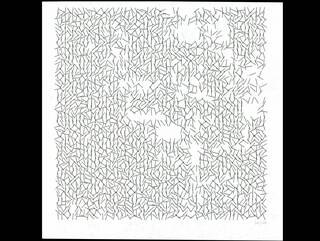
Vera Molnár, Interruptions (1969), V&A collection E.269-2011. This later drawing illustrates the practice discussed in the node; it is not dated here to 1968.
© Victoria and Albert Museum, London · Image rights remain with their respective holders; no open licence is asserted
Source · Algorithmic drawings / “machine imaginaire” practice ↗RESEARCH ACCOUNT
Finding variation within a rule: Molnár’s drawing experiments
ANTI-AI ARCHIVE · Revised 2026-10-03
Before access to a computer
The Centre Pompidou places Molnár’s practice within post-war geometric abstraction. Rule-based procedures and her imaginary-machine method preceded her use of computers and plotters in 1968. The sequence matters: procedural thinking was already part of her art; access to a machine changed the conditions for executing and comparing variations.
Section sources: Vera Molnár — Speak to the Eye
Reading Interruptions as a physical object
An Interruptions drawing in the National Gallery of Art is dated 1969: black ink on Benson plotter paper, approximately 44.45 × 35.88 cm, accession 2018.38.1. These particulars move the discussion from a generic label such as ‘algorithmic pioneer’ to a physical object with a scale, support and inked marks.
Section sources: Interruptions
Order and disturbance across a series
The Pompidou’s account associates a group of 1970s works with disturbances introduced into geometric compositions, including 160 carrés poussés à bout and Des lignes, pas des carrés. A useful way to approach a series is to compare what remains stable with what changes, rather than equating artistic interest with the amount of complexity a machine produces.
Section sources: Vera Molnár — Speak to the Eye
Object dates and inscriptions
The NGA records inscriptions bearing both 1969 and 1970 while retaining 1969 as the object’s catalogue date. Neither a reprint nor a revision can be inferred from the later inscription alone. Keeping catalogue conclusions, material evidence and unresolved interpretation separate is a practical task of archival research.
Section sources: Interruptions
How later exhibitions frame the practice
The V&A’s announced Degrees of Disruption display places Molnár alongside practitioners including Casey Reas and Licia He. As checked on 2 October 2026, its opening is scheduled for 16 October: this is a curatorial plan, not an account of an exhibition already visited. Juxtaposition can frame a comparison without establishing direct influence.
Section sources: Degrees of Disruption: Vera Molnar and Generative Art
Another way to think about control
Editorial interpretation: Molnár offers a way to study how artists establish a space of variation and then judge its differences. Making a procedure explicit does not eliminate aesthetic decisions. Her place in an AI-art genealogy allows comparison between computational practices, without retrospectively turning her drawing programs into contemporary machine-learning models.
Section sources: Vera Molnár — Speak to the Eye · Interruptions
Sources for this account
2024 retrospective account: imaginary machine, 1968 and the 1970s series
Object date, medium, dimensions, accession number and inscriptions
Announcement and display highlights; 16 October 2026 is the scheduled opening
Institutional records and exhibition accounts were read; the complete programs and original diaries were not examined. The NGA inscription discrepancy remains unresolved; the V&A exhibition had not opened at the check date. The account and translation are AI-assisted, pending independent human review. Section references identify evidence without claiming independent verification of every historical statement.
Continue with a comparative question
Compare different organisations of rules, probability and plotter output.
Compare formal variation with modelling knowledge about drawing without treating them as the same method.
Compare how different artists organise rules and variation.
Further comparison: Archetype: organising complexity through repetition
Further comparison: Screens: layered colour and deliberate misregistration
Further comparison: Themes and Variations: Molnár and Grasser
Dates & version record
Date displayed for this node: 1968–1980s · Historical date recorded for the source: 1968–1980s
These dates refer to the historical event or recorded version, not this page’s publication date. The original date precision and unresolved questions are retained.
Original sources & further reading
These links lead to the cited paper, article, institution or conference page. External texts retain their source languages.
Algorithmic drawings / “machine imaginaire” practice
https://www.centrepompidou.fr/en/program/calendar/event/PA7jRZ5
Current cited URL
Algorithmic drawings / “machine imaginaire” practice
https://www.centrepompidou.fr/en/program/calendar/event/TK5cQuY
URL cited in a research master or supplement; it may have moved or expired
Provenance, translation & verification
Timeline entry #028 · Historical node
Research materials & supplement references · 1
AI Art Genealogy Research Master · p. 9 · 023
Date as recorded: 1968–1980s
Algorithmic drawings / “machine imaginaire” practice ↗
Algorithmic drawings / “machine imaginaire” practice
Archive account based on the listed research materials, not a full translation of the linked work. AI-assisted translation; independent human review pending.
The master’s research claims and dates await independent verification.
Cite this node
ANTI-AI ARCHIVE. Algorithmic drawings / “machine imaginaire” practice. Art-history node #028. https://salondesrefuses.cn/en/art-history/023
For specific historical claims, also cite the original sources above and include your access date. This account is not a full translation of the linked work.
Adjacent nodes follow chronological order; adjacency does not establish direct influence or causation.