

Introduction
Mohr systematically uses computers and plotters after 1969 and holds a significant solo exhibition at the Musée d'Art Moderne de la Ville de Paris in 1971. His work demonstrates how a program can become an enduring system of authorship, comparable in its continuity to an artist's sustained method of painting.
 View full image ↗
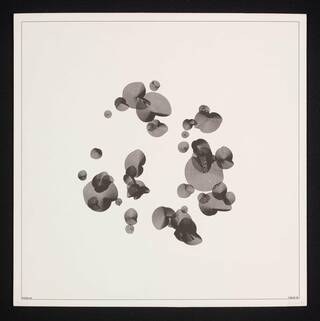
Manfred Mohr, P-62 (floating points) (1970), V&A collection E.186-2008; an example of the programmed drawing practice discussed in this node.
© Victoria and Albert Museum, London · Image rights remain with their respective holders; no open licence is asserted
Source · Computer-generated drawings; Une esthétique programmée ↗RESEARCH ACCOUNT
From an alphabet of lines to the plotter: how Mohr organised an image
ANTI-AI ARCHIVE · Revised 2026-10-03
From a drawn vocabulary to a program
The bitforms exhibition account relates Mohr’s transition to information aesthetics and algorithmic music, including Max Bense’s writings and his contact with Pierre Barbaud. His 1969 artist’s book Artificiata I was still drawn by hand. Beginning to program did not erase the formal problems that his earlier work had already raised.
Section sources: Artificiata II, Manfred Mohr
P-18: a random walk with a vocabulary
Mohr’s account of P-18 specifies horizontal, vertical and 45-degree lines, square waves and zigzags, with probabilities governing widths and lengths. The program selects from this vocabulary within a bounded area. Randomness therefore operates through defined possibilities. His page also distinguishes a drawing on paper from examples output by a high-resolution microfilm light-beam plotter.
Section sources: P-18, random walk
Computing access becomes part of production history
In his online annotations to the 1971 catalogue, Mohr recalls writing early programs on an SDS computer at Vincennes and using machines at several institutions. He identifies the CDC computer and Benson flatbed plotter at the Paris meteorological service for drawings from 1970 onwards. Computing and output depended on access to particular institutional resources.
Section sources: Manfred Mohr Computer Graphics — Une Esthétique Programmée: catalogue annotations
The 1971 exhibition and the reversed catalogue images
Une Esthétique Programmée at ARC, Musée d’Art Moderne de la Ville de Paris, gave these drawings a solo-exhibition setting in 1971. Mohr warns that white-on-black reproductions in the catalogue were photographically reversed: the originals were black ink on white paper. The catalogue also selects only a small number of examples from each algorithm rather than documenting every output.
Section sources: Manfred Mohr Computer Graphics — Une Esthétique Programmée: catalogue annotations
A different program, a different spatial problem
P-133, cluster phobia (1972), does not simply repeat the random-walk procedure. Mohr describes constructing gridded areas and fitting rectangles and broken lines into the remaining spaces, producing a circuit-like arrangement. Comparing it with P-18 makes differences between procedural problems visible, rather than treating all computer drawings as variations of one effect.
Section sources: P-133, cluster phobia
Programming relocates artistic decisions
Editorial interpretation: decisions are distributed across the vocabulary, constraints, probabilities, equipment and presentation. This offers a concrete way to examine who organises the conditions of generation. The relevant comparison with contemporary AI is the distribution of decisions, not an assumption that every computer-mediated practice shares the same authorship or data-licensing model.
Section sources: P-18, random walk · Manfred Mohr Computer Graphics — Une Esthétique Programmée: catalogue annotations · P-133, cluster phobia
Sources for this account
Organiser’s 2015 exhibition account: transition to programming and Artificiata I
Artist’s object page: algorithm, output methods and exhibition record
Artist’s online retrospective annotations; the linked 48-page catalogue was not read page by page
Artist’s object page: 1972 date, medium and staged algorithm description
Equipment and algorithm descriptions follow the artist’s retrospective account; programs were not run. The 1971 catalogue’s online annotations were read, not the complete catalogue. The account and translation are AI-assisted, pending independent human review. Section references identify evidence without claiming independent verification of every historical statement.
Continue with a comparative question
Compare rules and disturbance without treating similarity as demonstrated influence.
Compare formal procedures with the different project of modelling drawing knowledge.
Compare institutional computing resources with a learning-oriented environment; no direct technical descent is asserted.
Further comparison: Mark Wilson begins working with a personal computer
Dates & version record
Date displayed for this node: 1969–1971 · Historical date recorded for the source: 1969–1971
These dates refer to the historical event or recorded version, not this page’s publication date. The original date precision and unresolved questions are retained.
Original sources & further reading
These links lead to the cited paper, article, institution or conference page. External texts retain their source languages.
Computer-generated drawings; Une esthétique programmée
https://www.emohr.com/
Current cited URL
Provenance, translation & verification
Timeline entry #031 · Historical node
Research materials & supplement references · 1
AI Art Genealogy Research Master · p. 10 · 024
Date as recorded: 1969–1971
Computer-generated Drawings / A Programmed Aesthetics ↗
Computer-generated drawings; Une esthétique programmée
Archive account based on the listed research materials, not a full translation of the linked work. AI-assisted translation; independent human review pending.
The master’s research claims and dates await independent verification.
Cite this node
ANTI-AI ARCHIVE. Computer-generated Drawings / A Programmed Aesthetics. Art-history node #031. https://salondesrefuses.cn/en/art-history/024
For specific historical claims, also cite the original sources above and include your access date. This account is not a full translation of the linked work.
Adjacent nodes follow chronological order; adjacency does not establish direct influence or causation.