

Introduction
Processing makes drawing, interaction and program structure accessible within a creative-coding environment. Although not AI, it becomes important infrastructure for generative art in the 2000s. The master relates its culture of programmable visual practice to later use of notebooks, node workflows and prompt scripting.
 View full image ↗
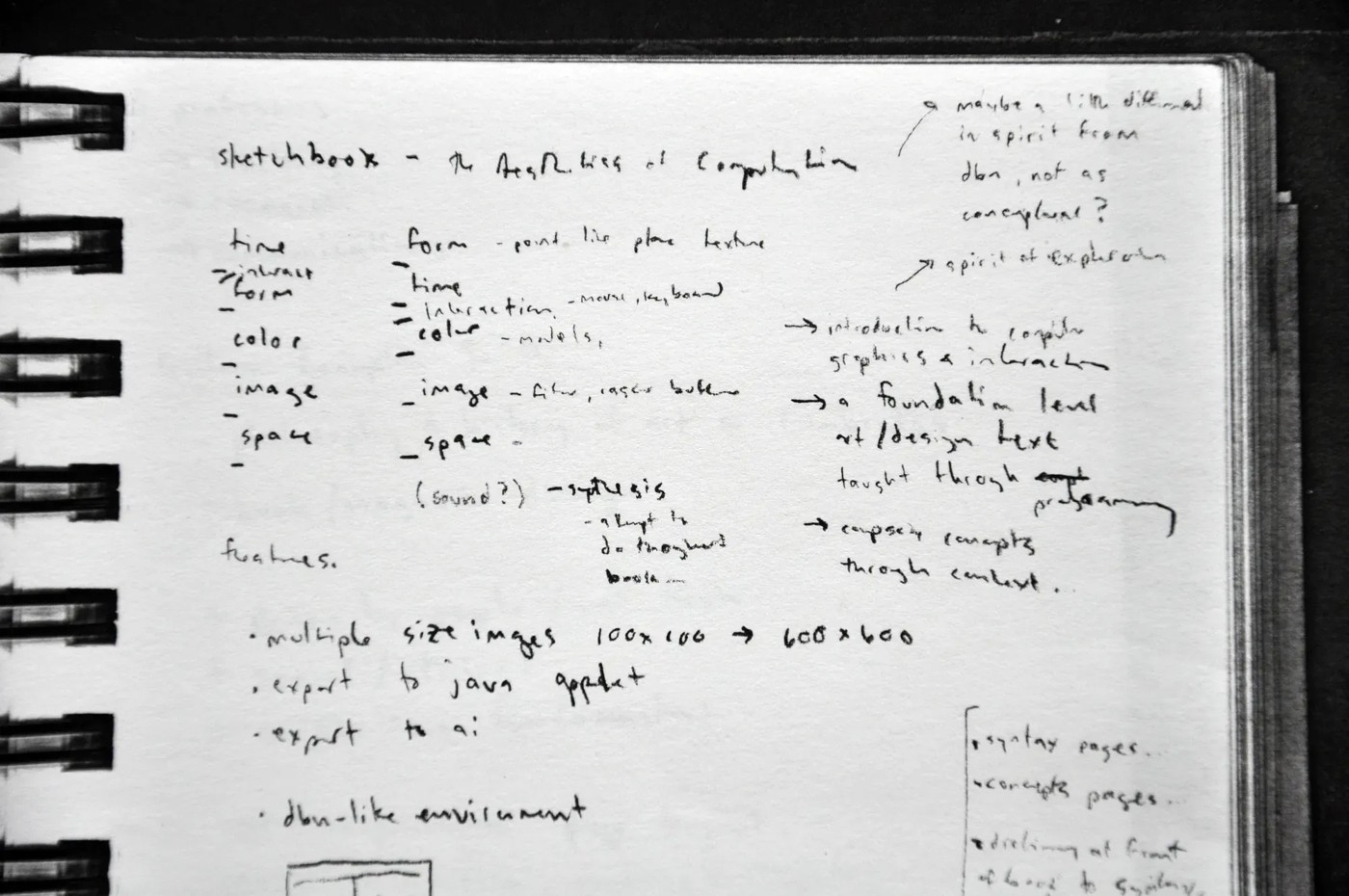
Casey Reas’s sketchbook notes from 2001, recording an early conversation about the project that became Processing. Caption and date follow the Processing Foundation’s history page.
Casey Reas / Processing Foundation · Rights in the original image and document remain with their respective holders
Source · History ↗RESEARCH ACCOUNT
Bringing programming into art education and everyday making.
ANTI-AI ARCHIVE · Revised 2026-10-03
Starting from examples
Processing combines editing, running and viewing visual results, supported by examples, references, books and a community. It is not a trained model that substitutes generated pictures for user instructions: people write programs specifying graphics, time and interaction. Its 2001 origins should be distinguished from subsequent software versions.
Section sources: Processing
A public environment formed around tools
Its historical significance includes teaching and shared practice, with code becoming material that can be modified and exchanged. Research on a Processing work should identify the program, libraries and runtime rather than using the software’s name as a substitute for analysis.
Section sources: Processing
Sources for this account
Project introduction, examples and community information read.
This account expands the archive within the cited scope. Historical interpretation is not presented as the original author’s statement or as a proven causal influence. The account and translation are AI-assisted, pending independent human review. Section references identify evidence without claiming independent verification of every historical statement.
Continue with a comparative question
Compare the methods, forms of control or presentation contexts of this entry and AARON.
Compare the methods, forms of control or presentation contexts of this entry and ComfyUI.
Compare institutional computing resources with a learning-oriented environment; no direct technical descent is asserted.
p5.js explicitly identifies Processing as a reference for its origin.
Further comparison: Ancient Courses of Fictional Rivers: constructing cartographic landscapes through simulation
Further comparison: 923 EMPTY ROOMS: a finite combinatorial space enters a distributed exhibition
Further comparison: Box Light Studies: observation and coding reshape one another
Further comparison: CENTURY: modernist references and interactive variation
Further comparison: Every Icon: enumerating possible images
Further comparison: Design by Numbers: programming for visual practitioners
Further comparison: Substrate: perpendicular growth of cracks
Further comparison: Process: textual rules and software interpretation
Further comparison: The Anatomy of Fracture
Further comparison: Becoming
Dates & version record
Date displayed for this node: 2001 · Historical date recorded for the source: 2001
These dates refer to the historical event or recorded version, not this page’s publication date. The original date precision and unresolved questions are retained.
Original sources & further reading
These links lead to the cited paper, article, institution or conference page. External texts retain their source languages.
Provenance, translation & verification
Timeline entry #070 · Historical node
Research materials & supplement references · 1
AI Art Genealogy Research Master · p. 13 · 038
Date as recorded: 2001
Processing ↗
Processing
Archive account based on the listed research materials, not a full translation of the linked work. AI-assisted translation; independent human review pending.
The master’s research claims and dates await independent verification.
Cite this node
ANTI-AI ARCHIVE. Processing. Art-history node #070. https://salondesrefuses.cn/en/art-history/038
For specific historical claims, also cite the original sources above and include your access date. This account is not a full translation of the linked work.
Adjacent nodes follow chronological order; adjacency does not establish direct influence or causation.