
Introduction
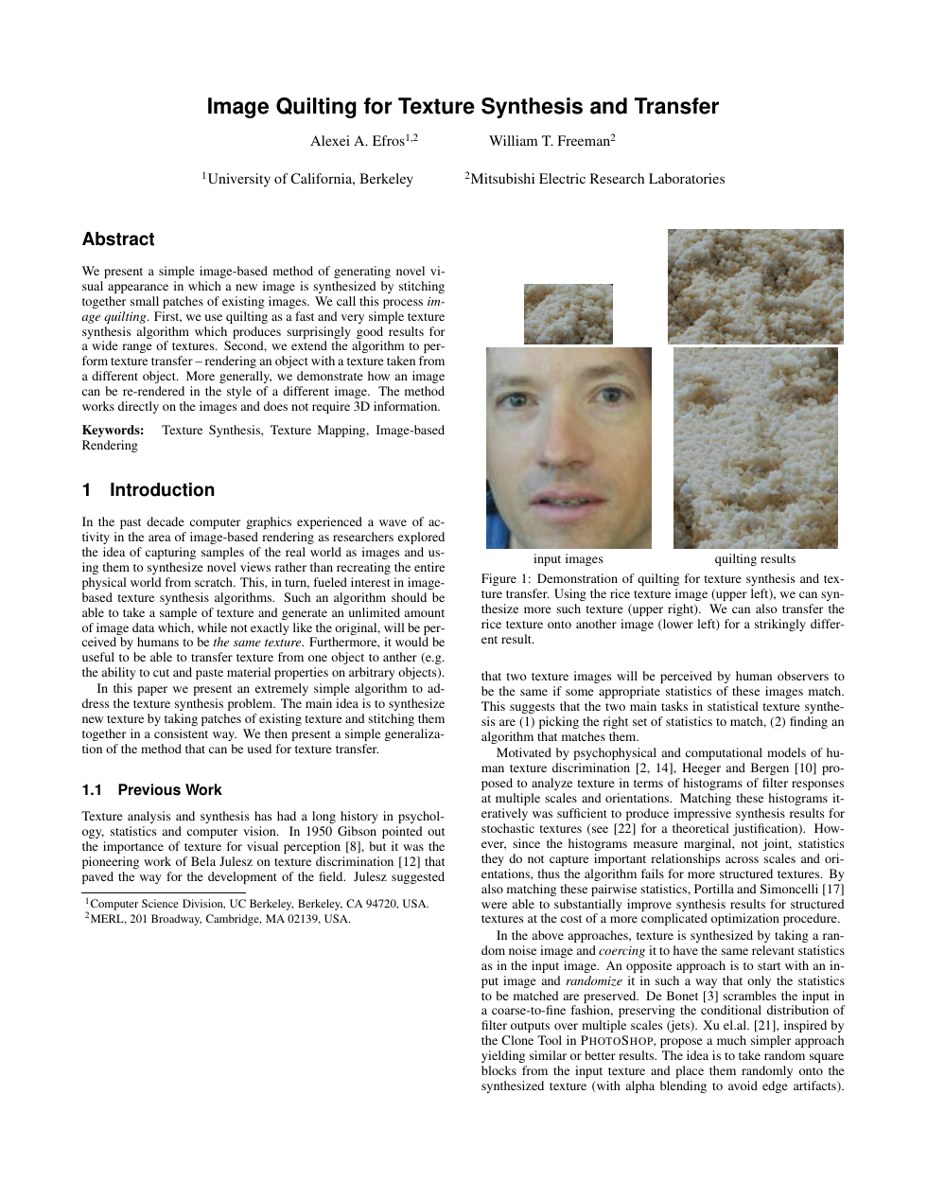
Image Quilting selects and joins patches from sample textures to synthesize larger textures, and also demonstrates texture transfer. It is not deep learning. It documents an important earlier route for reconstructing visual appearance from existing image material, preceding the widespread use of neural generative models.
 View full image ↗
Page 1 of the linked paper PDF, preserving its original figures and language. The source file identifies the edition; later revision or reprint dates do not replace the node’s historical date.
Alexei A. Efros; William T. Freeman · original paper · Image rights remain with their respective holders; no open licence is asserted
Source · Image Quilting for Texture Synthesis and Transfer ↗RESEARCH ACCOUNT
From sampled patches to texture transfer
ANTI-AI ARCHIVE · Revised 2026-10-02
Extending a sample into a new texture
Efros and Freeman synthesise a larger texture by joining small patches from existing images. Their method works directly with image material rather than requiring a three-dimensional model. The problem is to produce a new result that remains perceptually consistent with the source texture.
Section sources: Image Quilting for Texture Synthesis and Transfer
Transferring appearance between images
The method also supports texture transfer: one object can be rendered using appearance sampled from another. The input is both a sample to analyse and material used in synthesis. This differs from later methods that represent style through learned features, even when the outputs seem visually related.
Section sources: Image Quilting for Texture Synthesis and Transfer
Why this antecedent matters
Editorial interpretation: calling an AI image a collage requires attention to mechanism. Quilting genuinely works with image patches, but its implementation should not simply be projected onto diffusion models. Similar-looking effects can arise from substantially different processes.
Section sources: Image Quilting for Texture Synthesis and Transfer
Sources for this account
Original abstract and introduction read; image experiments not reproduced.
This account expands the archive within the cited scope. Historical interpretation is not presented as the original author’s statement or as a proven causal influence. The account and translation are AI-assisted, pending independent human review. Section references identify evidence without claiming independent verification of every historical statement.
Continue with a comparative question
Compare the methods, forms of control or presentation contexts of this entry and Pyramid-Based Texture Analysis/Synthesis; Parametric Texture Model.
Compare the methods, forms of control or presentation contexts of this entry and A Neural Algorithm of Artistic Style.
Dates & version record
Date displayed for this node: 2001 · Historical date recorded for the source: 2001
These dates refer to the historical event or recorded version, not this page’s publication date. The original date precision and unresolved questions are retained.
Original sources & further reading
These links lead to the cited paper, article, institution or conference page. External texts retain their source languages.
Image Quilting for Texture Synthesis and Transfer
https://people.eecs.berkeley.edu/~efros/research/quilting/quilting.pdf
Current cited URL
Provenance, translation & verification
Timeline entry #069 · Historical node
Research materials & supplement references · 1
AI Art Genealogy Research Master · p. 13 · 037
Date as recorded: 2001
Image Quilting for Texture Synthesis and Transfer ↗
Image Quilting for Texture Synthesis and Transfer
Archive account based on the listed research materials, not a full translation of the linked work. AI-assisted translation; independent human review pending.
The master’s research claims and dates await independent verification.
Cite this node
ANTI-AI ARCHIVE. Image Quilting for Texture Synthesis and Transfer. Art-history node #069. https://salondesrefuses.cn/en/art-history/037
For specific historical claims, also cite the original sources above and include your access date. This account is not a full translation of the linked work.
Adjacent nodes follow chronological order; adjacency does not establish direct influence or causation.