

Introduction
These texture-synthesis methods reconstruct appearance through multiscale filter responses and statistical constraints. Gatys's later neural style transfer uses statistics of deep-network features to represent style. The earlier tradition of statistical texture analysis is therefore an important technical antecedent, without implying that aesthetic style is exhausted by such statistics.
 View full image ↗
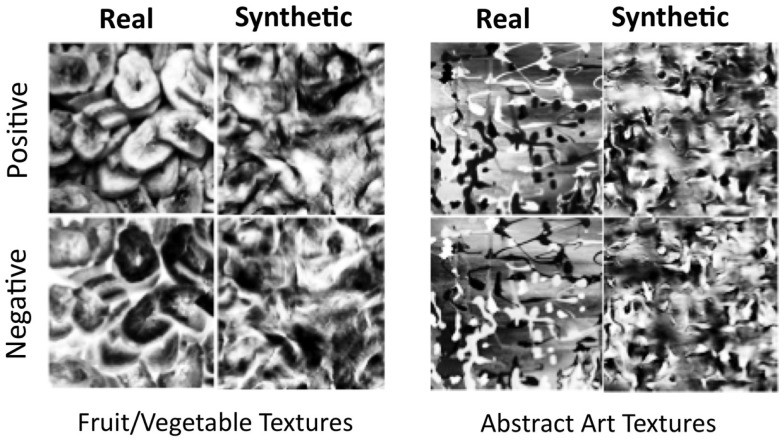
Original Figure 1 from Benjamin Balas’s 2012 paper comparing natural and synthetic textures. A later application of the Portilla–Simoncelli method, not a figure from the 2000 paper.
Benjamin Balas / Frontiers in Psychology · Rights remain with the respective holders; reproduction does not imply an open licence
Source · Contrast Negation and Texture Synthesis Differentially Disrupt Natural Texture Appearance - PMC ↗RESEARCH ACCOUNT
Reconstructing texture through statistical constraints rather than copying an image.
ANTI-AI ARCHIVE · Revised 2026-10-02
Historical object and process
Portilla and Simoncelli describe starting from noise and repeatedly matching a reference texture’s wavelet-subband and pixel statistics. Different outputs can share statistical properties without identical pixel arrangements. This node spans a 1990s research trajectory; the 1999 report and 2000 article should not be backdated as one completed 1995 version.
Section sources: Parametric Model for Visual Texture Representation and Synthesis
Significance and interpretive limits
Texture models make resemblance to a material computationally analysable and offer a comparison for later neural-style methods. Statistical matching does not explain every dimension of artistic style: subject, composition, cultural context and material use require separate analysis.
Section sources: Parametric Model for Visual Texture Representation and Synthesis
Sources for this account
Authors’ synthesis procedure and 1998–2000 bibliography read.
This account expands the archive within the cited scope. Historical interpretation is not presented as the original author’s statement or as a proven causal influence. The account and translation are AI-assisted, pending independent human review. Section references identify evidence without claiming independent verification of every historical statement.
Continue with a comparative question
Compare the methods, forms of control or presentation contexts of this entry and Image Quilting for Texture Synthesis and Transfer.
Compare the methods, forms of control or presentation contexts of this entry and A Neural Algorithm of Artistic Style.
Dates & version record
Date displayed for this node: 1995 / 2000 · Historical date recorded for the source: 1995 / 2000
These dates refer to the historical event or recorded version, not this page’s publication date. The original date precision and unresolved questions are retained.
Original sources & further reading
These links lead to the cited paper, article, institution or conference page. External texts retain their source languages.
Pyramid-Based Texture Analysis/Synthesis; Parametric Texture Model
https://www.cns.nyu.edu/pub/eero/portilla99-reprint.pdf
Current cited URL
Provenance, translation & verification
Timeline entry #060 · Historical node
Research materials & supplement references · 1
AI Art Genealogy Research Master · p. 13 · 035
Date as recorded: 1995 / 2000
Pyramid-Based Texture Analysis/Synthesis; Parametric Texture Model ↗
Pyramid-Based Texture Analysis/Synthesis; Parametric Texture Model
Archive account based on the listed research materials, not a full translation of the linked work. AI-assisted translation; independent human review pending.
The master’s research claims and dates await independent verification.
Cite this node
ANTI-AI ARCHIVE. Pyramid-Based Texture Analysis/Synthesis; Parametric Texture Model. Art-history node #060. https://salondesrefuses.cn/en/art-history/035
For specific historical claims, also cite the original sources above and include your access date. This account is not a full translation of the linked work.
Adjacent nodes follow chronological order; adjacency does not establish direct influence or causation.