

Introduction
Shannon establishes a mathematical theory of communication. The genealogy does not position him as the direct origin of AI art; it identifies a broader condition in which images, writing and sound can be treated as encodable information. Datasets, compressed representations, latent spaces and generative models develop within this wider informational framework.
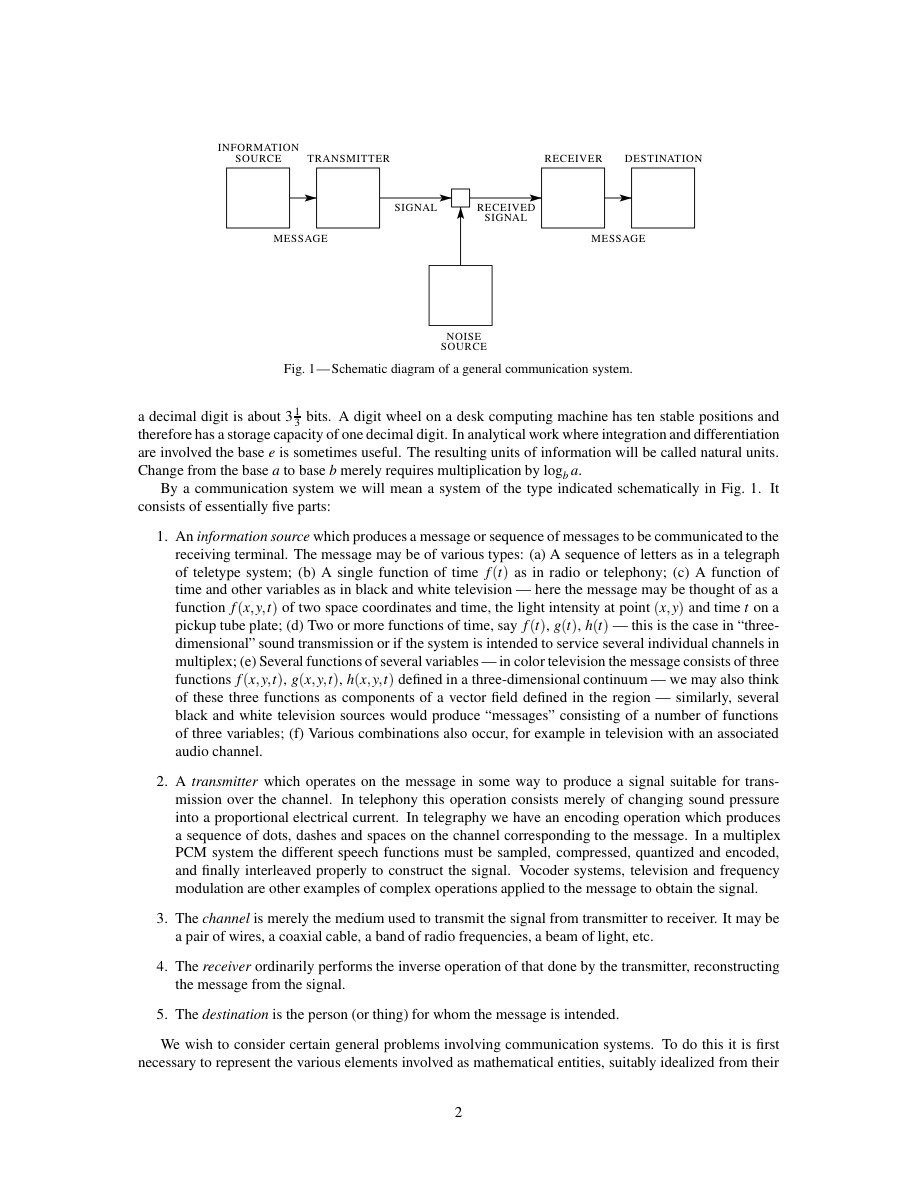 View full image ↗
Page 2 of the corrected reprint of Shannon’s 1948 paper, including Figure 1 of a communication system. This is a figure in the source document, not an archive redraw.
Claude E. Shannon · Harvard Mathematics hosted copy · Rights in the original image and document remain with their respective holders
Source · A Mathematical Theory of Communication ↗RESEARCH ACCOUNT
Information quantity is not the same as a work’s meaning.
ANTI-AI ARCHIVE · Revised 2026-10-02
The mathematical problem of communication
Shannon treats communication as the transmission of messages through a potentially noisy channel, separating source, encoding, transmission and reception. Probability supplies a measure of uncertainty; redundancy matters to reliable transmission. The 1948 paper and the 1949 volume with Weaver are distinct publication events.
Section sources: A Mathematical Theory of Communication
The boundary of information aesthetics
The framework supplies a calculable vocabulary for order, variation and repetition in images. Yet a communication measure does not by itself measure cultural value. Reading Shannon alongside Bense and Moles makes the movement of engineering concepts into aesthetics a historical question, rather than treating communication theory as an already complete theory of art.
Section sources: A Mathematical Theory of Communication
Sources for this account
Research master and bibliographic record consulted; access to the original paper was limited in this pass, so bibliographic checking is not recorded as full-text reading.
This account expands the archive within the cited scope. Historical interpretation is not presented as the original author’s statement or as a proven causal influence. The account and translation are AI-assisted, pending independent human review. Section references identify evidence without claiming independent verification of every historical statement.
Continue with a comparative question
Compare the methods, forms of control or presentation contexts of this entry and Aesthetica / Introduction to Information-Theoretic Aesthetics.
Compare the methods, forms of control or presentation contexts of this entry and Information Theory and Esthetic Perception.
Dates & version record
Date displayed for this node: 1948 · Historical date recorded for the source: 1948
These dates refer to the historical event or recorded version, not this page’s publication date. The original date precision and unresolved questions are retained.
Original sources & further reading
These links lead to the cited paper, article, institution or conference page. External texts retain their source languages.
A Mathematical Theory of Communication
https://doi.org/10.1002/j.1538-7305.1948.tb01338.x
Current cited URL
Provenance, translation & verification
Timeline entry #002 · Historical node
Research materials & supplement references · 1
AI Art Genealogy Research Master · p. 4 · 002
Date as recorded: 1948
A Mathematical Theory of Communication ↗
A Mathematical Theory of Communication
Archive account based on the listed research materials, not a full translation of the linked work. AI-assisted translation; independent human review pending.
The master’s research claims and dates await independent verification.
Cite this node
ANTI-AI ARCHIVE. A Mathematical Theory of Communication. Art-history node #002. https://salondesrefuses.cn/en/art-history/002
For specific historical claims, also cite the original sources above and include your access date. This account is not a full translation of the linked work.
Adjacent nodes follow chronological order; adjacency does not establish direct influence or causation.