

Introduction
McCulloch and Pitts use simplified neurons and logical calculus to examine how neural activity could perform computation. This is not a paper on image generation. Its importance to this genealogy is the proposition that perception and cognition can be represented as computable networks: a formal prehistory that should remain visible when discussing neural image generation.
 View full image ↗
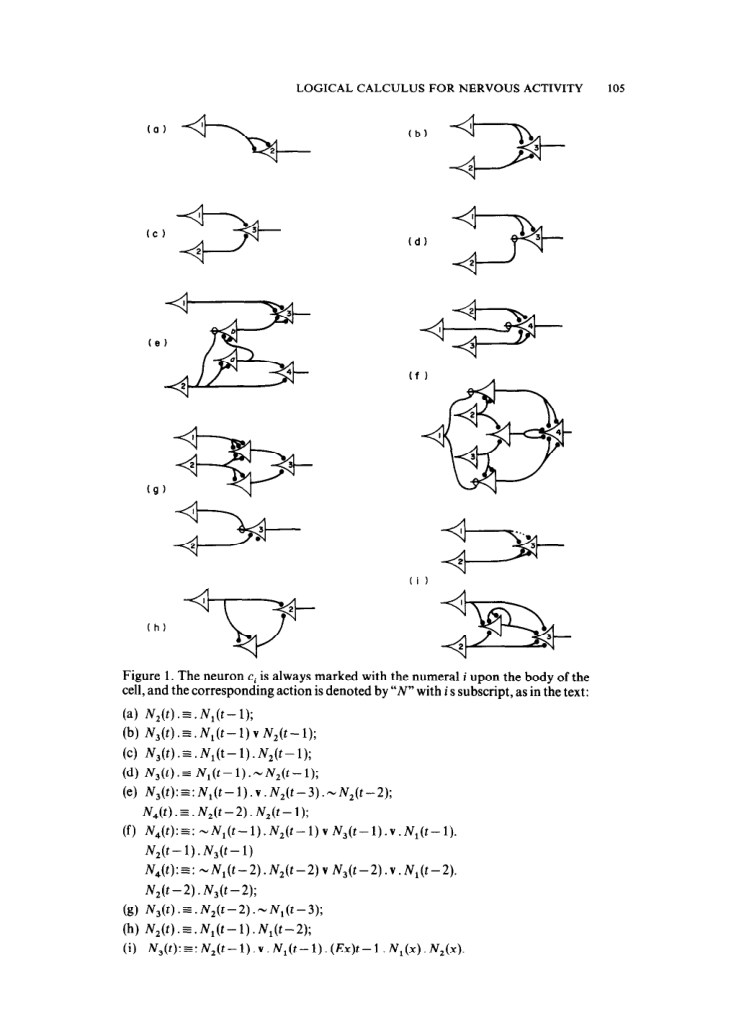
A scanned page of McCulloch and Pitts’ 1943 paper, including original neural-network figures. The paper’s notation and layout are preserved.
Warren S. McCulloch; Walter Pitts · Carnegie Mellon University hosted copy · Rights in the original image and document remain with their respective holders
Source · A Logical Calculus of the Ideas Immanent in Nervous Activity ↗RESEARCH ACCOUNT
How neural activity became a logical network
ANTI-AI ARCHIVE · Revised 2026-10-02
Reframing the problem
McCulloch and Pitts translated the all-or-none character of neural activity into propositional logic. Their argument runs in two directions: describing the behaviour of a given network, and constructing a network for an admissible logical expression. Neurons become both objects of investigation and elements of a computational formalism.
Section sources: A Logical Calculus of the Ideas Immanent in Nervous Activity
What the model does not establish
Networks containing cycles require more elaborate logical treatment. Networks built under different physiological assumptions may yield equivalent results, although their timing differs. This formal equivalence is not a complete reproduction of an actual brain, and the paper does not demonstrate the generation of artworks.
Section sources: A Logical Calculus of the Ideas Immanent in Nervous Activity
Why it belongs in this history
Editorial interpretation: the connection is the formalisation of cognition. Reading this paper alongside later neural image synthesis raises a question about the movement from logical units to learned parameters; it does not establish 1943 as the birth of AI art.
Section sources: A Logical Calculus of the Ideas Immanent in Nervous Activity
Sources for this account
Publisher abstract and bibliographic record read; mathematical proofs not independently checked.
This account expands the archive within the cited scope. Historical interpretation is not presented as the original author’s statement or as a proven causal influence. The account and translation are AI-assisted, pending independent human review. Section references identify evidence without claiming independent verification of every historical statement.
Continue with a comparative question
Compare the methods, forms of control or presentation contexts of this entry and The Organization of Behavior.
Compare the methods, forms of control or presentation contexts of this entry and The Perceptron.
Dates & version record
Date displayed for this node: 1943 · Historical date recorded for the source: 1943
These dates refer to the historical event or recorded version, not this page’s publication date. The original date precision and unresolved questions are retained.
Original sources & further reading
These links lead to the cited paper, article, institution or conference page. External texts retain their source languages.
A Logical Calculus of the Ideas Immanent in Nervous Activity
https://doi.org/10.1007/BF02478259
Current cited URL
Provenance, translation & verification
Timeline entry #001 · Historical node
Research materials & supplement references · 1
AI Art Genealogy Research Master · p. 4 · 001
Date as recorded: 1943
A Logical Calculus of the Ideas Immanent in Nervous Activity ↗
A Logical Calculus of the Ideas Immanent in Nervous Activity
Archive account based on the listed research materials, not a full translation of the linked work. AI-assisted translation; independent human review pending.
The master’s research claims and dates await independent verification.
Cite this node
ANTI-AI ARCHIVE. A Logical Calculus of the Ideas Immanent in Nervous Activity. Art-history node #001. https://salondesrefuses.cn/en/art-history/001
For specific historical claims, also cite the original sources above and include your access date. This account is not a full translation of the linked work.
Adjacent nodes follow chronological order; adjacency does not establish direct influence or causation.