

Introduction
Rosenblatt's perceptron links pattern recognition to neural-network learning. In the history of visual AI, it marks an early step from systems whose rules are entirely specified by programmers toward systems that adjust their parameters using examples. Its relevance here concerns this change in how visual capabilities are constructed.
 View full image ↗
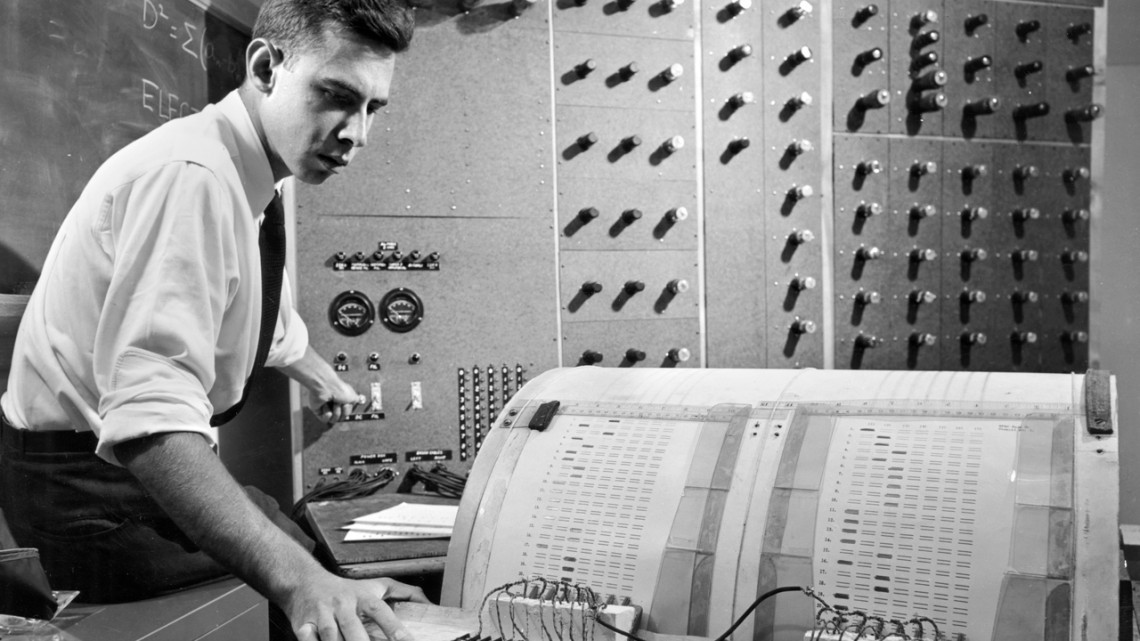
Archival photograph of Frank Rosenblatt working on the electronic profile analyzing computer, described by Cornell as a precursor to the perceptron. The 2019 retrospective does not date the photograph in its caption.
Cornell University, Division of Rare and Manuscript Collections · Rights in the original image and document remain with their respective holders
Source · Professor’s perceptron paved the way for AI – 60 years too soon | Cornell Chronicle ↗RESEARCH ACCOUNT
Recognition can be formed by adjusting connections.
ANTI-AI ARCHIVE · Revised 2026-10-02
The perceptron’s problem
Rosenblatt’s perceptron relates input patterns, connection weights and classification responses. Training changes how the system responds instead of requiring a separate handwritten rule for every pattern. The node concerns recognition and learning, not text-to-image generation; learning a particular task is not equivalent to general visual understanding.
Section sources: The Perceptron
From rules to training
The comparison with drawing programs concerns the location of control: explicit instructions organise form, while learned models also depend on examples and adjustment. An art history of these systems must ask how inputs and classification objectives are chosen. Later deep-model capabilities should not be projected backwards onto the 1958 perceptron.
Section sources: The Perceptron
Sources for this account
Account prepared from the research master and original paper identifier. A same-titled PDF retrieved in this pass was a later teaching presentation and was not used as full-text evidence for the original paper.
This account expands the archive within the cited scope. Historical interpretation is not presented as the original author’s statement or as a proven causal influence. The account and translation are AI-assisted, pending independent human review. Section references identify evidence without claiming independent verification of every historical statement.
Continue with a comparative question
Compare the methods, forms of control or presentation contexts of this entry and The Organization of Behavior.
Compare the methods, forms of control or presentation contexts of this entry and Gradient-Based Learning Applied to Document Recognition.
Dates & version record
Date displayed for this node: 1958 · Historical date recorded for the source: 1958
These dates refer to the historical event or recorded version, not this page’s publication date. The original date precision and unresolved questions are retained.
Original sources & further reading
These links lead to the cited paper, article, institution or conference page. External texts retain their source languages.
Provenance, translation & verification
Timeline entry #010 · Historical node
Research materials & supplement references · 1
AI Art Genealogy Research Master · p. 6 · 008
Date as recorded: 1958
The Perceptron ↗
The Perceptron
Archive account based on the listed research materials, not a full translation of the linked work. AI-assisted translation; independent human review pending.
The master’s research claims and dates await independent verification.
Cite this node
ANTI-AI ARCHIVE. The Perceptron. Art-history node #010. https://salondesrefuses.cn/en/art-history/008
For specific historical claims, also cite the original sources above and include your access date. This account is not a full translation of the linked work.
Adjacent nodes follow chronological order; adjacency does not establish direct influence or causation.