

Introduction
LeNet-5 and related work integrate convolution, shared weights and gradient-based training into a stable visual architecture. Later developments including AlexNet, convolutional encoders in generative models and visual feature extraction inherit elements of this tradition. The node documents technical conditions for subsequent visual learning.
 View full image ↗
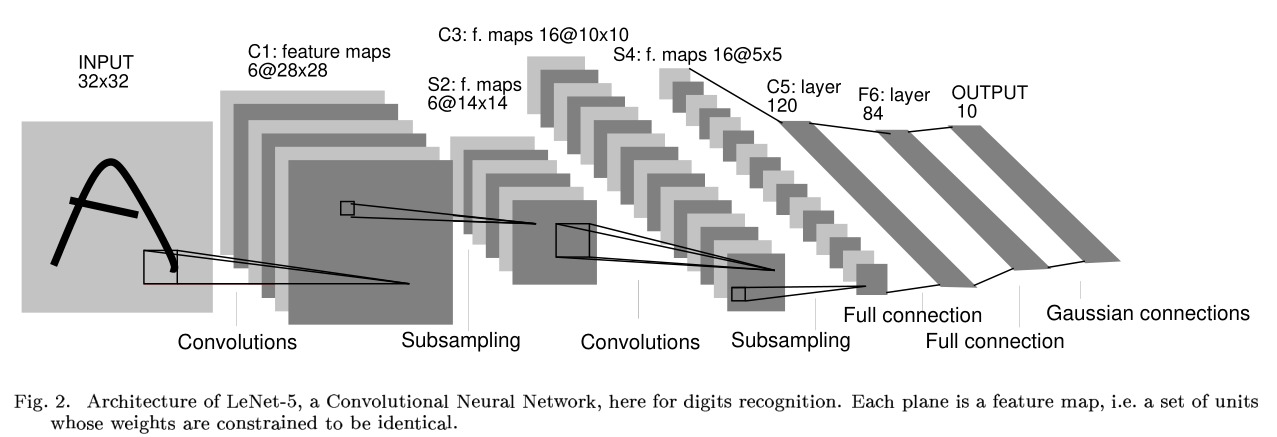
Figure 2 from the authors’ 1998 preprint of Gradient-Based Learning Applied to Document Recognition: the LeNet-5 architecture.
Yann LeCun; Léon Bottou; Yoshua Bengio; Patrick Haffner · Rights in the original image and document remain with their respective holders
Source · Gradient-Based Learning Applied to Document Recognition ↗RESEARCH ACCOUNT
From handcrafted features toward learned recognition.
ANTI-AI ARCHIVE · Revised 2026-10-02
Method and contribution
LeCun, Bottou, Bengio and Haffner connect gradient-based learning with document recognition, examining multilayer networks and convolutional structures for image classification. Tasks such as handwritten-digit recognition support comparison between systems. Recognising a digit and generating an artwork remain different tasks; classification accuracy is not treated as artistic ability.
Section sources: Gradient Based Learning Applied to Document Recognition
Art-historical interpretation
A history of visual computation also includes infrastructures for reading, classifying and organising images. Later generators use visual representations, but this does not mean the paper already proposed every subsequent generative method. Separating recognition from generation clarifies the different roles images play in training, evaluation and output.
Section sources: Gradient Based Learning Applied to Document Recognition
Sources for this account
Author bibliography and the research master’s methodological summary checked; recognition experiments were not reproduced.
This account expands the archive within the cited scope. Historical interpretation is not presented as the original author’s statement or as a proven causal influence. The account and translation are AI-assisted, pending independent human review. Section references identify evidence without claiming independent verification of every historical statement.
Continue with a comparative question
Compare the methods, forms of control or presentation contexts of this entry and The Perceptron.
Compare the methods, forms of control or presentation contexts of this entry and ILSVRC.
Dates & version record
Date displayed for this node: 1998 · Historical date recorded for the source: 1998
These dates refer to the historical event or recorded version, not this page’s publication date. The original date precision and unresolved questions are retained.
Original sources & further reading
These links lead to the cited paper, article, institution or conference page. External texts retain their source languages.
Gradient-Based Learning Applied to Document Recognition
https://doi.org/10.1109/5.726791
Current cited URL
Provenance, translation & verification
Timeline entry #064 · Historical node
Research materials & supplement references · 1
AI Art Genealogy Research Master · p. 13 · 036
Date as recorded: 1998
Gradient-Based Learning Applied to Document Recognition ↗
Gradient-Based Learning Applied to Document Recognition
Archive account based on the listed research materials, not a full translation of the linked work. AI-assisted translation; independent human review pending.
The master’s research claims and dates await independent verification.
Cite this node
ANTI-AI ARCHIVE. Gradient-Based Learning Applied to Document Recognition. Art-history node #064. https://salondesrefuses.cn/en/art-history/036
For specific historical claims, also cite the original sources above and include your access date. This account is not a full translation of the linked work.
Adjacent nodes follow chronological order; adjacency does not establish direct influence or causation.