

Introduction
Wiener's Cybernetics brings communication, feedback and control into one theoretical framework. For the archive's later questions of control and sovereignty, cultural information is not merely stored or transmitted: it can enter feedback loops and become a resource for regulating machine behavior and organising power. This connection is the master's historical interpretation.
 View full image ↗
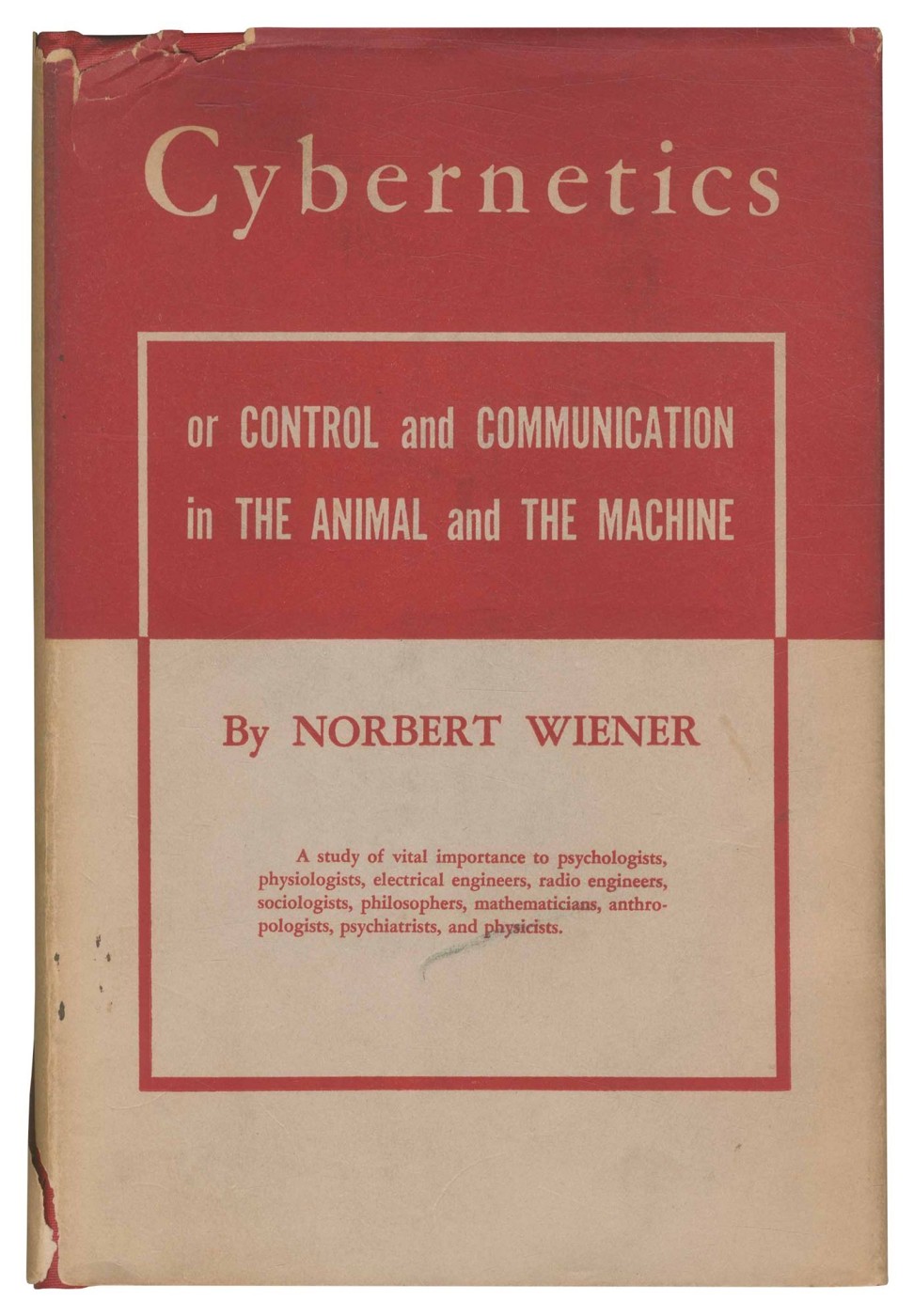
Physical copy of the 1948 American first edition of Wiener’s Cybernetics, photographed for a bookseller’s catalogue.
Norbert Wiener / Technology Press & Wiley; photograph Between the Covers · Rights remain with the respective holders; reproduction does not imply an open licence
Source · Cybernetics · 1948 edition ↗RESEARCH ACCOUNT
Feedback as a relation between machines and action
ANTI-AI ARCHIVE · Revised 2026-10-02
Communication inside a control loop
In 1948 Wiener connected information transmission with the regulation of behaviour: a system sends messages, receives responses and adjusts its activity. Chapters range across time series, feedback and oscillation, computing and the nervous system, and language and society. The project extends beyond the operation of any particular device.
Section sources: Cybernetics or Control and Communication in the Animal and the Machine
Distinguishing editions
The current edition combines the 1948 book with supplementary chapters from 1961. The later material on learning, self-reproducing machines and self-organising systems should not all be assigned to 1948 merely because it appears in one modern volume.
Section sources: Cybernetics or Control and Communication in the Animal and the Machine
From interactive installations to control
Editorial interpretation: feedback helps describe continuing relations among an artwork, its audience and its environment. It also distinguishes how a system regulates behaviour from who is entitled to specify its goals. A mechanism of control is not itself an explanation of political authority.
Section sources: Cybernetics or Control and Communication in the Animal and the Machine
Sources for this account
MIT Press description and contents read, with editions distinguished; not a complete reading of the book.
This account expands the archive within the cited scope. Historical interpretation is not presented as the original author’s statement or as a proven causal influence. The account and translation are AI-assisted, pending independent human review. Section references identify evidence without claiming independent verification of every historical statement.
Continue with a comparative question
Compare the methods, forms of control or presentation contexts of this entry and 9 Evenings: Theatre & Engineering.
Compare the methods, forms of control or presentation contexts of this entry and Software exhibition, Jewish Museum, New York.
Dates & version record
Date displayed for this node: 1948 · Historical date recorded for the source: 1948
These dates refer to the historical event or recorded version, not this page’s publication date. The original date precision and unresolved questions are retained.
Original sources & further reading
These links lead to the cited paper, article, institution or conference page. External texts retain their source languages.
Cybernetics
https://direct.mit.edu/books/oa-monograph/4581/Cybernetics-or-Control-and-Communication-in-the
Current cited URL
Provenance, translation & verification
Timeline entry #003 · Historical node
Research materials & supplement references · 1
AI Art Genealogy Research Master · p. 4 · 003
Date as recorded: 1948
Cybernetics ↗
Cybernetics
Archive account based on the listed research materials, not a full translation of the linked work. AI-assisted translation; independent human review pending.
The master’s research claims and dates await independent verification.
Cite this node
ANTI-AI ARCHIVE. Cybernetics. Art-history node #003. https://salondesrefuses.cn/en/art-history/003
For specific historical claims, also cite the original sources above and include your access date. This account is not a full translation of the linked work.
Adjacent nodes follow chronological order; adjacency does not establish direct influence or causation.