

Introduction
9 Evenings organizes artists and Bell Labs engineers into large-scale live experiments and contributes directly to the formation of E.A.T. The event expands the roles of computation and control systems in art, providing context for later interactive art, machine behavior and real-time generation.
 View full image ↗
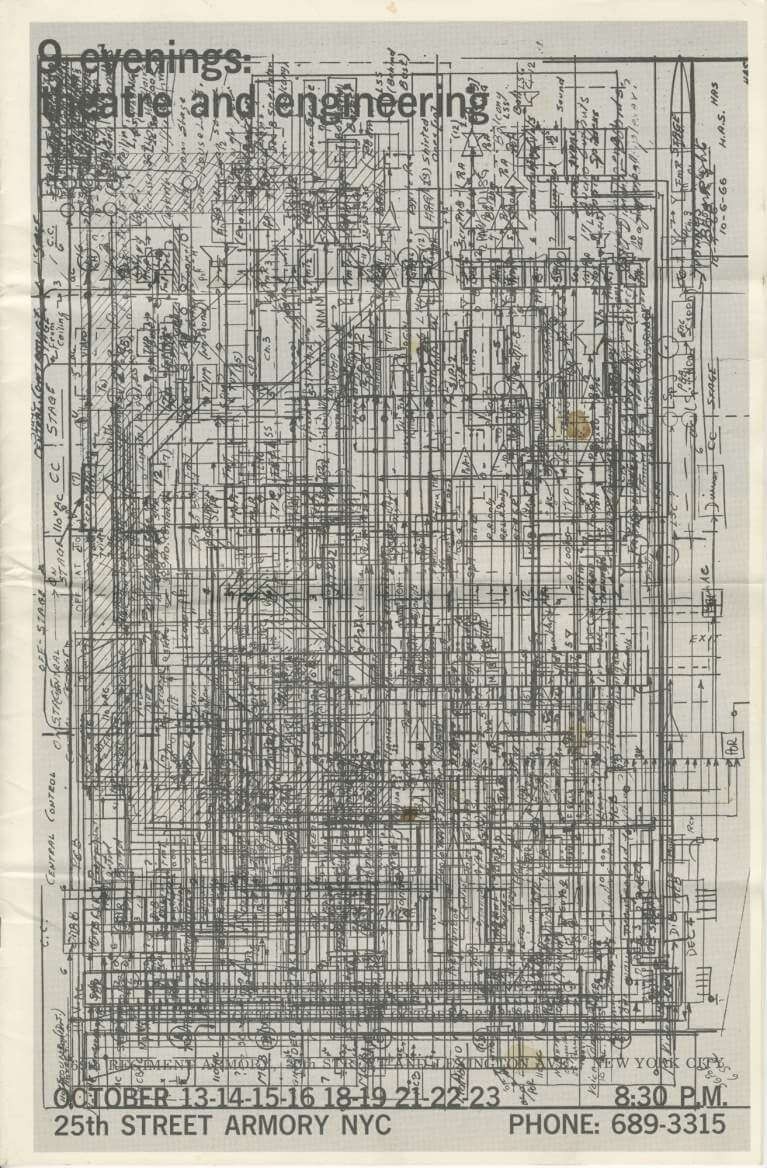
Cover of the original 1966 programme for 9 Evenings: Theatre & Engineering, preserved by the Rauschenberg Foundation archives.
Experiments in Art and Technology; design Pontus Hultén; Robert Rauschenberg Foundation Archives, A68 · Rights remain with the respective holders; reproduction does not imply an open licence
Source · 9 Evenings: Theatre & Engineering program | Robert Rauschenberg Foundation ↗RESEARCH ACCOUNT
The stage as a shared laboratory
ANTI-AI ARCHIVE · Revised 2026-10-02
Ten performances over nine evenings
In 1965 Billy Klüver, assisted by Robert Rauschenberg, recruited around thirty Bell Laboratories engineers for an interdisciplinary project. Artists and engineers worked together on stage technology. John Cage, Lucinda Childs, Yvonne Rainer and David Tudor were among the artists developing individual performances.
Section sources: 9 Evenings: Theatre & Engineering
Relocation and the surviving record
After cancellation of the American programme at the planned Stockholm festival, the event moved to New York’s 69th Regiment Armory, running from 13 to 23 October 1966. Film, recordings, technical diagrams, choreographic scores and props survive. Subsequent documentaries are distinct from original records of the performances.
Section sources: 9 Evenings: Theatre & Engineering
Technical collaboration as creative labour
Editorial interpretation: these performances make engineering collaboration visible within artistic production. Their question is how apparatus, rehearsal, maintenance and performers jointly realise a work, and how an archive preserves that collective labour—not simply whether a machine can create independently.
Section sources: 9 Evenings: Theatre & Engineering
Sources for this account
Daniel Langlois Foundation collection description and custodial history read.
This account expands the archive within the cited scope. Historical interpretation is not presented as the original author’s statement or as a proven causal influence. The account and translation are AI-assisted, pending independent human review. Section references identify evidence without claiming independent verification of every historical statement.
Continue with a comparative question
Compare the methods, forms of control or presentation contexts of this entry and Experiments in Art and Technology (organization).
Compare the methods, forms of control or presentation contexts of this entry and Art and Technology program/exhibition.
Dates & version record
Date displayed for this node: 1966 · Historical date recorded for the source: 1966
These dates refer to the historical event or recorded version, not this page’s publication date. The original date precision and unresolved questions are retained.
Original sources & further reading
These links lead to the cited paper, article, institution or conference page. External texts retain their source languages.
9 Evenings: Theatre & Engineering
https://www.fondation-langlois.org/html/e/page.php?NumPage=294
Current cited URL
Provenance, translation & verification
Timeline entry #022 · Historical node
Research materials & supplement references · 1
AI Art Genealogy Research Master · p. 8 · 019
Date as recorded: 1966
9 Evenings: Theatre & Engineering ↗
9 Evenings: Theatre & Engineering
Archive account based on the listed research materials, not a full translation of the linked work. AI-assisted translation; independent human review pending.
The master’s research claims and dates await independent verification.
Cite this node
ANTI-AI ARCHIVE. 9 Evenings: Theatre & Engineering. Art-history node #022. https://salondesrefuses.cn/en/art-history/019
For specific historical claims, also cite the original sources above and include your access date. This account is not a full translation of the linked work.
Adjacent nodes follow chronological order; adjacency does not establish direct influence or causation.