

Introduction
Billy Klüver, Fred Waldhauer, Robert Rauschenberg and Robert Whitman help establish Experiments in Art and Technology, institutionalizing collaboration between artists and engineers. E.A.T. is not an AI art organisation, but its collaborative production model becomes important to subsequent digital, media and experimental technological art.
 View full image ↗
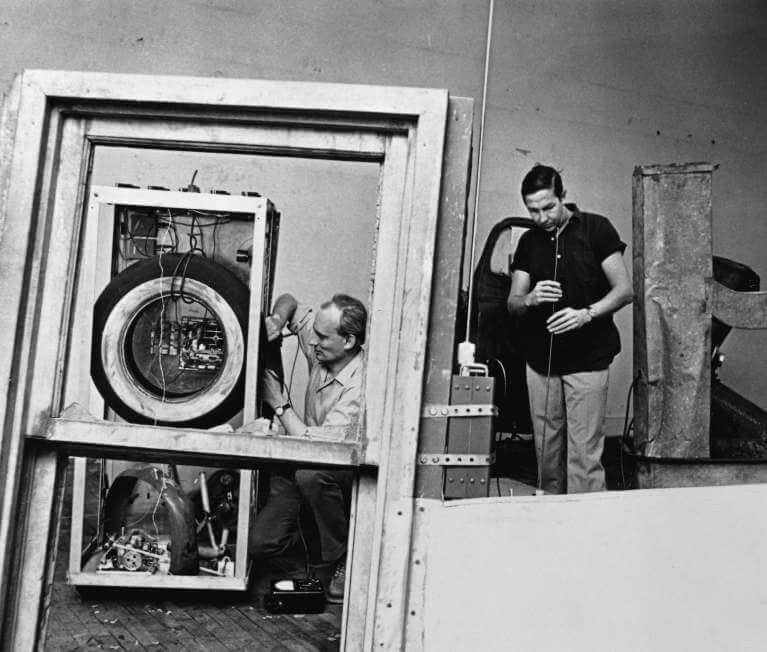
Rauschenberg and engineer Billy Klüver working on Oracle (1965), documenting collaboration before E.A.T. was founded.
Larry Morris / The New York Times / Redux Pictures; Robert Rauschenberg Foundation · Rights remain with the respective holders; reproduction does not imply an open licence
Source · Art and Technology, 1959–98 ↗RESEARCH ACCOUNT
Turning collaboration into an organisation
ANTI-AI ARCHIVE · Revised 2026-10-02
Beyond a single event
E.A.T. made artist–engineer collaboration an ongoing organisational practice. Its archive describes a 1980 package of 360 reports, catalogues, newsletters, proposals, lectures and articles distributed to libraries internationally. Collaboration generated an institutional record beyond the resulting artworks.
Section sources: Experiments in Art and Technology (organization)
An archive across several repositories
Activity records went to the Getty in 1993; film, audio and documentary-production materials concerning 9 Evenings went to the Daniel Langlois Foundation in 2001. Published documents were subsequently digitised. Repositories and media cover different parts of the record; no single page stands for the complete archive.
Section sources: Experiments in Art and Technology (organization)
Why the paperwork matters
Editorial interpretation: proposals and reports make the organisation, financing and explanation of collaboration researchable. They provide comparative material for contemporary partnerships between artists and AI companies, without establishing identical contracts, rights or distributions of resources.
Section sources: Experiments in Art and Technology (organization)
Sources for this account
E.A.T.’s description of its holdings read; the 360 documents were not individually examined.
This account expands the archive within the cited scope. Historical interpretation is not presented as the original author’s statement or as a proven causal influence. The account and translation are AI-assisted, pending independent human review. Section references identify evidence without claiming independent verification of every historical statement.
Continue with a comparative question
Compare the methods, forms of control or presentation contexts of this entry and 9 Evenings: Theatre & Engineering.
Compare the methods, forms of control or presentation contexts of this entry and Art and Technology program/exhibition.
Dates & version record
Date displayed for this node: 1966 · Historical date recorded for the source: 1966
These dates refer to the historical event or recorded version, not this page’s publication date. The original date precision and unresolved questions are retained.
Original sources & further reading
These links lead to the cited paper, article, institution or conference page. External texts retain their source languages.
Experiments in Art and Technology (organization)
https://www.experimentsinartandtechnology.org/e-a-t-archive
Current cited URL
Provenance, translation & verification
Timeline entry #023 · Historical node
Research materials & supplement references · 1
AI Art Genealogy Research Master · p. 9 · 020
Date as recorded: 1966
Experiments in Art and Technology (organization) ↗
Experiments in Art and Technology (organization)
Archive account based on the listed research materials, not a full translation of the linked work. AI-assisted translation; independent human review pending.
The master’s research claims and dates await independent verification.
Cite this node
ANTI-AI ARCHIVE. Experiments in Art and Technology (organization). Art-history node #023. https://salondesrefuses.cn/en/art-history/020
For specific historical claims, also cite the original sources above and include your access date. This account is not a full translation of the linked work.
Adjacent nodes follow chronological order; adjacency does not establish direct influence or causation.