

Introduction
AttnGAN aligns words with visual regions through attention and a deep attentional multimodal similarity model, improving details corresponding to complex descriptions. It provides an important pre-diffusion example of the problems now discussed as adherence to prompts and alignment between textual and visual information.
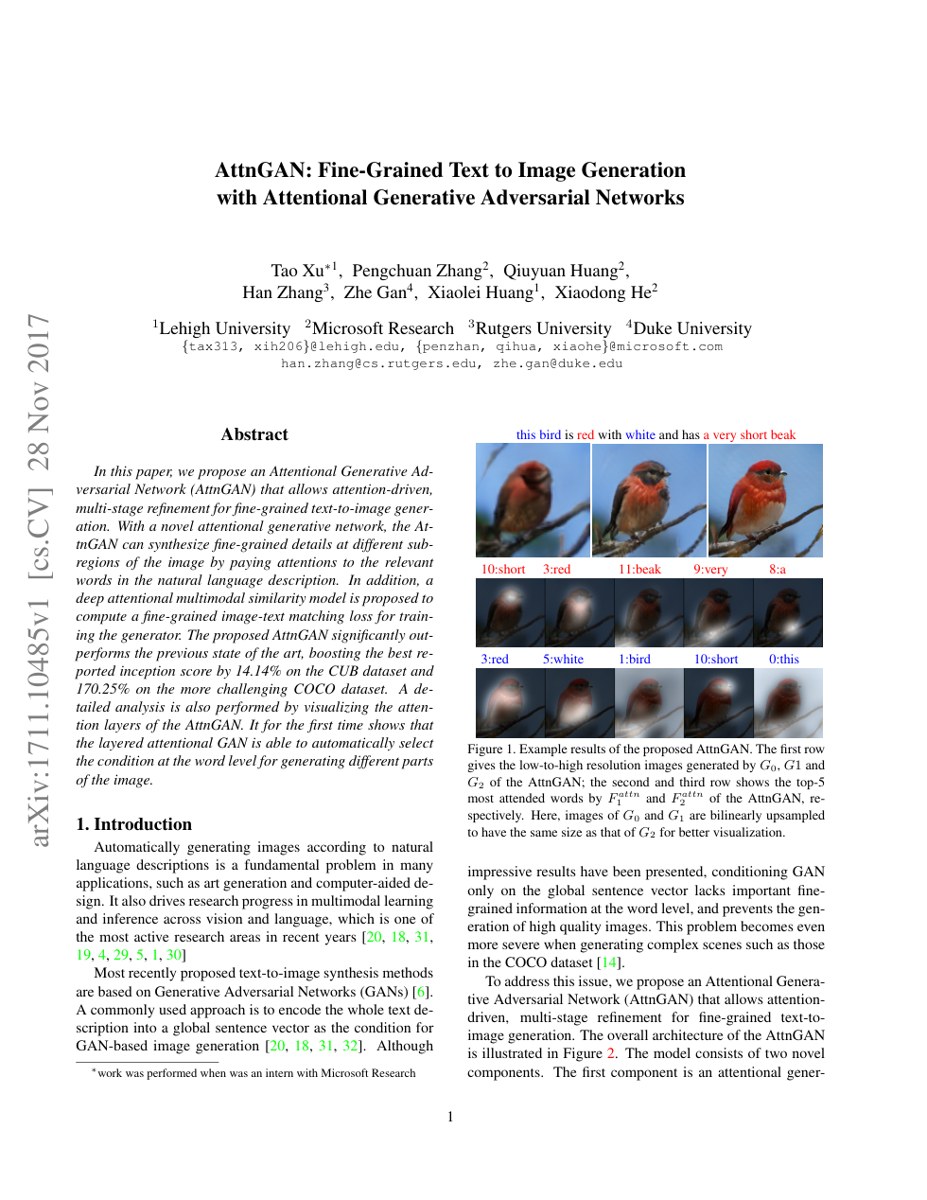 View full image ↗
Page 1 of the linked paper PDF, preserving its original figures and language. The source file identifies the edition; later revision or reprint dates do not replace the node’s historical date.
Tao Xu; Pengchuan Zhang; Qiuyuan Huang; Han Zhang; Zhe Gan; Xiaolei Huang; Xiaodong He · original paper · Image rights remain with their respective holders; no open licence is asserted
Source · AttnGAN: Fine-Grained Text to Image Generation with Attentional GANs ↗RESEARCH ACCOUNT
Relating words to parts of an image
ANTI-AI ARCHIVE · Revised 2026-10-02
Method and contribution
AttnGAN uses attention during staged refinement to associate image regions with relevant words. A multimodal similarity objective supports training, and attention visualisations help analyse the result. Reported benchmark improvements concern selected data and metrics, rather than proving comprehensive language understanding.
Section sources: AttnGAN: Fine-Grained Text to Image Generation with Attentional GANs
Art-historical interpretation
Editorial interpretation: the work gives a specific account of moving from sentence-level conditioning towards local associations. For artistic practice, the question concerns where language has an effect and how mismatches shape making, rather than whether longer prompts are inherently better.
Section sources: AttnGAN: Fine-Grained Text to Image Generation with Attentional GANs
Sources for this account
Author or conference abstract and version record read; full proofs and experiments were not independently reproduced.
This account expands the archive within the cited scope. Historical interpretation is not presented as the original author’s statement or as a proven causal influence. The account and translation are AI-assisted, pending independent human review. Section references identify evidence without claiming independent verification of every historical statement.
Continue with a comparative question
Compare the methods, forms of control or presentation contexts of this entry and StackGAN: Text to Photo-realistic Image Synthesis with Stacked GANs.
Compare the methods, forms of control or presentation contexts of this entry and Photorealistic Text-to-Image Diffusion Models with Deep Language Understanding.
Dates & version record
Date displayed for this node: 2017–2018 · Historical date recorded for the source: 2017–2018
These dates refer to the historical event or recorded version, not this page’s publication date. The original date precision and unresolved questions are retained.
Original sources & further reading
These links lead to the cited paper, article, institution or conference page. External texts retain their source languages.
AttnGAN: Fine-Grained Text to Image Generation with Attentional GANs
https://arxiv.org/abs/1711.10485
Current cited URL
Provenance, translation & verification
Timeline entry #094 · Historical node
Research materials & supplement references · 1
AI Art Genealogy Research Master · p. 19 · 059
Date as recorded: 2017–2018
AttnGAN: Fine-Grained Text to Image Generation with Attentional GANs ↗
AttnGAN: Fine-Grained Text to Image Generation with Attentional GANs
Archive account based on the listed research materials, not a full translation of the linked work. AI-assisted translation; independent human review pending.
The master’s research claims and dates await independent verification.
Cite this node
ANTI-AI ARCHIVE. AttnGAN: Fine-Grained Text to Image Generation with Attentional GANs. Art-history node #094. https://salondesrefuses.cn/en/art-history/059
For specific historical claims, also cite the original sources above and include your access date. This account is not a full translation of the linked work.
Adjacent nodes follow chronological order; adjacency does not establish direct influence or causation.