

Introduction
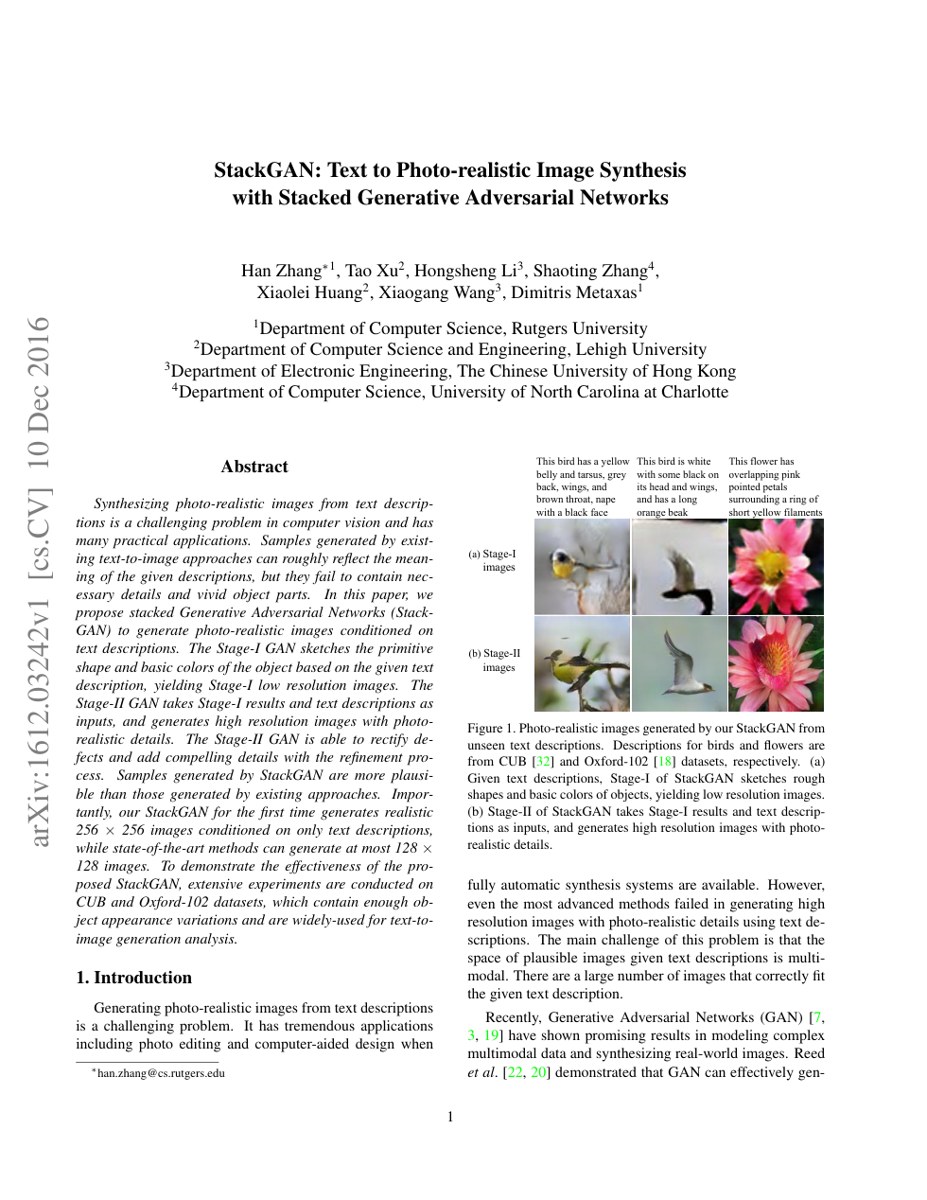
StackGAN uses a two-stage process that first turns a description into low-resolution structure and then refines it into a higher-resolution image. It is a significant branch of text-to-image research before DALL·E and Imagen, demonstrating that prompt-driven image generation has a technical history preceding diffusion models.
 View full image ↗
Page 1 of the linked paper PDF, preserving its original figures and language. The source file identifies the edition; later revision or reprint dates do not replace the node’s historical date.
Han Zhang; Tao Xu; Hongsheng Li; Shaoting Zhang; Xiaogang Wang; Xiaolei Huang; Dimitris Metaxas · original paper · Image rights remain with their respective holders; no open licence is asserted
Source · StackGAN: Text to Photo-realistic Image Synthesis with Stacked GANs ↗RESEARCH ACCOUNT
A two-stage approach to text-to-image synthesis
ANTI-AI ARCHIVE · Revised 2026-10-02
Method and contribution
StackGAN divides text-conditioned synthesis into an initial coarse image and a refinement stage. The second stage receives both the first image and the description, correcting defects and adding detail. Conditioning augmentation is introduced to support diversity and training stability; reported results belong to the paper’s experimental conditions.
Section sources: StackGAN: Text to Photo-realistic Image Synthesis with Stacked GANs
Art-historical interpretation
Editorial interpretation: the relationship among language, composition and detail becomes experimentally tractable. A sentence is not thereby translated into an image without loss. Data, architecture and evaluation continue to limit which descriptions can be realised.
Section sources: StackGAN: Text to Photo-realistic Image Synthesis with Stacked GANs
Sources for this account
Author or conference abstract and version record read; full proofs and experiments were not independently reproduced.
This account expands the archive within the cited scope. Historical interpretation is not presented as the original author’s statement or as a proven causal influence. The account and translation are AI-assisted, pending independent human review. Section references identify evidence without claiming independent verification of every historical statement.
Continue with a comparative question
Compare the methods, forms of control or presentation contexts of this entry and LAPGAN.
Compare the methods, forms of control or presentation contexts of this entry and AttnGAN: Fine-Grained Text to Image Generation with Attentional GANs.
Dates & version record
Date displayed for this node: 2016–2017 · Historical date recorded for the source: 2016–2017
These dates refer to the historical event or recorded version, not this page’s publication date. The original date precision and unresolved questions are retained.
Original sources & further reading
These links lead to the cited paper, article, institution or conference page. External texts retain their source languages.
StackGAN: Text to Photo-realistic Image Synthesis with Stacked GANs
https://arxiv.org/abs/1612.03242
Current cited URL
Provenance, translation & verification
Timeline entry #089 · Historical node
Research materials & supplement references · 1
AI Art Genealogy Research Master · p. 17 · 054
Date as recorded: 2016–2017
StackGAN: Text to Photo-realistic Image Synthesis with Stacked GANs ↗
StackGAN: Text to Photo-realistic Image Synthesis with Stacked GANs
Archive account based on the listed research materials, not a full translation of the linked work. AI-assisted translation; independent human review pending.
The master’s research claims and dates await independent verification.
Cite this node
ANTI-AI ARCHIVE. StackGAN: Text to Photo-realistic Image Synthesis with Stacked GANs. Art-history node #089. https://salondesrefuses.cn/en/art-history/054
For specific historical claims, also cite the original sources above and include your access date. This account is not a full translation of the linked work.
Adjacent nodes follow chronological order; adjacency does not establish direct influence or causation.