

Introduction
Sims extends generation beyond still images by evolving the body structures and control networks of virtual creatures together. Generative practice encompasses dynamic behavior and artificial life, providing context for later work in games, simulation art and embodied generative systems.
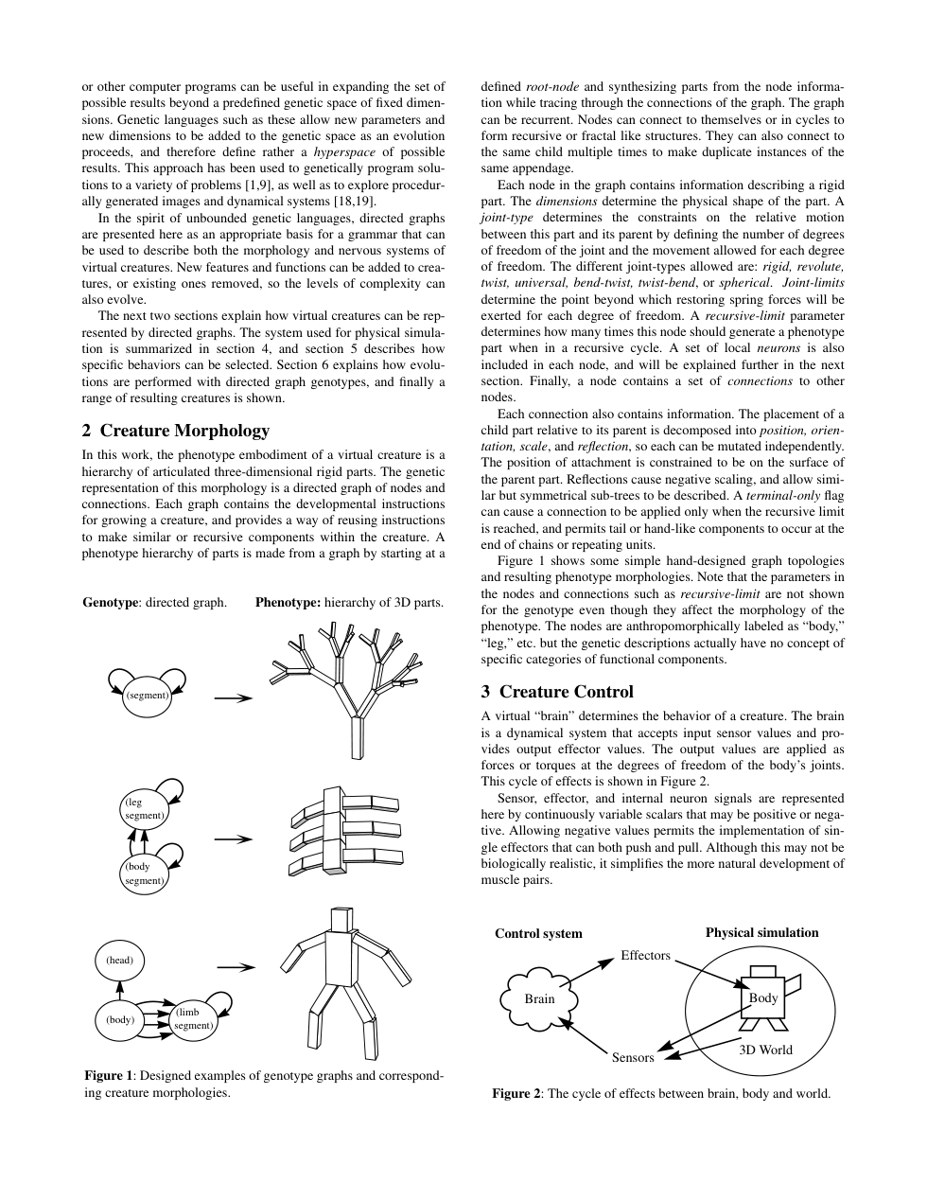 View full image ↗
Page 2 of the linked paper PDF, preserving its original figures and language. The source file identifies the edition; later revision or reprint dates do not replace the node’s historical date.
Karl Sims · original paper · Image rights remain with their respective holders; no open licence is asserted
Source · Evolving Virtual Creatures ↗RESEARCH ACCOUNT
Evolving bodies and their behaviour together
ANTI-AI ARCHIVE · Revised 2026-10-02
Beyond animating a predetermined body
Sims’s 1994 system evolves a creature’s morphology together with the neural controller governing muscular forces. A genetic representation using nodes and connections describes both body and control structure. Different fitness functions encourage swimming, walking, jumping or following.
Section sources: Evolving Virtual Creatures
How an objective organises the outcome
The paper addresses a trade-off between complexity and control. Directly specified positions offer precision, whereas physical simulation can yield plausible but less controllable movement. Evolutionary search is still organised by an evaluator’s chosen objective; automatic generation does not remove human framing.
Section sources: Evolving Virtual Creatures
Autonomy within a designed environment
Editorial interpretation: apparently autonomous bodies operate within a designed world and its criteria of success. The work offers a specific question for AI art: whose environment and evaluative rules make the system’s apparent independence possible?
Section sources: Evolving Virtual Creatures
Sources for this account
Author’s abstract and introduction read; evolutionary results not independently tested.
This account expands the archive within the cited scope. Historical interpretation is not presented as the original author’s statement or as a proven causal influence. The account and translation are AI-assisted, pending independent human review. Section references identify evidence without claiming independent verification of every historical statement.
Continue with a comparative question
Compare the methods, forms of control or presentation contexts of this entry and Boids.
Compare the methods, forms of control or presentation contexts of this entry and Artificial Evolution for Computer Graphics.
Dates & version record
Date displayed for this node: 1994 · Historical date recorded for the source: 1994
These dates refer to the historical event or recorded version, not this page’s publication date. The original date precision and unresolved questions are retained.
Original sources & further reading
These links lead to the cited paper, article, institution or conference page. External texts retain their source languages.
Evolving Virtual Creatures
https://www.karlsims.com/papers/siggraph94.pdf
Current cited URL
Provenance, translation & verification
Timeline entry #057 · Historical node
Research materials & supplement references · 1
AI Art Genealogy Research Master · p. 12 · 034
Date as recorded: 1994
Evolving Virtual Creatures ↗
Evolving Virtual Creatures
Archive account based on the listed research materials, not a full translation of the linked work. AI-assisted translation; independent human review pending.
The master’s research claims and dates await independent verification.
Cite this node
ANTI-AI ARCHIVE. Evolving Virtual Creatures. Art-history node #057. https://salondesrefuses.cn/en/art-history/034
For specific historical claims, also cite the original sources above and include your access date. This account is not a full translation of the linked work.
Adjacent nodes follow chronological order; adjacency does not establish direct influence or causation.