

Introduction
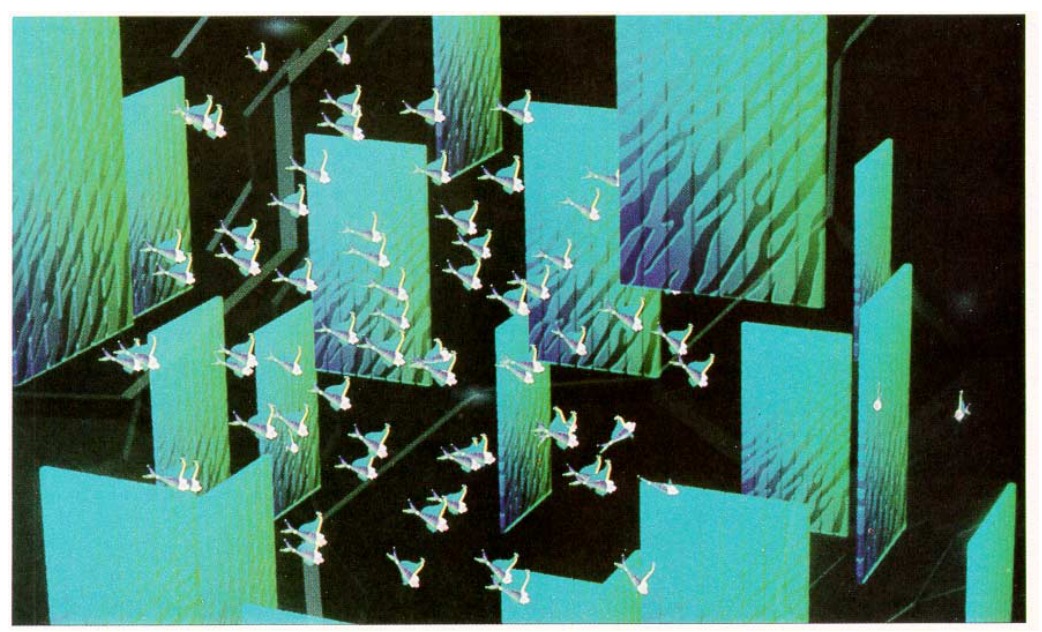
Boids simulates collective motion using local rules such as separation, alignment and cohesion. Its influence extends across animation, artificial life and generative art. The system shows how visual complexity can emerge from distributed rules rather than from a central designer specifying the behavior of the whole.
 View full image ↗
Colour plate from the final page of Craig Reynolds’s 1987 Boids paper: simulated flocking in a geometric environment. Excerpt from original proceedings page 34.
Craig W. Reynolds / SIGGRAPH 1987 · Rights in the original image and document remain with their respective holders
Source · Flocks, Herds, and Schools: A Distributed Behavioral Model ↗RESEARCH ACCOUNT
Collective motion from local rules
ANTI-AI ARCHIVE · Revised 2026-10-02
Beyond individually scripted flight paths
Reynolds approached flocking as an animation problem. Scripting a separate route for every bird makes complex collective motion difficult to construct. Each simulated bird instead acts locally, responding to its environment, simulated physics and programmed behaviours. The group’s movement emerges from their interaction.
Section sources: Boids
Moving control from paths to behaviour
The animator still designs the system, but specifies behaviours and constraints rather than every position in every frame. Reynolds places the approach within particle systems and behavioural animation. It is not an image model trained on photographs of birds.
Section sources: Boids
Generation does not require learning
Editorial interpretation: Boids supplies a concrete mechanism for studying collectivity and emergence in generative art. Visually complex behaviour can arise from simple local relations. Procedural simulation, machine learning and claims about biological life should nevertheless remain distinct.
Section sources: Boids
Sources for this account
Author-hosted abstract and publication record read; simulations not rerun.
This account expands the archive within the cited scope. Historical interpretation is not presented as the original author’s statement or as a proven causal influence. The account and translation are AI-assisted, pending independent human review. Section references identify evidence without claiming independent verification of every historical statement.
Continue with a comparative question
Compare the methods, forms of control or presentation contexts of this entry and Evolving Virtual Creatures.
Compare the methods, forms of control or presentation contexts of this entry and Biomorph evolutionary program.
Dates & version record
Date displayed for this node: 1987 · Historical date recorded for the source: 1987
These dates refer to the historical event or recorded version, not this page’s publication date. The original date precision and unresolved questions are retained.
Original sources & further reading
These links lead to the cited paper, article, institution or conference page. External texts retain their source languages.
Provenance, translation & verification
Timeline entry #050 · Historical node
Research materials & supplement references · 1
AI Art Genealogy Research Master · p. 12 · 031
Date as recorded: 1987
Boids ↗
Boids
Archive account based on the listed research materials, not a full translation of the linked work. AI-assisted translation; independent human review pending.
The master’s research claims and dates await independent verification.
Cite this node
ANTI-AI ARCHIVE. Boids. Art-history node #050. https://salondesrefuses.cn/en/art-history/031
For specific historical claims, also cite the original sources above and include your access date. This account is not a full translation of the linked work.
Adjacent nodes follow chronological order; adjacency does not establish direct influence or causation.