

Introduction
Dawkins's Biomorph program uses recursive rules and human selection to demonstrate cumulative evolution. It is not machine-learning art, but belongs alongside the evolutionary practices of Sims and Latham in a history of interactive evolutionary aesthetics, where creators select descendants within a generative space instead of drawing each result directly.
 View full image ↗
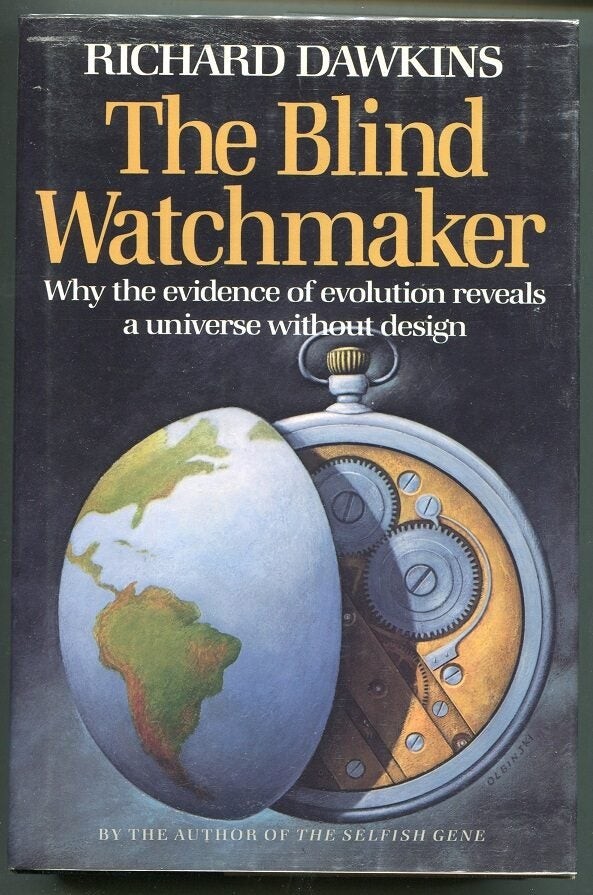
Photograph of the 1986 American first edition of Dawkins’s The Blind Watchmaker. Publication context for the Biomorph experiments, not a software screenshot.
Richard Dawkins / W. W. Norton; cover Rafał Olbiński; photograph Evening Star Books · Rights remain with the respective holders; reproduction does not imply an open licence
Source · The Blind Watchmaker · first American edition ↗RESEARCH ACCOUNT
Exploring visual form through selective breeding.
ANTI-AI ARCHIVE · Revised 2026-10-02
Historical object and process
Dawkins recalls a Macintosh program generating biomorphs through a tree-growing algorithm and numerical “genes.” A selected form becomes the parent for the next set of variations; later versions add controls including segmentation and symmetry. Editorial corrections to numbers in the recollection underline the need to preserve version differences rather than asserting one universal specification.
Section sources: Richard Dawkins reflects on the development of Watchmaker Suite
Significance and interpretive limits
Selection is not an incidental step after generation: it determines subsequent paths. This makes the program an important reference for interactive evolutionary art, while its role as an explanation of evolution remains distinct from later artists’ purposes.
Section sources: Richard Dawkins reflects on the development of Watchmaker Suite
Sources for this account
Dawkins’s retrospective excerpt read, retaining its version and recollection limits.
This account expands the archive within the cited scope. Historical interpretation is not presented as the original author’s statement or as a proven causal influence. The account and translation are AI-assisted, pending independent human review. Section references identify evidence without claiming independent verification of every historical statement.
Continue with a comparative question
Compare the methods, forms of control or presentation contexts of this entry and FormGrow / Mutator evolutionary systems.
Compare the methods, forms of control or presentation contexts of this entry and Artificial Evolution for Computer Graphics.
Dates & version record
Date displayed for this node: 1986 · Historical date recorded for the source: 1986
These dates refer to the historical event or recorded version, not this page’s publication date. The original date precision and unresolved questions are retained.
Original sources & further reading
These links lead to the cited paper, article, institution or conference page. External texts retain their source languages.
Biomorph evolutionary program
https://www.richarddawkins.net/books/the-blind-watchmaker/
Current cited URL
Provenance, translation & verification
Timeline entry #048 · Historical node
Research materials & supplement references · 1
AI Art Genealogy Research Master · p. 11 · 029
Date as recorded: 1986
Biomorph evolutionary program ↗
Biomorph evolutionary program
Archive account based on the listed research materials, not a full translation of the linked work. AI-assisted translation; independent human review pending.
The master’s research claims and dates await independent verification.
Cite this node
ANTI-AI ARCHIVE. Biomorph evolutionary program. Art-history node #048. https://salondesrefuses.cn/en/art-history/029
For specific historical claims, also cite the original sources above and include your access date. This account is not a full translation of the linked work.
Adjacent nodes follow chronological order; adjacency does not establish direct influence or causation.