

Introduction
Latham and Todd develop evolutionary systems for generating three-dimensional forms in settings including IBM UK. Their approach shifts artistic work from direct shaping toward defining generative rules and selecting mutations. The master treats this as a historical analogy for contemporary latent-space exploration and workflows built around variation.
 View full image ↗
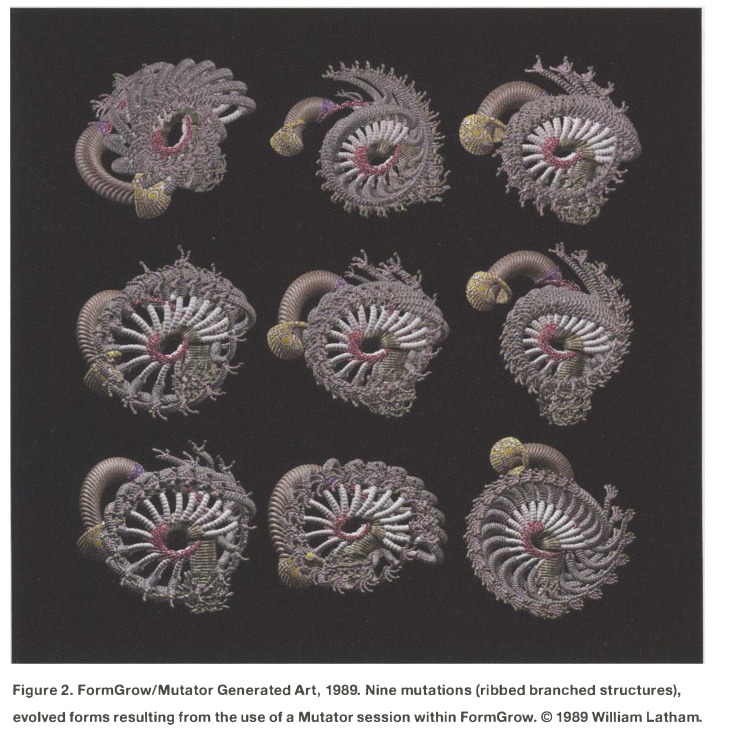
Nine mutated forms by William Latham, originally credited ©1989 William Latham. Preserved as Figure 2 in Lambert, Latham and Leymarie’s retrospective on evolutionary art.
©1989 William Latham · Nicholas Lambert; William Latham; Frederic Fol Leymarie · Rights in the original image and document remain with their respective holders
Source · The Emergence and Growth of Evolutionary Art—1980–1993 ↗RESEARCH ACCOUNT
Organising artistic practice around variation and selection of form.
ANTI-AI ARCHIVE · Revised 2026-10-02
Historical object and process
Latham’s collaboration with Stephen Todd connects generation, mutation and selection of organic forms. Goldsmiths records exhibitions in 1988, a 1989 sequence from The Evolution of Form and the 1992 book Evolutionary Art and Computers. FormGrow, Mutator and later VR works belong to a developing practice rather than one fixed program released on a single date.
Section sources: Prof William Latham — Goldsmiths
Significance and interpretive limits
The artist helps define a space of possible forms and selects which will develop. This differs both from direct drawing and from contemporary models trained on large image collections. Comparisons should preserve the different dates of code, exhibitions and subsequent reconstructions.
Section sources: Prof William Latham — Goldsmiths
Sources for this account
Institutional record of works, exhibitions and publications read; early software not independently run.
This account expands the archive within the cited scope. Historical interpretation is not presented as the original author’s statement or as a proven causal influence. The account and translation are AI-assisted, pending independent human review. Section references identify evidence without claiming independent verification of every historical statement.
Continue with a comparative question
Compare the methods, forms of control or presentation contexts of this entry and Biomorph evolutionary program.
Compare the methods, forms of control or presentation contexts of this entry and Artificial Evolution for Computer Graphics.
Dates & version record
Date displayed for this node: 1988–1992 · Historical date recorded for the source: 1988–1992
These dates refer to the historical event or recorded version, not this page’s publication date. The original date precision and unresolved questions are retained.
Original sources & further reading
These links lead to the cited paper, article, institution or conference page. External texts retain their source languages.
FormGrow / Mutator evolutionary systems
https://www.doc.gold.ac.uk/~mas01whl/
Current cited URL
Provenance, translation & verification
Timeline entry #052 · Historical node
Research materials & supplement references · 1
AI Art Genealogy Research Master · p. 12 · 032
Date as recorded: 1988–1992
FormGrow / Mutator evolutionary systems ↗
FormGrow / Mutator evolutionary systems
Archive account based on the listed research materials, not a full translation of the linked work. AI-assisted translation; independent human review pending.
The master’s research claims and dates await independent verification.
Cite this node
ANTI-AI ARCHIVE. FormGrow / Mutator evolutionary systems. Art-history node #052. https://salondesrefuses.cn/en/art-history/032
For specific historical claims, also cite the original sources above and include your access date. This account is not a full translation of the linked work.
Adjacent nodes follow chronological order; adjacency does not establish direct influence or causation.