
Introduction
Mandelbrot's fractal research is not AI, but has substantial relevance to generative art: simple rules can produce complex, self-similar visual worlds. The spread of fractal imagery during the 1980s and 1990s also helps connect mathematical computation and visual invention in public culture.
 View full image ↗
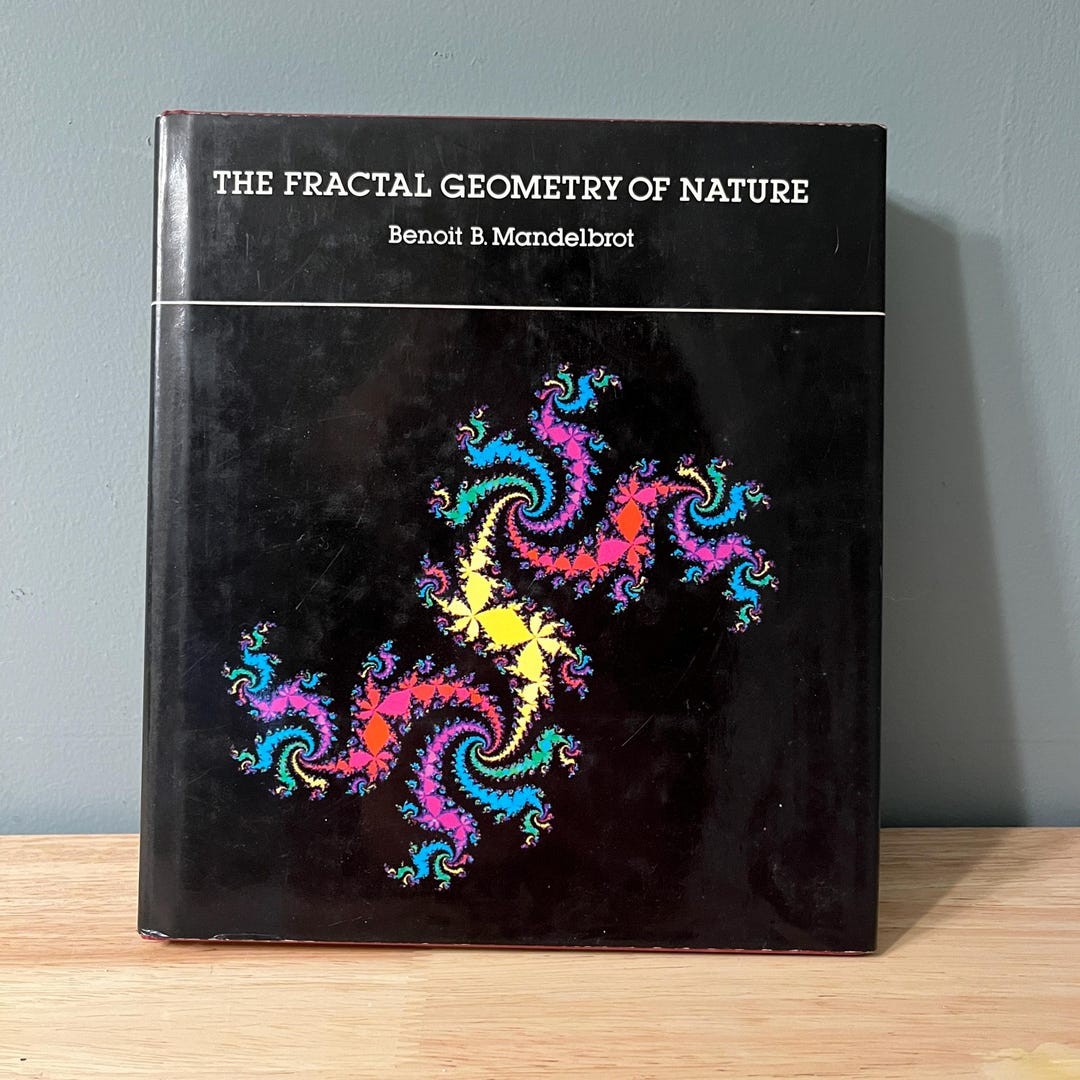
Physical-copy photograph of Mandelbrot’s The Fractal Geometry of Nature, corresponding to the 1982 English work in this node’s 1975/1982 publication history.
Benoit B. Mandelbrot / W. H. Freeman; seller photograph via Etsy · Rights remain with the respective holders; reproduction does not imply an open licence
Source · The Fractal Geometry of Nature · historical book copy ↗RESEARCH ACCOUNT
Recursive rules can produce irregular visual worlds.
ANTI-AI ARCHIVE · Revised 2026-10-02
Scale and form
Mandelbrot examines rough forms that smooth geometric objects describe poorly. Computer graphics make complex structures produced by repeated operations visible and comparable. The 1975 French work and The Fractal Geometry of Nature in 1982 are related but distinct publications, retained here as a combined chronology.
Section sources: Fractal geometry
Generation does not necessarily involve learning
Fractal imagery is an important comparison for generative art: rich forms can arise from computational rules without learning an image database. Control includes formulas, parameters, framing and colour. Its presence in this broader genealogy distinguishes sources of visual complexity rather than relabelling every fractal image as AI art.
Section sources: Fractal geometry
Sources for this account
IBM’s account of Mandelbrot’s research read; publication dates retain the research master’s distinction between editions.
This account expands the archive within the cited scope. Historical interpretation is not presented as the original author’s statement or as a proven causal influence. The account and translation are AI-assisted, pending independent human review. Section references identify evidence without claiming independent verification of every historical statement.
Continue with a comparative question
Compare the methods, forms of control or presentation contexts of this entry and Biomorph evolutionary program.
Compare the methods, forms of control or presentation contexts of this entry and FormGrow / Mutator evolutionary systems.
Dates & version record
Date displayed for this node: 1975 / 1982 · Historical date recorded for the source: 1975 / 1982
These dates refer to the historical event or recorded version, not this page’s publication date. The original date precision and unresolved questions are retained.
Original sources & further reading
These links lead to the cited paper, article, institution or conference page. External texts retain their source languages.
Les objets fractals (1975); The Fractal Geometry of Nature (1982)
https://mitpressbookstore.mit.edu/book/9781648370410
Current cited URL
Les objets fractals (1975); The Fractal Geometry of Nature (1982)
https://users.math.yale.edu/mandelbrot/web_books.html
URL cited in a research master or supplement; it may have moved or expired
Provenance, translation & verification
Timeline entry #041 · Historical node
Research materials & supplement references · 1
AI Art Genealogy Research Master · p. 10 · 027
Date as recorded: 1975 / 1982
Fractal Objects (1975) / The Fractal Geometry of Nature (1982) ↗
Les objets fractals (1975); The Fractal Geometry of Nature (1982)
Archive account based on the listed research materials, not a full translation of the linked work. AI-assisted translation; independent human review pending.
The master’s research claims and dates await independent verification.
Cite this node
ANTI-AI ARCHIVE. Fractal Objects (1975) / The Fractal Geometry of Nature (1982). Art-history node #041. https://salondesrefuses.cn/en/art-history/027
For specific historical claims, also cite the original sources above and include your access date. This account is not a full translation of the linked work.
Adjacent nodes follow chronological order; adjacency does not establish direct influence or causation.