

Introduction
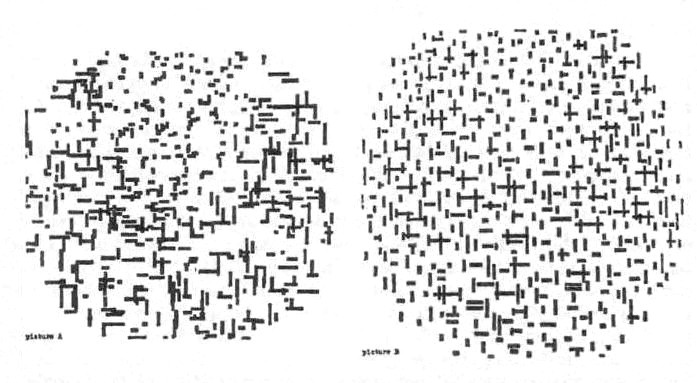
Noll generates computer images resembling a Mondrian composition and uses viewer experiments to compare aesthetic preferences and judgments of authorship. This anticipates later debates about machine imitation of style and the recognition of AI images. The technical mechanism, however, remains programmed generation rather than learning from training images.
 View full image ↗
Original Figure 4 from Noll’s Human or Machine: the Mondrian and computer-generated picture pair presented to participants. The comparison is preserved as published.
© A. Michael Noll 1965; © Rijksmuseum Kröller-Müller · Chilton Computing archive · Rights in the original image and document remain with their respective holders
Source · Human or Machine ↗RESEARCH ACCOUNT
Making viewers’ attribution judgements an experimental object.
ANTI-AI ARCHIVE · Revised 2026-10-02
Historical object and process
Noll produced a computational composition related to Mondrian’s line arrangements and compared viewers’ preferences and attributions using reproductions. The work record dates the image to 1964 and the published study to 1966. The experiment concerns display conditions and judgement as well as a computer’s ability to produce similar black-and-white forms.
Section sources: A. Michael Noll — Artworks
Significance and interpretive limits
The result cannot establish that human painting has lost significance: comparing reproductions does not include a work’s full material or historical context. It is more useful for studying how names, attribution and display shape viewing, and for comparison with later blind evaluations of generated images.
Section sources: A. Michael Noll — Artworks
Sources for this account
Computer Composition With Lines record and its 1966 study reference read.
This account expands the archive within the cited scope. Historical interpretation is not presented as the original author’s statement or as a proven causal influence. The account and translation are AI-assisted, pending independent human review. Section references identify evidence without claiming independent verification of every historical statement.
Continue with a comparative question
Compare the methods, forms of control or presentation contexts of this entry and Computing Machinery and Intelligence.
Compare the methods, forms of control or presentation contexts of this entry and Early computer-generated art exhibitions and Noll experiments.
Dates & version record
Date displayed for this node: 1964–1966 · Historical date recorded for the source: 1964–1966
These dates refer to the historical event or recorded version, not this page’s publication date. The original date precision and unresolved questions are retained.
Original sources & further reading
These links lead to the cited paper, article, institution or conference page. External texts retain their source languages.
Human or Machine: A Subjective Comparison of Piet Mondrian’s Composition with Lines and a Computer-Generated Picture
https://doi.org/10.1080/00140136608964399
Current cited URL
Provenance, translation & verification
Timeline entry #017 · Historical node
Research materials & supplement references · 1
AI Art Genealogy Research Master · p. 8 · 017
Date as recorded: 1964–1966
Human or Machine: A Subjective Comparison of Piet Mondrian’s Composition with Lines and a Computer-Generated Picture ↗
Human or Machine: A Subjective Comparison of Piet Mondrian’s Composition with Lines and a Computer-Generated Picture
Archive account based on the listed research materials, not a full translation of the linked work. AI-assisted translation; independent human review pending.
The master’s research claims and dates await independent verification.
Cite this node
ANTI-AI ARCHIVE. Human or Machine: A Subjective Comparison of Piet Mondrian’s Composition with Lines and a Computer-Generated Picture. Art-history node #017. https://salondesrefuses.cn/en/art-history/017
For specific historical claims, also cite the original sources above and include your access date. This account is not a full translation of the linked work.
Adjacent nodes follow chronological order; adjacency does not establish direct influence or causation.