

Introduction
Sketchpad brings graphical objects, constraints and human–computer interaction into one system, helping establish interactive computer graphics. It reminds us that a history of AI art concerns not only how models generate images, but also how interfaces turn computational capacities into usable visual practices.
 View full image ↗
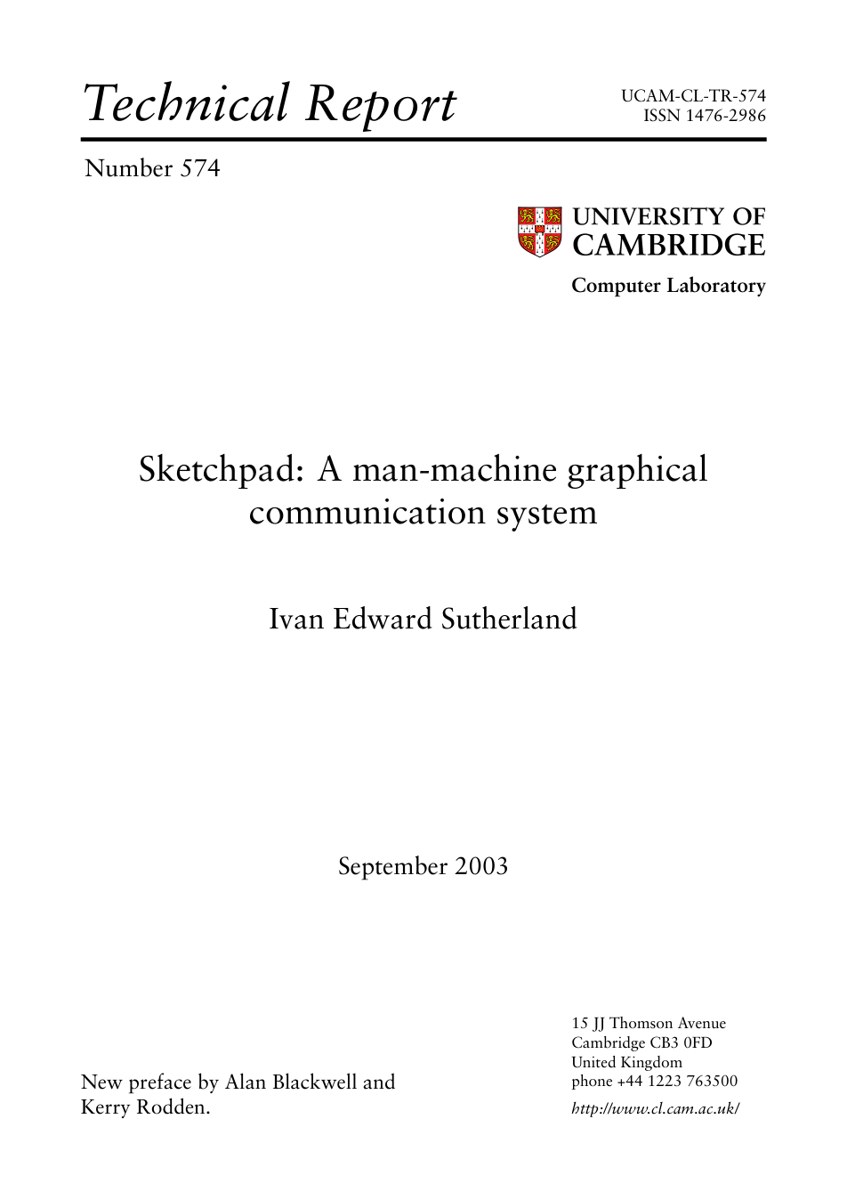
Page 1 of the linked paper PDF, preserving its original figures and language. The source file identifies the edition; later revision or reprint dates do not replace the node’s historical date.
Ivan Sutherland · original paper · Image rights remain with their respective holders; no open licence is asserted
Source · Sketchpad ↗RESEARCH ACCOUNT
A drawing as a set of editable relations
ANTI-AI ARCHIVE · Revised 2026-10-02
More than lines on a screen
Sutherland’s 1963 dissertation describes interaction with graphical objects through a light pen. The 2003 electronic edition foregrounds selection, dragging and direct manipulation: computational abstractions become visible objects that a user can operate on, rather than merely marks transferred from paper to a display.
Section sources: Sketchpad
Disseminating an idea rather than a product
The editors explain that executable versions were confined to a customised machine at MIT Lincoln Laboratory. The dissertation, demonstration film and conference publication circulated its ideas more widely. The linked document is a 2003 republication of work submitted in 1963, not evidence of a 2003 invention.
Section sources: Sketchpad
The draughtsperson remains in the system
Editorial interpretation: Sketchpad provides a comparison for systems in which creators manipulate objects and relations rather than only describing an intended image in words. The distribution of control through an interface is itself part of artistic practice.
Section sources: Sketchpad
Sources for this account
Bibliographic material, preface and opening of the 2003 edition read; the original system was not run.
This account expands the archive within the cited scope. Historical interpretation is not presented as the original author’s statement or as a proven causal influence. The account and translation are AI-assisted, pending independent human review. Section references identify evidence without claiming independent verification of every historical statement.
Continue with a comparative question
Compare the methods, forms of control or presentation contexts of this entry and Man-Computer Symbiosis.
Compare the methods, forms of control or presentation contexts of this entry and T2I-Adapter: Learning Adapters to Dig out More Controllable Ability for Text-to-Image Diffusion Models.
Dates & version record
Date displayed for this node: 1963 · Historical date recorded for the source: 1963
These dates refer to the historical event or recorded version, not this page’s publication date. The original date precision and unresolved questions are retained.
Original sources & further reading
These links lead to the cited paper, article, institution or conference page. External texts retain their source languages.
Provenance, translation & verification
Timeline entry #016 · Historical node
Research materials & supplement references · 1
AI Art Genealogy Research Master · p. 8 · 016
Date as recorded: 1963
Sketchpad ↗
Sketchpad
Archive account based on the listed research materials, not a full translation of the linked work. AI-assisted translation; independent human review pending.
The master’s research claims and dates await independent verification.
Cite this node
ANTI-AI ARCHIVE. Sketchpad. Art-history node #016. https://salondesrefuses.cn/en/art-history/016
For specific historical claims, also cite the original sources above and include your access date. This account is not a full translation of the linked work.
Adjacent nodes follow chronological order; adjacency does not establish direct influence or causation.