

Introduction
Licklider proposes human–computer symbiosis: people and computers undertake different tasks and form a new cognitive arrangement through real-time interaction. The master relates this history of interaction to contemporary conversational image generation and visual agents. The connection concerns interfaces for collaborative work, rather than an identity between the earlier proposal and present models.
 View full image ↗
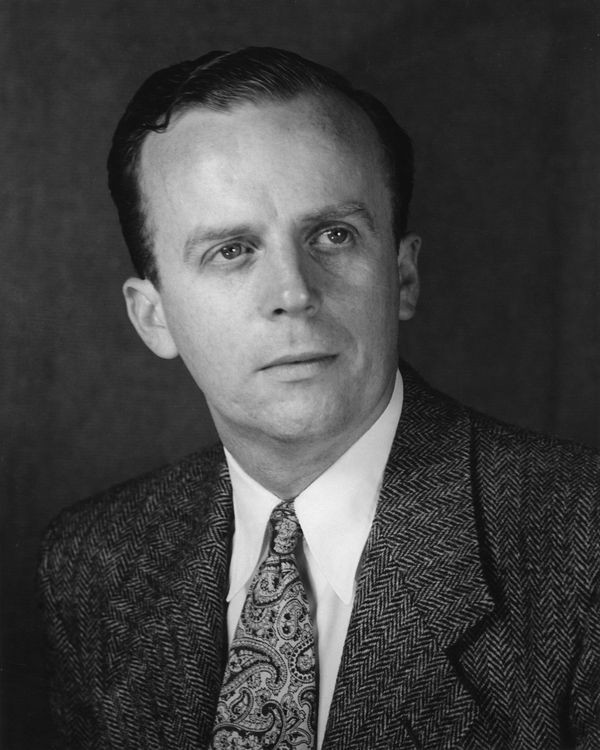
Archival portrait of J. C. R. Licklider from the Computer History Museum, documenting the author of Man–Computer Symbiosis. The photograph is not separately dated.
Computer History Museum · Rights remain with the respective holders; reproduction does not imply an open licence
Source · Connections: Global Networks · J.C.R. Licklider ↗RESEARCH ACCOUNT
Redistributing thought between people and computers
ANTI-AI ARCHIVE · Revised 2026-10-02
From solving a problem to formulating it
Licklider’s 1960 paper asks computers to assist in formulating problems, not only solving problems already specified. His proposed partnership supports decisions in changing situations: people establish goals, hypotheses and evaluative criteria, while computers perform the routinised work that prepares decisions.
Section sources: Man-Computer Symbiosis
The material requirements of cooperation
The requirements include time-sharing, memory components and organisation, programming languages, and input and output equipment. Symbiosis therefore depends on infrastructure that makes timely feedback and revision possible; it is more than an appealing metaphor for harmonious cooperation.
Section sources: Man-Computer Symbiosis
A question for creative interfaces
Editorial interpretation: prompts, node graphs and editing tools can be examined through who specifies, executes and evaluates a task, without assuming direct descent from this paper. Its inclusion makes divisions of labour visible; cooperation does not automatically establish equality.
Section sources: Man-Computer Symbiosis
Sources for this account
Abstract and introduction read; its efficiency predictions were not independently validated.
This account expands the archive within the cited scope. Historical interpretation is not presented as the original author’s statement or as a proven causal influence. The account and translation are AI-assisted, pending independent human review. Section references identify evidence without claiming independent verification of every historical statement.
Continue with a comparative question
Compare the methods, forms of control or presentation contexts of this entry and Sketchpad.
Compare the methods, forms of control or presentation contexts of this entry and T2I-Adapter: Learning Adapters to Dig out More Controllable Ability for Text-to-Image Diffusion Models.
Dates & version record
Date displayed for this node: 1960 · Historical date recorded for the source: 1960
These dates refer to the historical event or recorded version, not this page’s publication date. The original date precision and unresolved questions are retained.
Original sources & further reading
These links lead to the cited paper, article, institution or conference page. External texts retain their source languages.
Man-Computer Symbiosis
https://groups.csail.mit.edu/medg/people/psz/Licklider.html
Current cited URL
Provenance, translation & verification
Timeline entry #014 · Historical node
Research materials & supplement references · 1
AI Art Genealogy Research Master · p. 6 · 011
Date as recorded: 1960
Man-Computer Symbiosis ↗
Man-Computer Symbiosis
Archive account based on the listed research materials, not a full translation of the linked work. AI-assisted translation; independent human review pending.
The master’s research claims and dates await independent verification.
Cite this node
ANTI-AI ARCHIVE. Man-Computer Symbiosis. Art-history node #014. https://salondesrefuses.cn/en/art-history/011
For specific historical claims, also cite the original sources above and include your access date. This account is not a full translation of the linked work.
Adjacent nodes follow chronological order; adjacency does not establish direct influence or causation.