

Introduction
In 1965, Nees exhibits computer graphics in Stuttgart; Noll and Béla Julesz show computer-generated pictures at New York's Howard Wise Gallery; Nake is also among the earliest public exhibitors of algorithmic art. The computer enters art institutions as a means of producing form, extending its role beyond engineering.
 View full image ↗
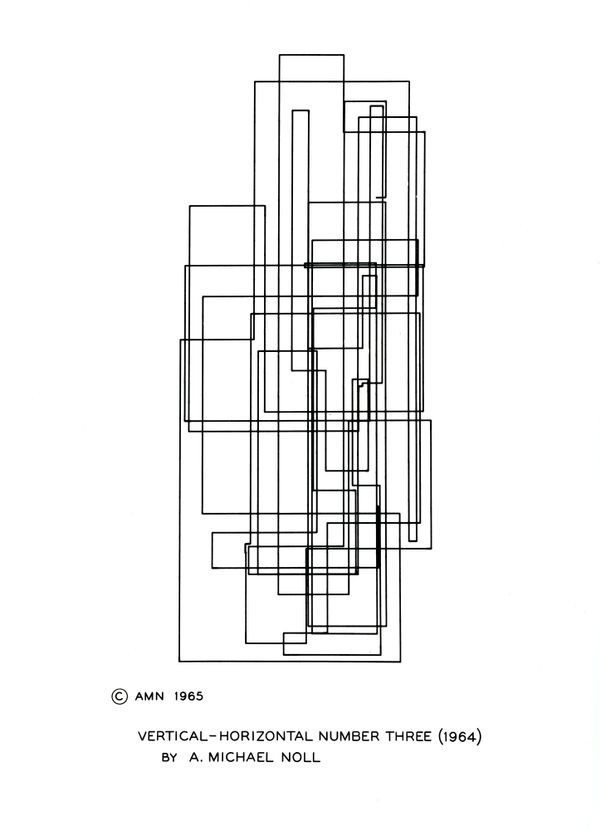
A. Michael Noll’s Vertical-Horizontal Number Three (1965), reproduced in the Computer History Museum’s collection record.
A. Michael Noll / Computer History Museum · Rights in the original image and document remain with their respective holders
Source · Vertical-Horizontal Number Three - CHM Revolution ↗RESEARCH ACCOUNT
Computer-generated images move from laboratory output into exhibition and collection.
ANTI-AI ARCHIVE · Revised 2026-10-03
Historical object and process
Noll’s institutional profile records computer graphics, animation and interactive research at Bell Labs in the 1960s, alongside exhibitions in the United States and Europe between 1965 and 1975. Geometric transformations, random patterns and stereoscopic animation cannot all be collapsed into a later model of AI image generation. This overview should be read with specific work and exhibition entries.
Section sources: A. Michael Noll — Digital Art Pioneer
Significance and interpretive limits
Computational outputs acquire new places of viewing and forms of attribution, beyond improvements in equipment. Claims about the earliest exhibition require precise comparison of dates, places and solo versus group formats; this overview does not substitute for that verification.
Section sources: A. Michael Noll — Digital Art Pioneer
Sources for this account
Digital Art Museum artist profile, work types and exhibition span read.
This account expands the archive within the cited scope. Historical interpretation is not presented as the original author’s statement or as a proven causal influence. The account and translation are AI-assisted, pending independent human review. Section references identify evidence without claiming independent verification of every historical statement.
Continue with a comparative question
Compare the methods, forms of control or presentation contexts of this entry and Human or Machine: A Subjective Comparison of Piet Mondrian’s Composition with Lines and a Computer-Generated Picture.
Compare the methods, forms of control or presentation contexts of this entry and Hommage à Paul Klee Nr. 2.
Compare the methods, forms of control or presentation contexts of this entry and Event One.
Compare exhibition and publication in 1965.
Further comparison: Schotter: order and perturbation
Dates & version record
Date displayed for this node: 1965 · Historical date recorded for the source: 1965
These dates refer to the historical event or recorded version, not this page’s publication date. The original date precision and unresolved questions are retained.
Original sources & further reading
These links lead to the cited paper, article, institution or conference page. External texts retain their source languages.
Early computer-generated art exhibitions and Noll experiments
https://digitalartmuseum.org/history/
Current cited URL
Provenance, translation & verification
Timeline entry #019 · Historical node
Research materials & supplement references · 1
AI Art Genealogy Research Master · p. 8 · 018
Date as recorded: 1965
Early computer-generated art exhibitions and Noll experiments ↗
Early computer-generated art exhibitions and Noll experiments
Archive account based on the listed research materials, not a full translation of the linked work. AI-assisted translation; independent human review pending.
The master’s research claims and dates await independent verification.
Cite this node
ANTI-AI ARCHIVE. Early computer-generated art exhibitions and Noll experiments. Art-history node #019. https://salondesrefuses.cn/en/art-history/018
For specific historical claims, also cite the original sources above and include your access date. This account is not a full translation of the linked work.
Adjacent nodes follow chronological order; adjacency does not establish direct influence or causation.