

Introduction
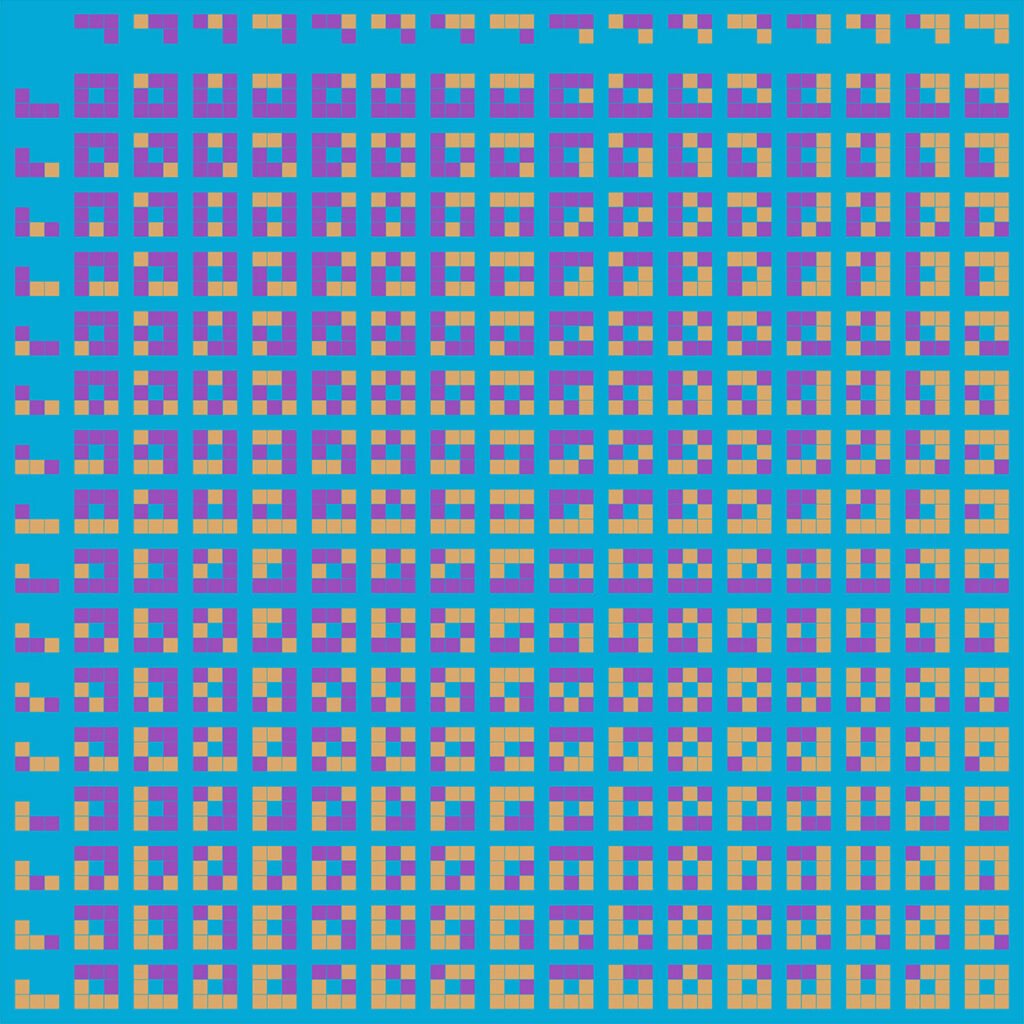
In Neighbourhood Count (1991), Paul Brown organises cellular-automaton neighbourhood configurations into a printed composition. The work connects rules, enumeration and colour patterns, broadening histories centred on machine-learned images.
Why this entry remains in the timeline
A specific print makes the relationship between local rules and artistic selection visible, while retaining the distinction between generative and machine-learning art. No priority claim is made.
Archive editorial judgment based on the cited sources; this does not establish global priority.
 View full image ↗
Paul Brown, Neighbourhood Count, work dated 1991. Reproduction on the artist’s website; the date of this digital reproduction is unverified.
Paul Brown; image from the artist’s work catalogue · Rights remain with the artist and relevant holders; the source link does not imply an open licence.
Source · Paul Brown’s work catalogue ↗RESEARCH ACCOUNT
Rules, neighbourhoods and the printed image
ANTI-AI ARCHIVE · Revised 2026-10-10
A dated print
Brown’s website lists Neighbourhood Count as a laserprint from 1991. The V&A corroborates the year and identifies the object as E.1066-2008. The image shown here is a reproduction from the artist’s website; its digital file does not establish the date of the original object.
Section sources: Paul Brown’s work catalogue · V&A collection selection on artificial intelligence
How neighbourhoods become patterns
The V&A explains the patterns through cellular-automaton neighbourhood states: eight positions surrounding a centre yield 256 configurations. Their arrangement forms an array of coloured motifs. This organises rules and states rather than a prompt-based image-training workflow.
Section sources: V&A collection selection on artificial intelligence
From algorithmic possibilities to a composition
Editorial interpretation: the work matters not simply because computation produces patterns, but because artistic selection and arrangement make rules visible. Alongside AARON, it invites comparison of how different programs constrain images without treating all computer-assisted work as contemporary AI.
Section sources: Paul Brown’s work catalogue · V&A collection selection on artificial intelligence
Sources for this account
1990s section: Neighbourhood Count, the 1991 date, laserprint medium and corresponding image.
Paul Brown / Neighbourhood Count section: date, accession number and neighbourhood-state account.
The original program, output sequence and complete technical archive have not been examined. The individual V&A object page could not be read; the accessible institutional account and artist catalogue are used instead. Cellular automata are not equated with machine learning, and the reproduction date remains unverified. The account and translation are AI-assisted, pending independent human review. Section references identify evidence without claiming independent verification of every historical statement.
Continue with a comparative question
Compare how explicitly authored rule systems participate in making images.
Dates & version record
Date displayed for this node: 1991 · Historical date recorded for the source: 1991
Both the artist’s catalogue and the V&A date the work to 1991, not the publication of their web pages. The date of the artist’s digital reproduction is unverified. Discovered and accessioned on 10 October 2026.
These dates refer to the historical event or recorded version, not this page’s publication date. The original date precision and unresolved questions are retained.
Original sources & further reading
These links lead to the cited paper, article, institution or conference page. External texts retain their source languages.
Neighbourhood Count
https://paul-brown.art/gallery/
Current cited URL
Collection Selection Boxes — Artificial Intelligence
https://www.vam.ac.uk/info/collection-selection-boxes-artificial-intelligence
URL cited in a research master or supplement; it may have moved or expired
The artist’s 1990s catalogue, the V&A account and the corresponding reproduction were examined. The original program was not run; the individual V&A collection page was inaccessible.
Provenance, translation & verification
Timeline entry #055 · Cellular-automaton print
Research materials & supplement references · 2
Historical accessions, 10 October 2026 · 1990s section: Neighbourhood Count, the 1991 date, laserprint medium and corresponding image. · 001
Date as recorded: 1991
Paul Brown’s work catalogue ↗
Gallery
Historical accessions, 10 October 2026 · Paul Brown / Neighbourhood Count section: date, accession number and neighbourhood-state account. · 359-2
Date as recorded: 1991
V&A collection selection on artificial intelligence ↗
Collection Selection Boxes — Artificial Intelligence
Archive account based on the listed research materials, not a full translation of the linked work. AI-assisted translation; independent human review pending.
Official material was read within the stated scope; see the source note for reading limits and outstanding checks.
Cite this node
ANTI-AI ARCHIVE. Paul Brown: Neighbourhood Count. Art-history node #055. https://salondesrefuses.cn/en/art-history/359
For specific historical claims, also cite the original sources above and include your access date. This account is not a full translation of the linked work.
Adjacent nodes follow chronological order; adjacency does not establish direct influence or causation.