

Introduction
ImageNet connects WordNet's semantic hierarchy with millions of images and uses crowdsourcing for annotation. The master interprets this as a Dataset Turn: cultural and everyday images become organised as scalable resources for machine learning and comparison, alongside their existence as things people view. This turn is an editorial framework, not a neutral period label.
 View full image ↗
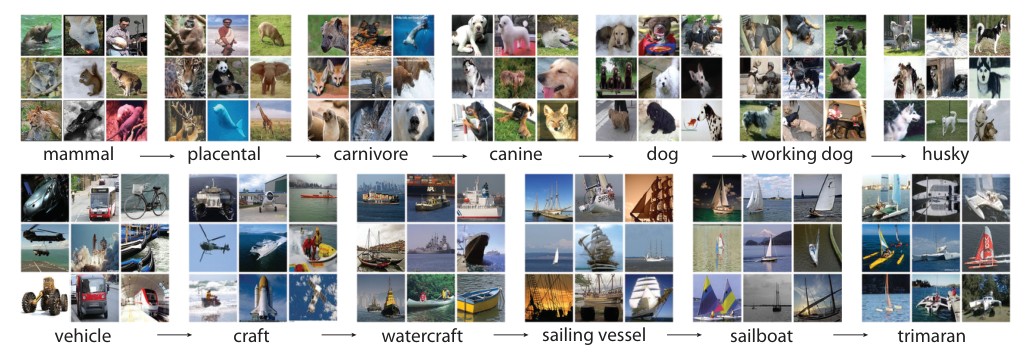
Hierarchical image examples from Figure 1 of the original 2009 ImageNet paper, excerpted from PDF page 2 with category labels and examples retained.
Jia Deng et al. / Princeton University, CVPR 2009 · Rights remain with the respective holders; reproduction does not imply an open licence
Source · ImageNet: A Large-Scale Hierarchical Image Database · Figure 1 ↗RESEARCH ACCOUNT
A visual database is built through both taxonomy and annotation labour.
ANTI-AI ARCHIVE · Revised 2026-10-02
Method and contribution
ImageNet connects WordNet’s semantic hierarchy with image collections. The 2009 paper reports the categories and samples then available and describes collection and annotation involving Amazon Mechanical Turk. Planned scale must be distinguished from completed scale, and later ILSVRC subsets from the original database.
Section sources: ImageNet: A Large-Scale Hierarchical Image Database
Art-historical interpretation
Recognition depends on institutions of naming and human judgement as well as algorithms. The database invites questions about how categories are divided, which images represent concepts and how annotation labour appears—or disappears—in accounts of technical achievement.
Section sources: ImageNet: A Large-Scale Hierarchical Image Database
Sources for this account
Original abstract, introduction and description of data organisation read.
This account expands the archive within the cited scope. Historical interpretation is not presented as the original author’s statement or as a proven causal influence. The account and translation are AI-assisted, pending independent human review. Section references identify evidence without claiming independent verification of every historical statement.
Continue with a comparative question
Compare the methods, forms of control or presentation contexts of this entry and ILSVRC.
Compare the methods, forms of control or presentation contexts of this entry and AlexNet.
Compare the methods, forms of control or presentation contexts of this entry and LAION-5B: An open large-scale dataset for training next generation image-text models.
Dates & version record
Date displayed for this node: 2009 · Historical date recorded for the source: 2009
These dates refer to the historical event or recorded version, not this page’s publication date. The original date precision and unresolved questions are retained.
Original sources & further reading
These links lead to the cited paper, article, institution or conference page. External texts retain their source languages.
ImageNet: A Large-Scale Hierarchical Image Database
https://doi.org/10.1109/CVPR.2009.5206848
Current cited URL
Provenance, translation & verification
Timeline entry #075 · Historical node
Research materials & supplement references · 1
AI Art Genealogy Research Master · p. 14 · 041
Date as recorded: 2009
ImageNet: A Large-Scale Hierarchical Image Database ↗
ImageNet: A Large-Scale Hierarchical Image Database
Archive account based on the listed research materials, not a full translation of the linked work. AI-assisted translation; independent human review pending.
The master’s research claims and dates await independent verification.
Cite this node
ANTI-AI ARCHIVE. ImageNet: A Large-Scale Hierarchical Image Database. Art-history node #075. https://salondesrefuses.cn/en/art-history/041
For specific historical claims, also cite the original sources above and include your access date. This account is not a full translation of the linked work.
Adjacent nodes follow chronological order; adjacency does not establish direct influence or causation.