

Introduction
AlexNet substantially outperforms established methods on ImageNet classification and helps make deep convolutional networks central to computer vision. The master reads this as a convergence of dataset scale, GPU computation and learned representations, extending the Dataset Turn into the production of new visual capabilities.
 View full image ↗
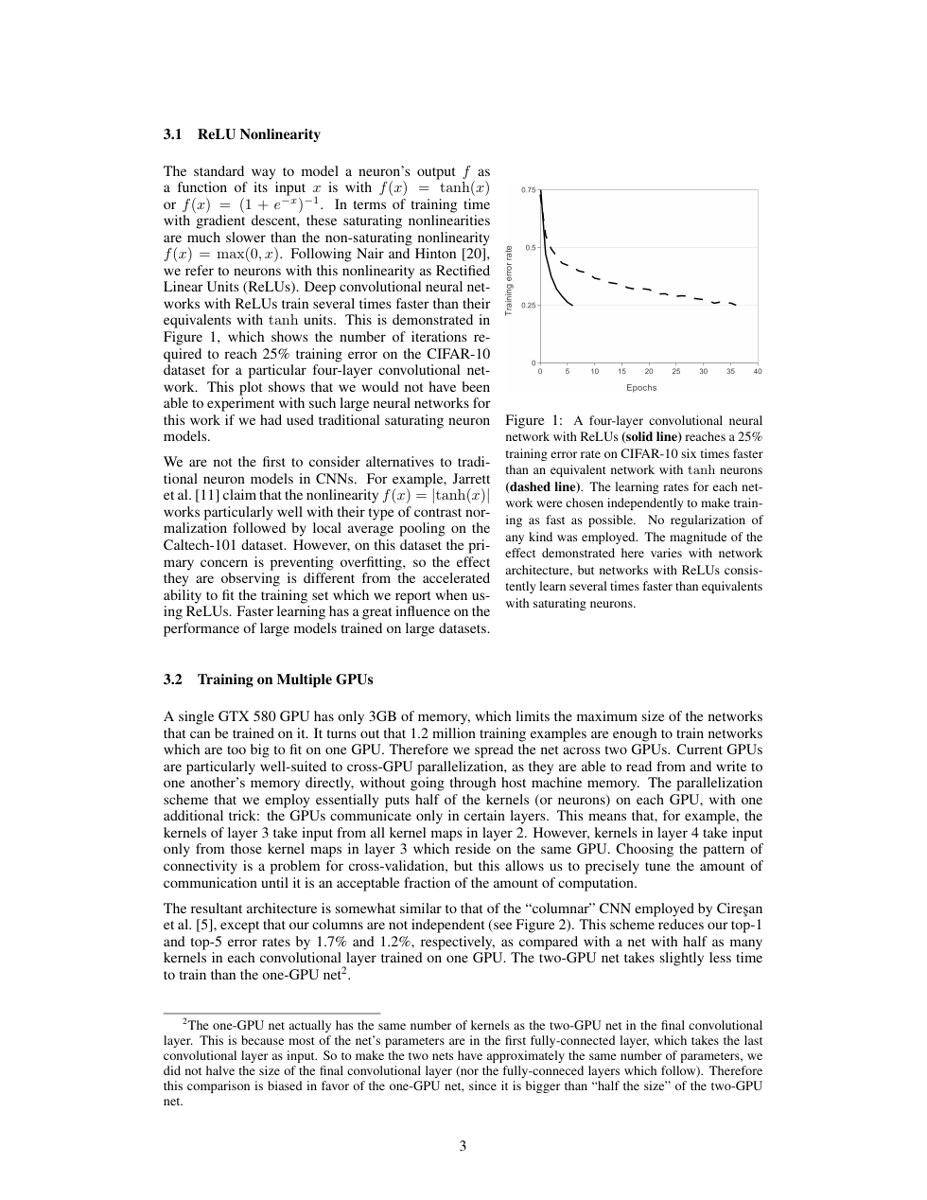
Page 3 of the linked paper PDF, preserving its original figures and language. The source file identifies the edition; later revision or reprint dates do not replace the node’s historical date.
Krizhevsky, Sutskever & Hinton · original paper · Image rights remain with their respective holders; no open licence is asserted
Source · AlexNet ↗RESEARCH ACCOUNT
From classification to a new visual infrastructure
ANTI-AI ARCHIVE · Revised 2026-10-02
Method and contribution
AlexNet addressed the classification of ImageNet images into one thousand categories, not painting generation. The abstract describes a large convolutional network, a GPU implementation, non-saturating neurons and a method to reduce overfitting. Reported performance belongs to particular data and error measures, rather than demonstrating superiority across every visual task.
Section sources: AlexNet
Art-historical interpretation
Editorial interpretation: the connection to art lies in learned visual representations and their computational conditions. Later style transfer and feature visualisation redirected such networks towards image-making. Turning a recognition system into creative material is a historical change, not its original purpose.
Section sources: AlexNet
Sources for this account
Author or conference abstract and version record read; full proofs and experiments were not independently reproduced.
This account expands the archive within the cited scope. Historical interpretation is not presented as the original author’s statement or as a proven causal influence. The account and translation are AI-assisted, pending independent human review. Section references identify evidence without claiming independent verification of every historical statement.
Continue with a comparative question
Compare the methods, forms of control or presentation contexts of this entry and A Neural Algorithm of Artistic Style.
Compare the methods, forms of control or presentation contexts of this entry and DeepDream.
Dates & version record
Date displayed for this node: 2012 · Historical date recorded for the source: 2012
These dates refer to the historical event or recorded version, not this page’s publication date. The original date precision and unresolved questions are retained.
Original sources & further reading
These links lead to the cited paper, article, institution or conference page. External texts retain their source languages.
AlexNet
https://papers.nips.cc/paper/4824-imagenet-classification-with-deep-convolutional-neural-networks
Current cited URL
Provenance, translation & verification
Timeline entry #077 · Historical node
Research materials & supplement references · 1
AI Art Genealogy Research Master · p. 15 · 043
Date as recorded: 2012
AlexNet ↗
AlexNet
Archive account based on the listed research materials, not a full translation of the linked work. AI-assisted translation; independent human review pending.
The master’s research claims and dates await independent verification.
Cite this node
ANTI-AI ARCHIVE. AlexNet. Art-history node #077. https://salondesrefuses.cn/en/art-history/043
For specific historical claims, also cite the original sources above and include your access date. This account is not a full translation of the linked work.
Adjacent nodes follow chronological order; adjacency does not establish direct influence or causation.