

Introduction
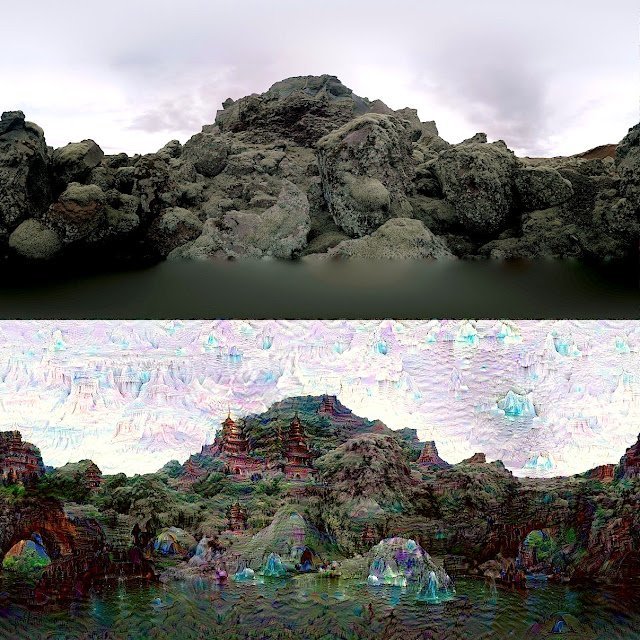
DeepDream amplifies internal network activations to make recognized patterns visible. It is not contemporary text-to-image generation, but gives a broad public an early encounter with a recognizable visual aesthetic arising from neural representations. Artists, media and online communities quickly incorporate that aesthetic into their practices and discussions.
 View full image ↗
Illustration from Google Research’s DeepDream page comparing an input image and its neural-network transformation.
Google Research · Image rights remain with their respective holders; no open licence is asserted
Source · DeepDream ↗RESEARCH ACCOUNT
Turning a recognition network towards image-making
ANTI-AI ARCHIVE · Revised 2026-10-02
Method and contribution
Google’s July 2015 DeepDream code example exposed controls over the network layer to enhance, iteration count and zoom, and allowed alternative pretrained networks. A tool for investigating what a network had learned also became a means of producing visually striking images for artists and programmers.
Section sources: DeepDream
Art-historical interpretation
Editorial interpretation: recurring forms relate to learned representations and their amplification, not evidence that a machine literally dreams. The episode shows a diagnostic tool becoming a creative interface, with the choice of model itself becoming an artistic decision.
Section sources: DeepDream
Sources for this account
Official DeepDream code repository and project description read.
This account expands the archive within the cited scope. Historical interpretation is not presented as the original author’s statement or as a proven causal influence. The account and translation are AI-assisted, pending independent human review. Section references identify evidence without claiming independent verification of every historical statement.
Continue with a comparative question
Compare the methods, forms of control or presentation contexts of this entry and AlexNet.
Compare the methods, forms of control or presentation contexts of this entry and A Neural Algorithm of Artistic Style.
Dates & version record
Date displayed for this node: 2015 · Historical date recorded for the source: 2015
These dates refer to the historical event or recorded version, not this page’s publication date. The original date precision and unresolved questions are retained.
Original sources & further reading
These links lead to the cited paper, article, institution or conference page. External texts retain their source languages.
DeepDream
https://research.google/blog/deepdream-a-code-example-for-visualizing-neural-networks/
Current cited URL
Provenance, translation & verification
Timeline entry #084 · Historical node
Research materials & supplement references · 1
AI Art Genealogy Research Master · p. 16 · 049
Date as recorded: 2015
DeepDream ↗
DeepDream
Archive account based on the listed research materials, not a full translation of the linked work. AI-assisted translation; independent human review pending.
The master’s research claims and dates await independent verification.
Cite this node
ANTI-AI ARCHIVE. DeepDream. Art-history node #084. https://salondesrefuses.cn/en/art-history/049
For specific historical claims, also cite the original sources above and include your access date. This account is not a full translation of the linked work.
Adjacent nodes follow chronological order; adjacency does not establish direct influence or causation.