

Introduction
Founded in Britain, the Computer Arts Society connects artists, designers, engineers and researchers. Its significance is institutional: computer art begins to acquire sustained structures for exhibition, discussion, publication and professional exchange, moving beyond scattered experiments into a continuing field of practice.
 View full image ↗
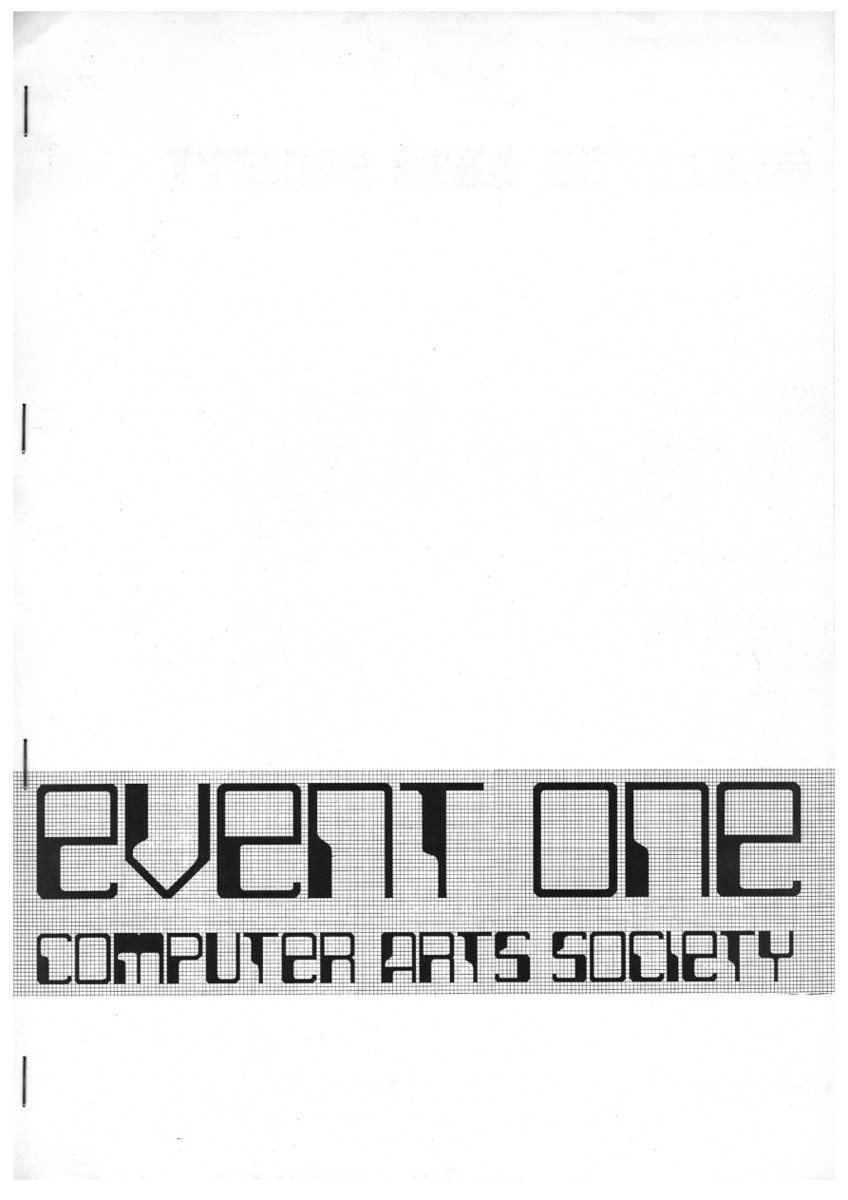
Cover of the Computer Arts Society’s Event One exhibition catalogue (1969). It documents an exhibition after the society’s establishment, not its founding in 1968.
Computer Arts Society Archive · Rights in the original image and document remain with their respective holders
Source · Computer Arts Society ↗RESEARCH ACCOUNT
Building a community around computer art
ANTI-AI ARCHIVE · Revised 2026-10-02
An encounter at a congress
CAS traces its formation to the 1968 IFIP congress in Edinburgh. Alan Sutcliffe gathered contacts among people working in related fields, and formed the society with George Mallen and John Lansdown. Initial London meetings followed that September, bringing together experience in music, architecture and cybernetics.
Section sources: Computer Arts Society — About: History
The need to circulate methods
Creative activity was expanding, but methods were poorly documented and practitioners in different art forms had limited contact. CAS developed exhibitions, discussion and preservation activities; Event One followed in 1969. Its re-establishment in 2002 should be distinguished from the initial period.
Section sources: Computer Arts Society — About: History
Institutions shape what can be remembered
Editorial interpretation: societies that enable exchange, publication and preservation shape art history alongside works and algorithms. CAS supplies that institutional context; membership or exhibition within computer art does not automatically classify a work as AI art.
Section sources: Computer Arts Society — About: History
Sources for this account
The society’s founding history and archive overview were read.
This account expands the archive within the cited scope. Historical interpretation is not presented as the original author’s statement or as a proven causal influence. The account and translation are AI-assisted, pending independent human review. Section references identify evidence without claiming independent verification of every historical statement.
Continue with a comparative question
Compare the methods, forms of control or presentation contexts of this entry and Cybernetic Serendipity exhibition.
Compare the methods, forms of control or presentation contexts of this entry and Processing.
Dates & version record
Date displayed for this node: 1968 · Historical date recorded for the source: 1968
These dates refer to the historical event or recorded version, not this page’s publication date. The original date precision and unresolved questions are retained.
Original sources & further reading
These links lead to the cited paper, article, institution or conference page. External texts retain their source languages.
Provenance, translation & verification
Timeline entry #026 · Historical node
Research materials & supplement references · 1
AI Art Genealogy Research Master · p. 9 · 021
Date as recorded: 1968
Computer Arts Society ↗
Computer Arts Society
Archive account based on the listed research materials, not a full translation of the linked work. AI-assisted translation; independent human review pending.
The master’s research claims and dates await independent verification.
Cite this node
ANTI-AI ARCHIVE. Computer Arts Society. Art-history node #026. https://salondesrefuses.cn/en/art-history/021
For specific historical claims, also cite the original sources above and include your access date. This account is not a full translation of the linked work.
Adjacent nodes follow chronological order; adjacency does not establish direct influence or causation.