

Introduction
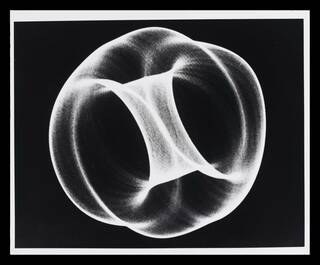
Laposky generates electronic waveforms with an oscilloscope and records them photographically as abstract images. Before digital computer art becomes established, this practice connects electrical signals, mathematical curves and visual composition. It forms a prehistory of electronic generative aesthetics rather than an instance of contemporary machine learning.
 View full image ↗
Ben Laposky, Oscillon 40 (1952), V&A collection E.958-2008.
© Victoria and Albert Museum, London · Image rights remain with their respective holders; no open licence is asserted
Source · Oscillons / Electronic Abstractions ↗RESEARCH ACCOUNT
Electronic waveforms become durable works through photography.
ANTI-AI ARCHIVE · Revised 2026-10-02
Historical object and process
The V&A identifies Laposky’s Oscillon 40 as a 1952 photograph within the prehistory of computer art. Electronic traces on an oscilloscope are not marks drawn sequentially on paper: photography translates a temporary screen state into an image that can be exhibited, collected and reproduced. This is electronic and analogue experimentation, not machine learning simply because a machine produces the image.
Section sources: Patric D. Prince: digital art visionary
Significance and interpretive limits
The node foregrounds mediation through circuitry, screen, camera and photograph. The archive’s former V&A URL resolved to an unrelated object and has been replaced with an institutional account identifying the work and accession number. Visual resemblance cannot substitute for object identification.
Section sources: Patric D. Prince: digital art visionary
Sources for this account
V&A discussion and caption for Laposky read; accession E.958-2008.
This account expands the archive within the cited scope. Historical interpretation is not presented as the original author’s statement or as a proven causal influence. The account and translation are AI-assisted, pending independent human review. Section references identify evidence without claiming independent verification of every historical statement.
Continue with a comparative question
Compare the methods, forms of control or presentation contexts of this entry and Oscillograms; early computer / electronic art writing.
Compare the methods, forms of control or presentation contexts of this entry and Pixillation.
Further comparison: Spectron: from voltage imagery to browser animation
Further comparison: Synth Poems: reconstructible generative audiovisual works
Dates & version record
Date displayed for this node: 1952 · Historical date recorded for the source: 1952
These dates refer to the historical event or recorded version, not this page’s publication date. The original date precision and unresolved questions are retained.
Original sources & further reading
These links lead to the cited paper, article, institution or conference page. External texts retain their source languages.
Oscillons / Electronic Abstractions
https://www.vam.ac.uk/articles/patric-d-prince-digital-art-visionary
Current cited URL
The former collection URL resolves to James William Wild’s Cairo sketchbook and is no longer used as evidence for this work. The V&A Patric D. Prince article identifies Oscillon 40 (1952), museum number E.958-2008. The old URL is retained only as a revision record.
Provenance, translation & verification
Timeline entry #006 · Historical node
Research materials & supplement references · 1
AI Art Genealogy Research Master · p. 7 · 012
Date as recorded: 1952
Oscillons / Electronic Abstractions ↗
Oscillons / Electronic Abstractions
Archive account based on the listed research materials, not a full translation of the linked work. AI-assisted translation; independent human review pending.
Official material was read within the stated scope; see the source note for reading limits and outstanding checks.
Cite this node
ANTI-AI ARCHIVE. Oscillons / Electronic Abstractions. Art-history node #006. https://salondesrefuses.cn/en/art-history/012
For specific historical claims, also cite the original sources above and include your access date. This account is not a full translation of the linked work.
Adjacent nodes follow chronological order; adjacency does not establish direct influence or causation.