

The archive provides Chinese and English research texts. Translations may be AI-assisted and may not yet have received independent human review. Consult the original-language sources alongside them.
The appeals court required that a work initially be authored by a human. It did not decide constitutional questions or consider Thaler’s abandoned argument that he was the author.
 View full image ↗
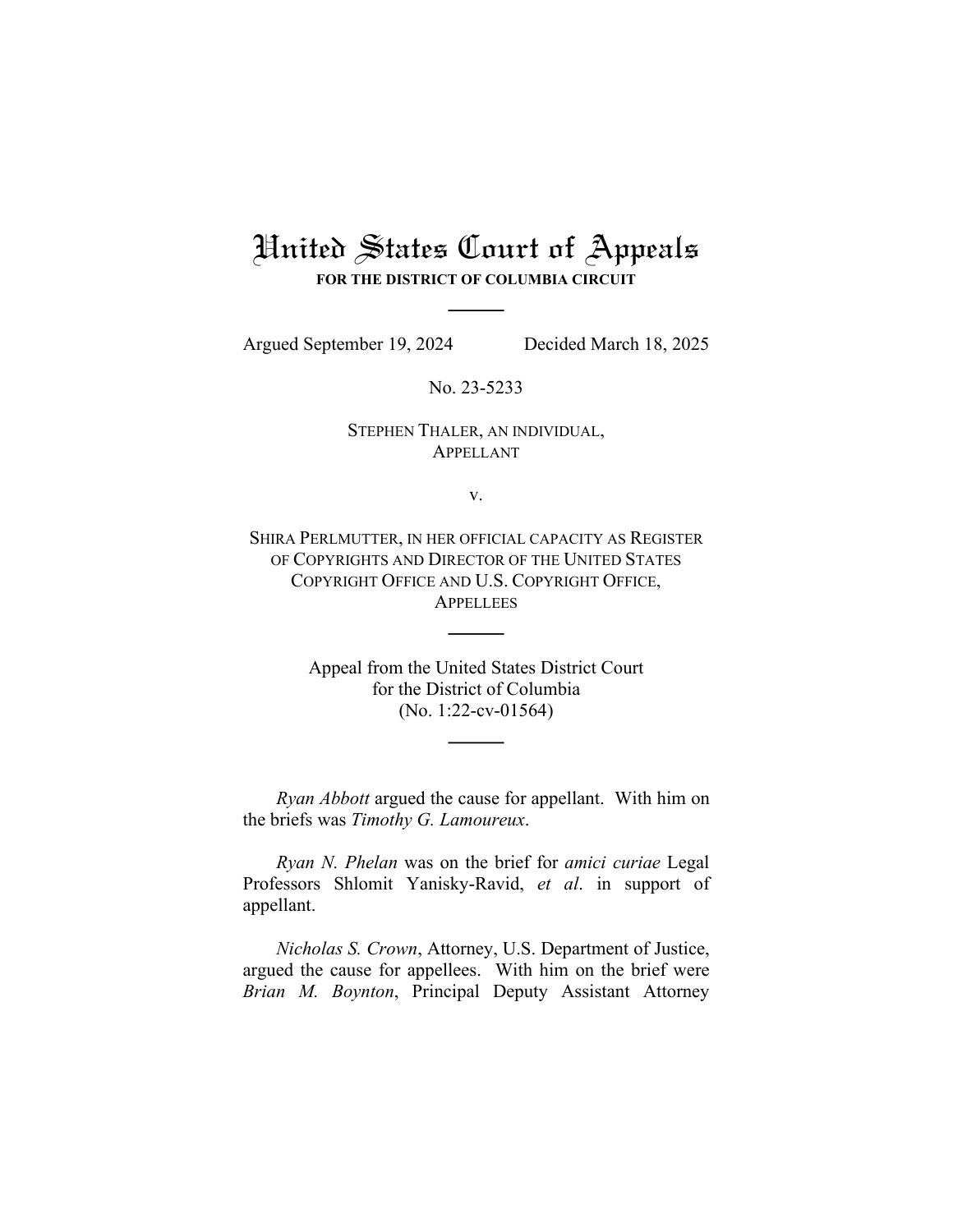
Opening page of the source document associated with “Thaler v. Perlmutter, No. 23-5233”. Original page layout retained; follow the source for the full text.
Image source: U.S. Court of Appeals for the D.C. Circuit; rights remain with the original rights holders.
Source · Thaler v. Perlmutter, No. 23-5233 ↗What changed
The appeals court required that a work initially be authored by a human. It did not decide constitutional questions or consider Thaler’s abandoned argument that he was the author.
Limited to this application naming a machine as sole author and to the questions the court expressly addressed.
Editorial research question
Editorial interpretation: records institutional boundaries of human authorship as context for artistic disputes; the applicant is not classified as an anti-AI activist.
This is an editorial interpretation or question, separate from factual statements.
Evidence & sources
The appeals court required that a work initially be authored by a human. It did not decide constitutional questions or consider Thaler’s abandoned argument that he was the author.
SRC-0138Pages 1–3: case number, date, issues, and conclusion affirming refusal to register.
U.S. Court of Appeals for the D.C. Circuit · EN · 2025-03-18
Case
Related documents
DOC-0126Thaler v. Perlmutter, No. 23-5233Cite this record
ANTI-AI ARCHIVE. “Court of appeals upholds refusal to register.” evt-0144. Include this page’s URL and your access date when citing.