

The archive provides Chinese and English research texts. Translations may be AI-assisted and may not yet have received independent human review. Consult the original-language sources alongside them.
This batch includes two events: one-click blocking and the pay-per-crawl private beta.
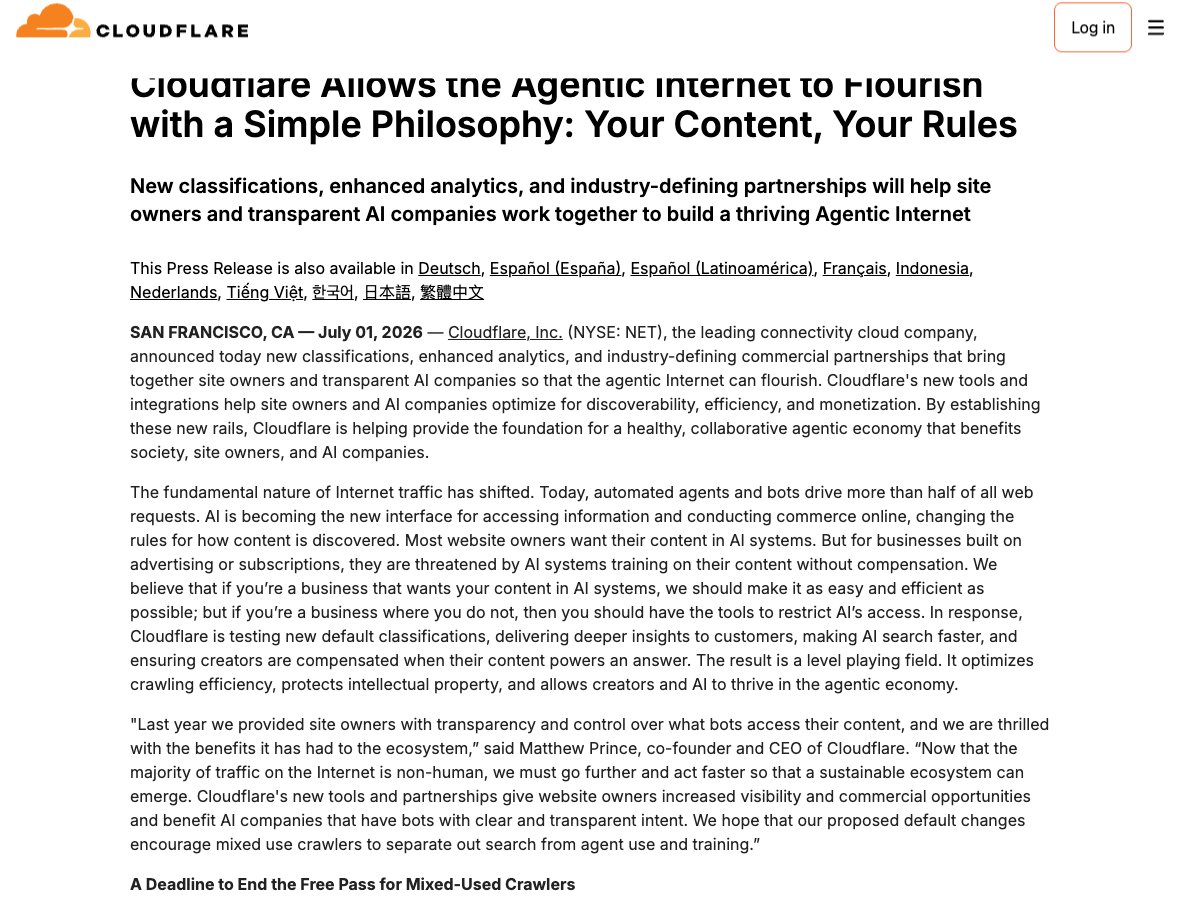 View full image ↗
Source-page excerpt from “Cloudflare Allows the Agentic Internet to Flourish With a Simple Philosophy: Your Content, Your Rules”, captured on 1 October 2026. The original-language layout is retained; this is not a snapshot taken on the event date.
Source: Cloudflare; rights remain with the original holders.
Source · Cloudflare Allows the Agentic Internet to Flourish With a Simple Philosophy: Your Content, Your Rules ↗The start date is the earliest event in this batch, not necessarily the beginning of the entire controversy. Case status is an editorial research status, not litigation status.
Case chronology
Cloudflare introduces a one-click AI-crawler blocking option
Cloudflare announces an AI Scrapers and Crawlers toggle for customers, including those on its free plan.
Cloudflare announces a private beta of Pay Per Crawl
Cloudflare describes its Pay Per Crawl private beta, allowing website operators to set access prices for selected AI crawlers.
Cloudflare announces planned crawler defaults separating search, agent use and training
Cloudflare announces planned 15 September defaults for specified customer groups: allow search but block training and agent access on advertising-supported pages, including mixed crawlers that do not separate purposes. Customers can change settings.
Research question
Compares refusal, payment, and platform dependence without classifying the vendor as part of an anti-AI camp.
Related documents
DOC-0407Cloudflare Allows the Agentic Internet to Flourish With a Simple Philosophy: Your Content, Your RulesSources
Cloudflare · EN · 2024-07-03
Cloudflare · EN · 2026-07-01
Related cases
Cite this record
ANTI-AI ARCHIVE. “Cloudflare / AI crawler access controls.” case-0002. Include this page’s URL and your access date when citing.