

Generative Art History examines how artists organise works through rules, code, materials and systems, and how works take form through execution, viewing, selection and circulation. It connects early computing and plotting, software art and creative coding, evolution and machine learning, and on-chain works and exhibition networks. AI art is one branch: authored algorithms, random processes, live simulation and learned models have different conditions of creation and execution. The main catalogue and right-hand timeline share 328 entries; 55 crypto work examples are compared within the generative-art guide, with their bilingual accounts, source imagery and official presentation links preserved. The archive begins with an intellectual context in 1943, without claiming that generative art originated then.
 View full image ↗
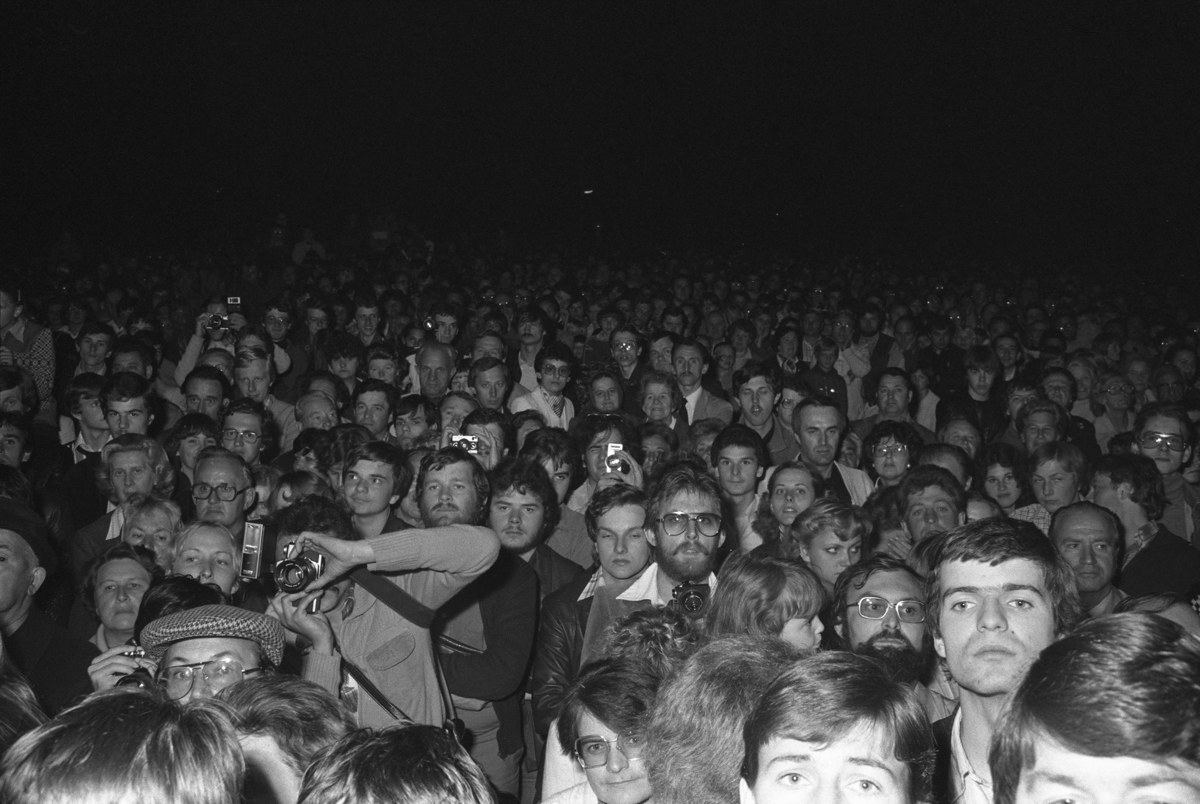
Audience at the first Linz Klangwolke in 1979, reproduced in Ars Electronica’s retrospective on its first festival.
Ars Electronica Archive
Source · Ars Electronica Festival ↗Why begin in 1943? ↗
The 1943 entry retains the research master’s neural-computation context for some later computational and AI practices. Generative art also has earlier histories of rules, combinatorics and material processes that this catalogue does not yet cover comprehensively. Intellectual contexts, artworks and institutional events are distinguished; technical release dates do not substitute for art history. Computer plotting, software art, evolutionary systems, machine learning and crypto art can be compared without assuming that all computation uses the same method, or that chronological adjacency establishes influence.
How can you use these 328 nodes? ↗
Select a period or entry on the right-hand timeline to locate its catalogue card. Click a card to preview it, then choose Read for the full account. The generative-art guide offers three groups of timeline entries and six thematic work discussions; crypto work examples do not occupy individual timeline stops. Detail pages lead with official project, presentation or executable-work links, followed by imagery, process, viewing guidance, historical interpretation and sources. A static preview represents one output or moment; dynamic, interactive and audiovisual works should also be viewed at their source. Entries preserve date precision, original titles, credits, source limits and translation-review status, distinguishing artwork dates, NFT releases and image retrieval dates. The guide to important papers since 2022 offers seven research paths and distinguishes initial submission, revision and product release.
Generative art: historical turning points and artistic practices ↗
This guide connects 46 main-timeline entries across early computing, software art and crypto generation, with 55 works and re-versioning cases discussed in six thematic groups. Ten crypto entries identify changes in generation, preservation, distribution, participation or exhibition; Art Blocks and Chromie Squiggle form a single platform milestone. Fidenza, Ringers, Memories of Qilin and Tezos/fxhash works retain images, bilingual accounts and original sources without each occupying a timeline stop. Selection is an editorial judgment based on available evidence, not a ranking by price, popularity or fame; unproven priority claims are not presented as fact.
Important papers since 2022: methods and cultural questions ↗
This guide connects 52 research-related entries: 33 papers from 2022–2025 added in this pass, five existing achievements enriched with paper and version sources, and previously catalogued research. Seven paths cover architectures and sampling, editing, 3D, video, sound, evaluation and cultural inquiry. Selection prioritises distinct methodological contributions, production and viewing conditions, and explanatory value for evaluation, data and artists’ rights, rather than companies or product popularity. Initial preprint submission supplies the new timeline date; conference versions, revisions and releases remain separate. Figures retain source, credit and version context, with demonstrations linked to author projects. This pass reads abstracts, submission records and specified figure pages without reproducing experiments. It does not exhaust 2022–2026 scholarship; the longer-term significance of recent 2026 candidates remains under review.
An archive research guide. Chinese and English text may include AI-assisted translation and awaits independent human review. Check historical claims against each node’s original sources.
Continue reading
Why begin in 1943? ↗How can you use these 328 nodes? ↗Generative art: historical turning points and artistic practices ↗Important papers since 2022: methods and cultural questions ↗Return to the art-history catalogue ↗Cite this page
ANTI-AI ARCHIVE. Generative Art History: historical threads, 1943–2026. https://salondesrefuses.cn/en/art-history/guides/overview
Include your access date. For historical claims, also cite the relevant node and original source.