

Introduction
Camata turns footage of robots in the Atacama Desert into an evolving installation. The institution describes machine learning as participating in real-time editing, sound and environmental response: AI organises the temporal structure of viewing rather than only producing individual images.
Why this entry remains in the timeline
Shows how AI enters editing and exhibition temporality, connecting robotic performance, site conditions and institutional presentation without treating institutional descriptions as a code audit.
Archive editorial judgment based on the cited sources; this does not establish global priority.
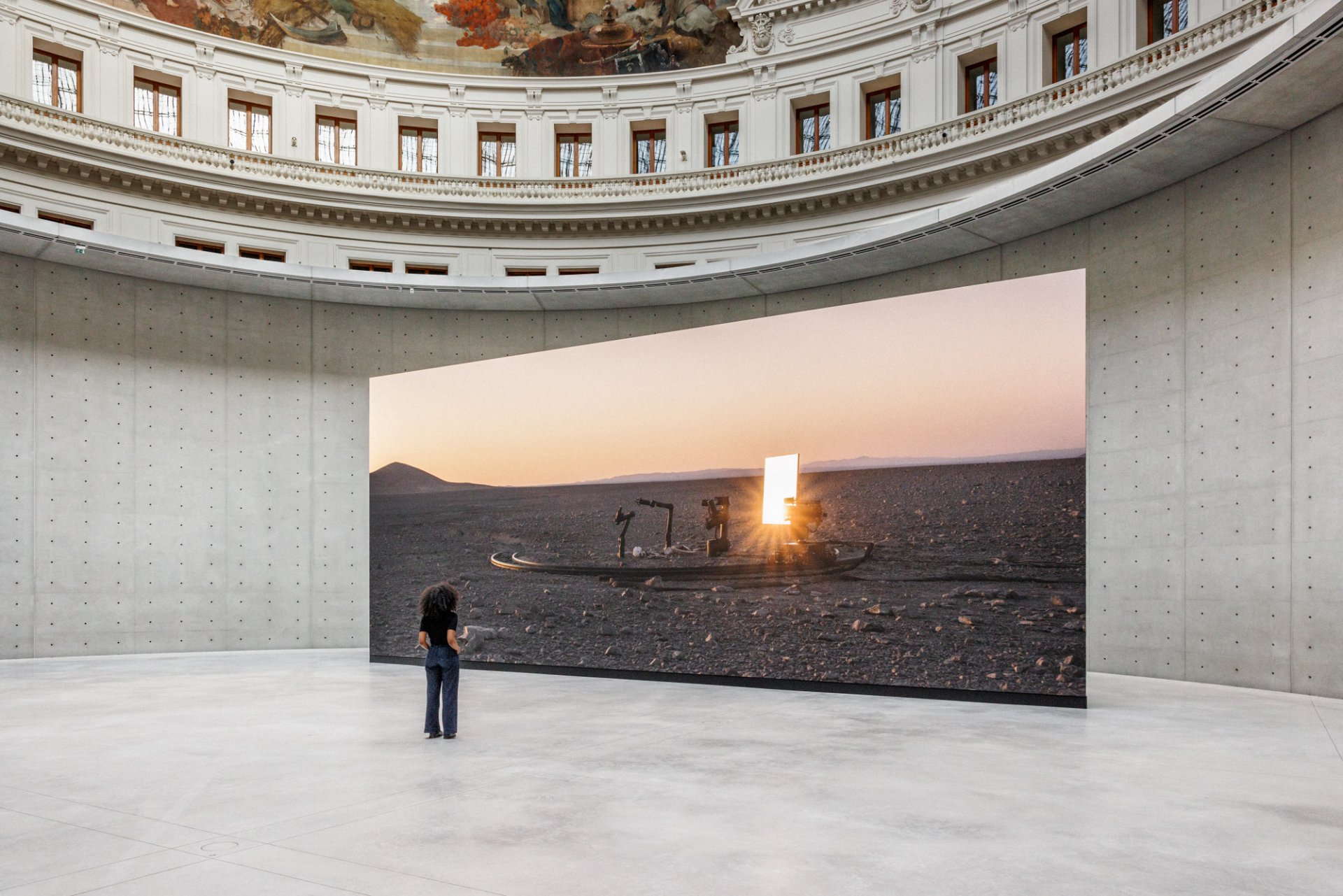 View full image ↗
Camata (work dated 2024), installation view at the Bourse de Commerce, Paris, in 2026. This records a later presentation, not the 2024 Venice installation.
Photograph: Florent Michel / 11h45; source: Pinault Collection · Artwork and photographic rights remain with their holders; the source link does not imply an open licence.
Source · Pinault Collection: Pierre Huyghe ↗RESEARCH ACCOUNT
A film sequenced in relation to its exhibition environment
ANTI-AI ARCHIVE · Revised 2026-10-10
Recorded material and a film in operation
Pinault dates Camata to 2024. Robots move around human remains in the Atacama Desert, while editing and sound continue to change during presentation. The robots depicted, the recorded location footage and the computation organising its sequence have different roles.
Section sources: Pinault’s account of Camata in Paris
How the institution and artist describe the system
In the interview dated 20 March 2026, Huyghe describes phases rather than a fixed beginning and ending, and discusses temperature, humidity and the presence of people. These are the artist’s claims about operation, not independent confirmation of sensor data flows, training methods or the degree of autonomy.
Section sources: Interview with Pierre Huyghe, 20 March 2026
Different settings in Venice and Paris
The official Liminal archive records the Venice exhibition from 17 March to 24 November 2024. The later Paris presentation occupies the Bourse de Commerce Rotunda, whose light and space the artist distinguishes from Venice. The photograph here records Paris in 2026, not the 2024 Venice presentation.
Section sources: Pinault archive of Liminal in Venice · Interview with Pierre Huyghe, 20 March 2026 · Pinault’s account of Camata in Paris
AI as a way of organising time
Editorial interpretation: the work shifts attention from whether a machine can make an image to who determines sequence and duration. Site conditions, artistic decisions and learning systems become objects of analysis together; this implies neither consciousness nor full public disclosure of how the installation works.
Section sources: Pinault’s account of Camata in Paris · Interview with Pierre Huyghe, 20 March 2026
Sources for this account
Work date, 2026 exhibition dates, real-time sequencing account and installation photograph.
Answers on Camata, learning machines, environmental sensing and the Venice/Paris settings.
Punta della Dogana, 17 March–24 November 2024; curator Anne Stenne.
A complete operating cycle, code, models, training data, sensor records and licence agreements have not been examined. The filming context relies on institutional and artist accounts. Technical differences between Venice and Paris remain unresolved; later reports do not independently prove every feature of the 2024 version. The account and translation are AI-assisted, pending independent human review. Section references identify evidence without claiming independent verification of every historical statement.
Continue with a comparative question
Compare participation and computational systems across periods without assuming identical algorithms.
Dates & version record
Date displayed for this node: 2024 · Historical date recorded for the source: 2024
The work is dated 2024; the Venice Liminal exhibition ran from 17 March to 24 November 2024. The Paris presentation, interview dated 20 March 2026 and installation photograph are later materials, not the work’s original date. Research material and this node were accessioned on 10 October 2026.
These dates refer to the historical event or recorded version, not this page’s publication date. The original date precision and unresolved questions are retained.
Original sources & further reading
These links lead to the cited paper, article, institution or conference page. External texts retain their source languages.
Camata
https://www.pinaultcollection.com/en/boursedecommerce/pierre-huyghe-1
Current cited URL
What interests me is the indeterminate space in which things appear without being intelligible — Pierre Huyghe
https://www.pinaultcollection.com/en/boursedecommerce/what-interests-me-indeterminate-space-which-things-appear-without-being-intelligible-pierre-huyghe
URL cited in a research master or supplement; it may have moved or expired
Pierre Huyghe — Liminal
https://lesoeuvres.pinaultcollection.com/en/exhibition/pierre-huyghe-liminal
URL cited in a research master or supplement; it may have moved or expired
Pinault’s work account, artist interview and Venice exhibition archive were read. Related research sources: src-1084 through src-1091. Models, training material, sensor implementation and permissions have not been independently audited.
Provenance, translation & verification
Timeline entry #276 · Real-time film installation
Research materials & supplement references · 3
Historical accessions, 10 October 2026 · Work date, 2026 exhibition dates, real-time sequencing account and installation photograph. · 002
Date as recorded: 2024
Pinault’s account of Camata in Paris ↗
Pierre Huyghe
Historical accessions, 10 October 2026 · Answers on Camata, learning machines, environmental sensing and the Venice/Paris settings. · 360-2
Date as recorded: 2024
Interview with Pierre Huyghe, 20 March 2026 ↗
What interests me is the indeterminate space in which things appear without being intelligible — Pierre Huyghe
Historical accessions, 10 October 2026 · Punta della Dogana, 17 March–24 November 2024; curator Anne Stenne. · 360-3
Date as recorded: 2024
Pinault archive of Liminal in Venice ↗
Pierre Huyghe — Liminal
Archive account based on the listed research materials, not a full translation of the linked work. AI-assisted translation; independent human review pending.
Official material was read within the stated scope; see the source note for reading limits and outstanding checks.
Cite this node
ANTI-AI ARCHIVE. Pierre Huyghe: Camata. Art-history node #276. https://salondesrefuses.cn/en/art-history/360
For specific historical claims, also cite the original sources above and include your access date. This account is not a full translation of the linked work.
Adjacent nodes follow chronological order; adjacency does not establish direct influence or causation.