

Introduction
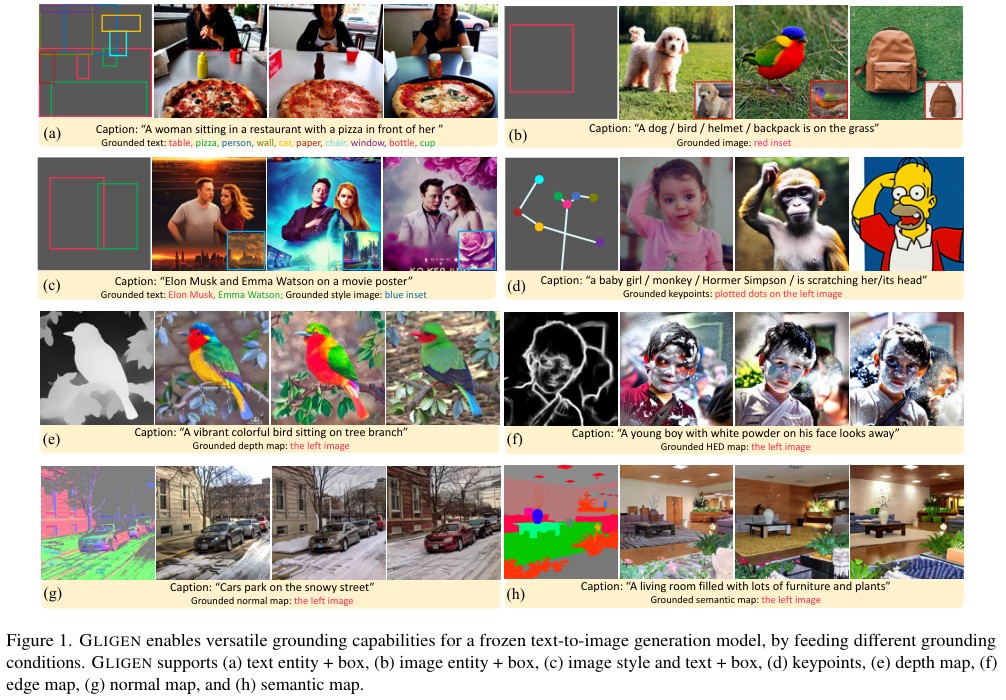
GLIGEN adds gated layers to inject grounding conditions into a pretrained diffusion model, using text and bounding boxes to control objects and layout beyond a prompt alone.
 View full image ↗
Figure 1: generation with boxes, keypoints and other spatial conditions. Source: v2; the image version is distinct from the initial submission date.
Li, Yuheng; Liu, Haotian; Wu, Qingyang; Mu, Fangzhou; Yang, Jianwei; Gao, Jianfeng; Li, Chunyuan; Lee, Yong Jae · original paper / arXiv · Rights in the paper and depicted works remain with their holders. Research quotation does not establish an open licence; republication rights await independent review.
Source · GLIGEN: Open-Set Grounded Text-to-Image Generation ↗RESEARCH ACCOUNT
GLIGEN adds gated layers to inject grounding conditions into a pretrained diffusion model, using text and bounding boxes to control objects and layout beyond a prompt alone.
ANTI-AI ARCHIVE · Revised 2026-10-03
What the paper investigates
The original model weights stay frozen while new trainable layers receive grounding information through gates. Captions and bounding boxes provide conditions. Experiments test how this control generalises to unfamiliar concepts and spatial arrangements.
Section sources: GLIGEN: Open-Set Grounded Text-to-Image Generation
Its place in generative-art history
Editorial interpretation: bounding boxes make “where” an explicit compositional input. Comparison with ControlNet should distinguish conditioning types and control mechanisms, rather than presenting all controllable generation as a single interchangeable tool.
Section sources: GLIGEN: Open-Set Grounded Text-to-Image Generation
Reading limits and versions
Successful grounding experiments do not guarantee exact execution of every object and relationship in a complex scene.
Section sources: GLIGEN: Open-Set Grounded Text-to-Image Generation
Sources for this account
Read the arXiv abstract, authors and version history, plus the selected figure/page on PDF page 1; proofs and full experiments were not independently audited.
Read the arXiv abstract, authors and version history, plus the selected figure/page on PDF page 1; proofs and full experiments were not independently audited. The account and translation are AI-assisted, pending independent human review. Section references identify evidence without claiming independent verification of every historical statement.
Continue with a comparative question
GLIGEN: compare methods, control or evaluation conditions with Prompt-to-Prompt.
GLIGEN: compare methods, control or evaluation conditions with Spatial control of generation.
GLIGEN: compare methods, control or evaluation conditions with T2I-Adapter.
Dates & version record
Date displayed for this node: 2023-01-17 · Historical date recorded for the source: 2023-01-17
The timeline uses the initial arXiv submission, distinct from conference publication, model release and the archive addition on 3 October 2026. The account and image refer to v2; its date is recorded in the source history.
These dates refer to the historical event or recorded version, not this page’s publication date. The original date precision and unresolved questions are retained.
Original sources & further reading
These links lead to the cited paper, article, institution or conference page. External texts retain their source languages.
GLIGEN: Open-Set Grounded Text-to-Image Generation
https://arxiv.org/abs/2301.07093
Current cited URL
Read the arXiv abstract, authors and version history, plus the selected figure/page on PDF page 1; proofs and full experiments were not independently audited.
Provenance, translation & verification
Archive node #211 · Initial research-paper submission; methods, evaluation and production conditions
Research materials & supplement references · 1
Recent research papers: additions and reconciled sources since 2022 · Read the arXiv abstract, authors and version history, plus the selected figure/page on PDF page 1; proofs and full experiments were not independently audited. · 011
Date as recorded: 2023-01-17
GLIGEN: Open-Set Grounded Text-to-Image Generation ↗
GLIGEN: Open-Set Grounded Text-to-Image Generation
Archive account based on the listed research materials, not a full translation of the linked work. AI-assisted translation; independent human review pending.
Official material was read within the stated scope; see the source note for reading limits and outstanding checks.
Cite this node
ANTI-AI ARCHIVE. GLIGEN: Open-Set Grounded Text-to-Image Generation. Art-history node #211. https://salondesrefuses.cn/en/art-history/334
For specific historical claims, also cite the original sources above and include your access date. This account is not a full translation of the linked work.
Adjacent nodes follow chronological order; adjacency does not establish direct influence or causation.