

Introduction
The original LoRA paper appears in 2021, reducing fine-tuning costs by freezing a main model and training low-rank update matrices. During 2022–2023, the Stable Diffusion community adapts this into small exchangeable modules for styles, characters, clothing, poses and likenesses. Style and identity can circulate as lightweight model files as well as names in prompts.
 View full image ↗
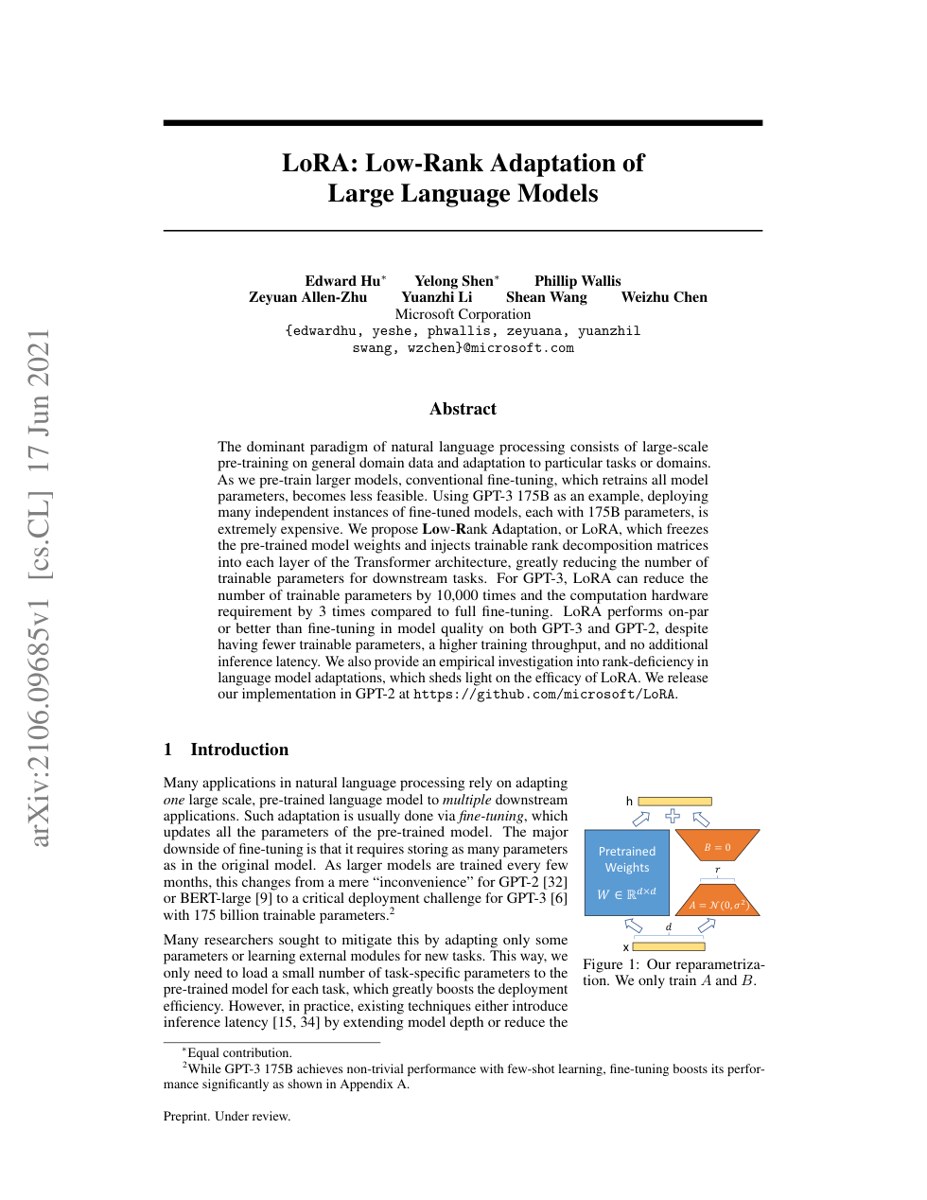
Page 1 of the linked paper PDF, preserving its original figures and language. The source file identifies the edition; later revision or reprint dates do not replace the node’s historical date.
Edward Hu et al. (LoRA); Stable Diffusion open-source community · original paper · Image rights remain with their respective holders; no open licence is asserted
Source · LoRA: Low-Rank Adaptation of Large Language Models + diffusion community adoption ↗RESEARCH ACCOUNT
Learning compact adjustments while keeping base weights frozen.
ANTI-AI ARCHIVE · Revised 2026-10-02
Method and contribution
The original LoRA paper concerns language-model adaptation. It freezes pretrained parameters and introduces trainable low-rank matrices, reducing the parameters and storage required for task-specific tuning. This predates widespread diffusion-community adoption and should not be rewritten as an already established art-style marketplace in 2021.
Section sources: LoRA: Low-Rank Adaptation of Large Language Models + diffusion community adoption
Art-historical interpretation
Later visual use allows custom differences to circulate as smaller files. The historical questions concern relations between base models and additional training: who supplies foundational capability, selects personalisation material, names a style and distributes it.
Section sources: LoRA: Low-Rank Adaptation of Large Language Models + diffusion community adoption
Sources for this account
Author or conference abstract and version record read; full proofs and experiments were not independently reproduced.
This account expands the archive within the cited scope. Historical interpretation is not presented as the original author’s statement or as a proven causal influence. The account and translation are AI-assisted, pending independent human review. Section references identify evidence without claiming independent verification of every historical statement.
Continue with a comparative question
Compare the methods, forms of control or presentation contexts of this entry and Civitai model-sharing platform.
Compare the methods, forms of control or presentation contexts of this entry and AnimateDiff: Animate Your Personalized Text-to-Image Diffusion Models without Specific Tuning.
Dates & version record
Date displayed for this node: 2022–2023 · Historical date recorded for the source: 2022–2023
These dates refer to the historical event or recorded version, not this page’s publication date. The original date precision and unresolved questions are retained.
Original sources & further reading
These links lead to the cited paper, article, institution or conference page. External texts retain their source languages.
LoRA: Low-Rank Adaptation of Large Language Models + diffusion community adoption
https://arxiv.org/abs/2106.09685
Current cited URL
Provenance, translation & verification
Timeline entry #136 · Historical node
Research materials & supplement references · 2
AI Art Genealogy Research Master · p. 27 · 092
Date as recorded: 2022–2023
LoRA: Low-Rank Adaptation of Large Language Models + diffusion community adoption ↗
LoRA: Low-Rank Adaptation of Large Language Models + diffusion community adoption
GenAI Visual Release Chronology Research Master · p. 11 · R051
Date as recorded: 2022–2023
LoRA: Low-Rank Adaptation of Large Language Models + diffusion community adoption ↗
LoRA Enters the Stable Diffusion Ecosystem
Archive account based on the listed research materials, not a full translation of the linked work. AI-assisted translation; independent human review pending.
The master’s research claims and dates await independent verification.
Cite this node
ANTI-AI ARCHIVE. LoRA: Low-Rank Adaptation of Large Language Models + diffusion community adoption. Art-history node #136. https://salondesrefuses.cn/en/art-history/092
For specific historical claims, also cite the original sources above and include your access date. This account is not a full translation of the linked work.
Adjacent nodes follow chronological order; adjacency does not establish direct influence or causation.