

Introduction
Parti explores an autoregressive approach alongside diffusion, generating image tokens as another kind of language. It shows that the expansion of text-to-image generation in 2022 did not follow a single technical route. Token-based modelling remains a parallel way to organize the relation between descriptions and visual outputs.
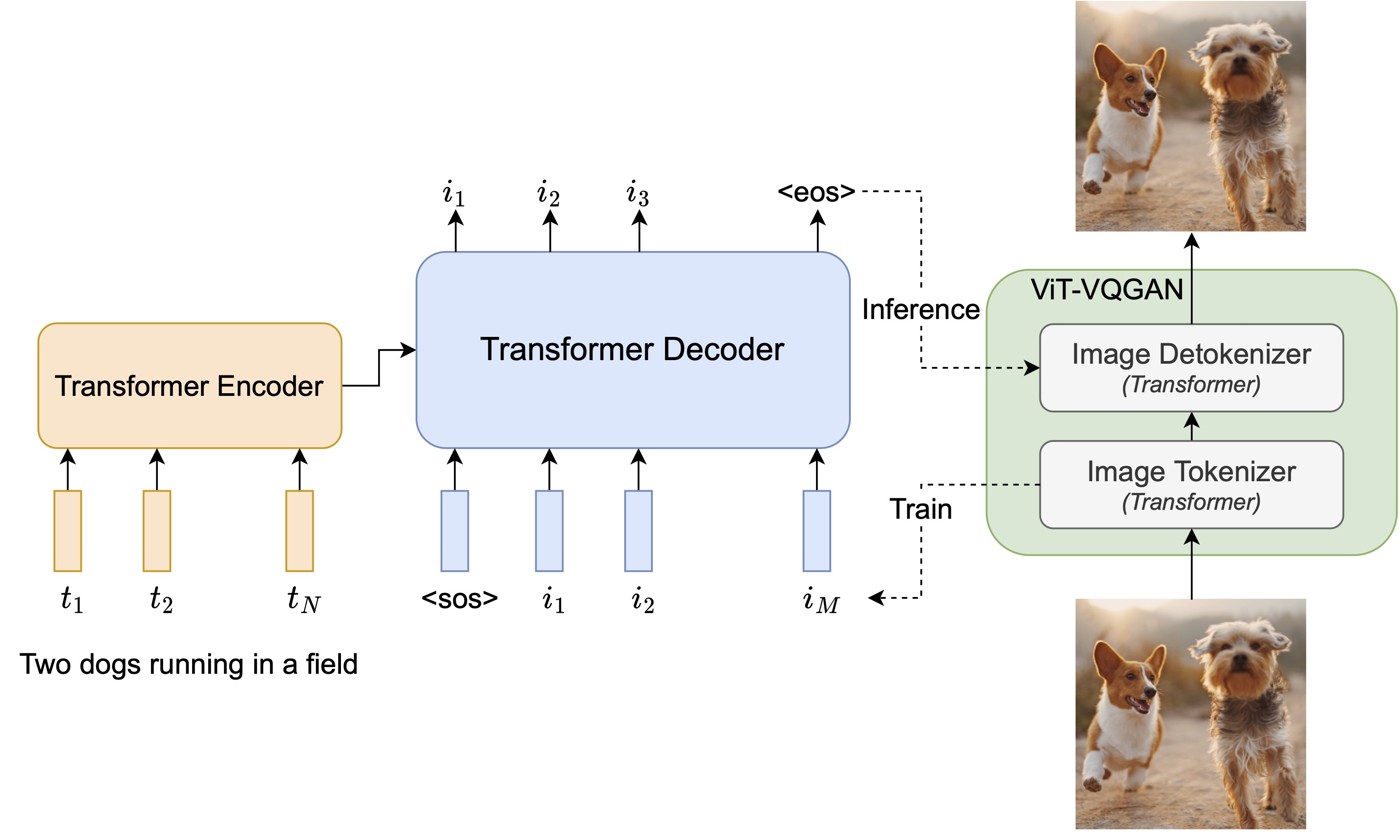 View full image ↗
Architecture overview from Parti’s official research page, showing text encoding, image tokens and autoregressive decoding. Original 2022 project figure.
Parti research team / Google Research · Rights in the original image and document remain with their respective holders
Source · Parti: Pathways Autoregressive Text-to-Image Model ↗RESEARCH ACCOUNT
Treating an image as a sequence of generated tokens.
ANTI-AI ARCHIVE · Revised 2026-10-03
Method and contribution
Parti explores autoregressive text-to-image generation: visual content is encoded into discrete representations and image tokens are predicted sequentially under textual conditioning. The project compares model scales and complex prompts and includes failure examples. Its difference from contemporary diffusion approaches shows that image generation in 2022 did not follow a single technical route.
Section sources: Scaling Autoregressive Models for Content-Rich Text-to-Image Generation
Art-historical interpretation
For artistic practice, the question is how complex language organises objects, relationships and detail. Successful demonstrations do not establish reliability for every prompt; failures also document the boundaries of a model’s visual imagination. Comparing Parti and Imagen concerns how descriptions are handled as well as how realistic an output looks.
Section sources: Scaling Autoregressive Models for Content-Rich Text-to-Image Generation
Research paper and release dates
First submitted on 22 June 2022, the paper treats text-to-image synthesis as sequence-to-sequence modelling with ViT-VQGAN image tokens. It studies model scaling and analyses capabilities and limitations with PartiPrompts. The paper enriches the existing Parti entry without duplicating it.
Section sources: Scaling Autoregressive Models for Content-Rich Text-to-Image Generation
Sources for this account
Author or conference abstract and version record read; full proofs and experiments were not independently reproduced.
Read the abstract, authors and arXiv submission record, not a full-paper review.
This account expands the archive within the cited scope. Historical interpretation is not presented as the original author’s statement or as a proven causal influence. The account and translation are AI-assisted, pending independent human review. Section references identify evidence without claiming independent verification of every historical statement.
Continue with a comparative question
Compare the methods, forms of control or presentation contexts of this entry and Photorealistic Text-to-Image Diffusion Models with Deep Language Understanding.
Compare the methods, forms of control or presentation contexts of this entry and Latent Diffusion Models.
Dates & version record
Date displayed for this node: 2022-06 · Historical date recorded for the source: 2022-06
These dates refer to the historical event or recorded version, not this page’s publication date. The original date precision and unresolved questions are retained.
Original sources & further reading
These links lead to the cited paper, article, institution or conference page. External texts retain their source languages.
Scaling Autoregressive Models for Content-Rich Text-to-Image Generation
https://sites.research.google/parti/
Current cited URL
Scaling Autoregressive Models for Content-Rich Text-to-Image Generation
https://arxiv.org/abs/2206.10789
URL cited in a research master or supplement; it may have moved or expired
Provenance, translation & verification
Timeline entry #146 · Historical node
Research materials & supplement references · 4
AI Art Genealogy Research Master · p. 25 · 084
Date as recorded: 2022-06
Scaling Autoregressive Models for Content-Rich Text-to-Image Generation ↗
Scaling Autoregressive Models for Content-Rich Text-to-Image Generation
GenAI Visual Release Chronology Research Master · p. 6 · R023
Date as recorded: 2022-06
Scaling Autoregressive Models for Content-Rich Text-to-Image Generation ↗
Google Parti
GenAI Visual Release Chronology Research Master · p. 6 · R025
Date as recorded: 2022-06
Scaling Autoregressive Models for Content-Rich Text-to-Image Generation ↗
Parti
Recent research papers: additions and reconciled sources since 2022 · Read the abstract, authors and arXiv submission record, not a full-paper review. · 035
Date as recorded: 2022-06-22
Scaling Autoregressive Models for Content-Rich Text-to-Image Generation ↗
Scaling Autoregressive Models for Content-Rich Text-to-Image Generation
Archive account based on the listed research materials, not a full translation of the linked work. AI-assisted translation; independent human review pending.
The master’s research claims and dates await independent verification.
Cite this node
ANTI-AI ARCHIVE. Scaling Autoregressive Models for Content-Rich Text-to-Image Generation. Art-history node #146. https://salondesrefuses.cn/en/art-history/084
For specific historical claims, also cite the original sources above and include your access date. This account is not a full translation of the linked work.
Adjacent nodes follow chronological order; adjacency does not establish direct influence or causation.