

Introduction
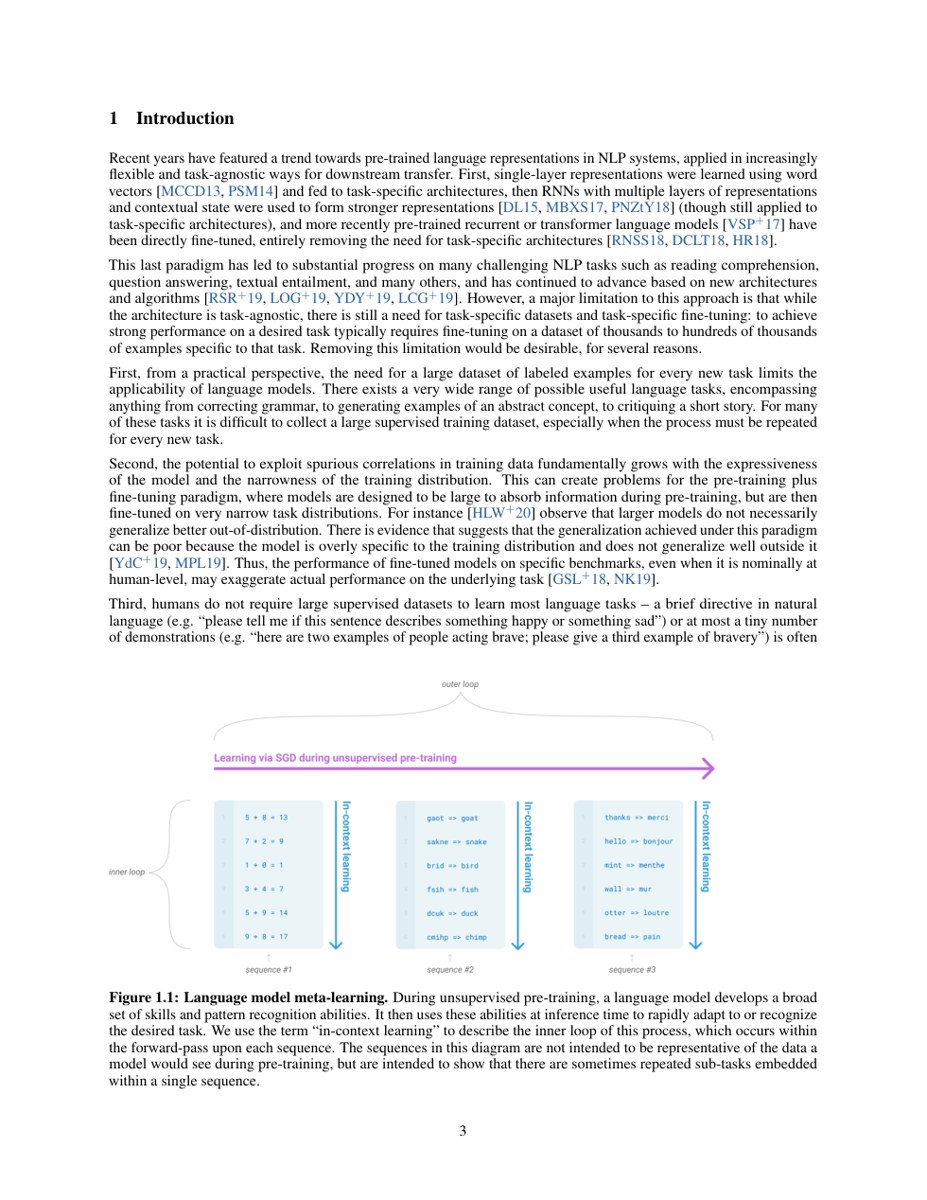
GPT-3 is not an image model, but helps elevate the prompt from ordinary input text into an interface for specifying many different tasks. The master connects later systems such as DALL·E 3, conversational image generation and language-driven editing to this broader change: natural language becomes a control layer for models.
 View full image ↗
Page 3 of the linked paper PDF, preserving its original figures and language. The source file identifies the edition; later revision or reprint dates do not replace the node’s historical date.
Tom B. Brown et al.; OpenAI · original paper · Image rights remain with their respective holders; no open licence is asserted
Source · Language Models are Few-Shot Learners ↗RESEARCH ACCOUNT
Changing a language model’s task through prompts and a few examples.
ANTI-AI ARCHIVE · Revised 2026-10-02
Method and contribution
The GPT-3 paper investigates few-shot use after large-scale pretraining: instructions and examples are supplied as text without updating weights separately for each task. Experiments cover translation, question answering and other language tasks. The object is a language model, not an already available general image generator in 2020.
Section sources: Language Models are Few-Shot Learners
Art-historical interpretation
For generative practice, the research makes the organisation of input a significant operation. Prompts, examples and selection influence results without providing item-by-item control over them. Connections to visual systems must be established through particular models or workflows.
Section sources: Language Models are Few-Shot Learners
Sources for this account
Author or conference abstract and version record read; full proofs and experiments were not independently reproduced.
This account expands the archive within the cited scope. Historical interpretation is not presented as the original author’s statement or as a proven causal influence. The account and translation are AI-assisted, pending independent human review. Section references identify evidence without claiming independent verification of every historical statement.
Continue with a comparative question
Compare the methods, forms of control or presentation contexts of this entry and Zero-Shot Text-to-Image Generation.
Compare the methods, forms of control or presentation contexts of this entry and InstructPix2Pix: Learning to Follow Image Editing Instructions.
Dates & version record
Date displayed for this node: 2020-05 · Historical date recorded for the source: 2020-05
These dates refer to the historical event or recorded version, not this page’s publication date. The original date precision and unresolved questions are retained.
Original sources & further reading
These links lead to the cited paper, article, institution or conference page. External texts retain their source languages.
Language Models are Few-Shot Learners
https://arxiv.org/abs/2005.14165
Current cited URL
Provenance, translation & verification
Timeline entry #113 · Historical node
Research materials & supplement references · 1
AI Art Genealogy Research Master · p. 22 · 072
Date as recorded: 2020-05
Language Models are Few-Shot Learners ↗
Language Models are Few-Shot Learners
Archive account based on the listed research materials, not a full translation of the linked work. AI-assisted translation; independent human review pending.
The master’s research claims and dates await independent verification.
Cite this node
ANTI-AI ARCHIVE. Language Models are Few-Shot Learners. Art-history node #113. https://salondesrefuses.cn/en/art-history/072
For specific historical claims, also cite the original sources above and include your access date. This account is not a full translation of the linked work.
Adjacent nodes follow chronological order; adjacency does not establish direct influence or causation.