

Introduction
VQGAN combines convolutional encoding of local visual structure with a Transformer's capacity for broader modelling, producing high-quality discrete visual representations. It directly influences early VQGAN+CLIP art practices and contributes technical experience to later generative models operating within compressed latent spaces.
 View full image ↗
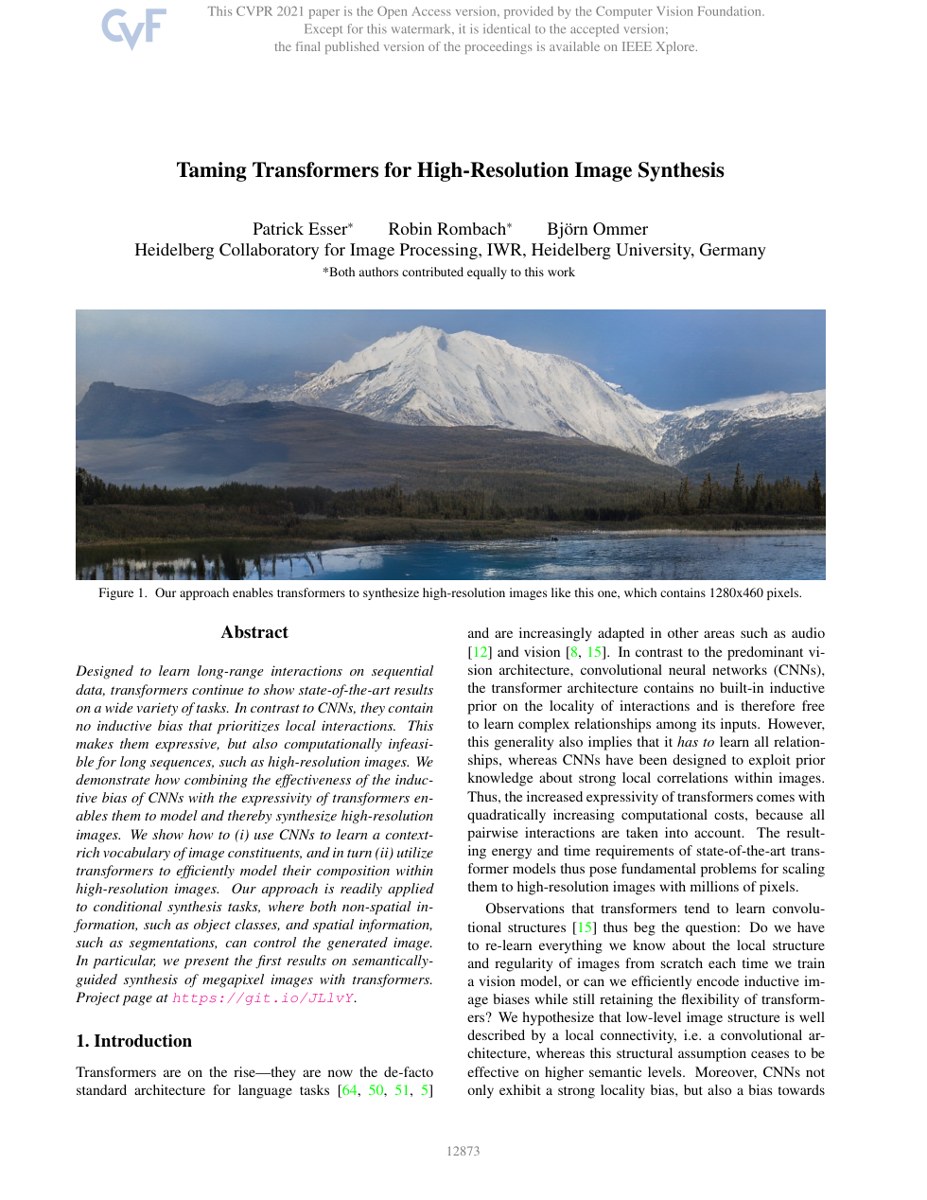
Page 1 of the linked paper PDF, preserving its original figures and language. The source file identifies the edition; later revision or reprint dates do not replace the node’s historical date.
Esser, Rombach & Ommer · original paper · Image rights remain with their respective holders; no open licence is asserted
Source · Taming Transformers / VQGAN ↗RESEARCH ACCOUNT
Combining a vocabulary of image parts with long-range composition.
ANTI-AI ARCHIVE · Revised 2026-10-02
Method and contribution
Taming Transformers uses convolutional networks to learn compressed image constituents and a transformer to model their composition. This avoids directly modelling an extremely long sequence of high-resolution pixels. Classes and spatial segmentations can condition generation. The conference publication and the 2020 preprint belong to separate stages of the record.
Section sources: Taming Transformers / VQGAN
Art-historical interpretation
Its significance includes subsequent recombination: VQGAN+CLIP workflows connect this visual representation to text–image similarity. The paper and the community workflow deserve separate records, because the former does not already contain all the latter’s procedures or aesthetics.
Section sources: Taming Transformers / VQGAN
Sources for this account
Author or conference abstract and version record read; full proofs and experiments were not independently reproduced.
This account expands the archive within the cited scope. Historical interpretation is not presented as the original author’s statement or as a proven causal influence. The account and translation are AI-assisted, pending independent human review. Section references identify evidence without claiming independent verification of every historical statement.
Continue with a comparative question
Compare the methods, forms of control or presentation contexts of this entry and Neural Discrete Representation Learning.
Compare the methods, forms of control or presentation contexts of this entry and VQGAN+CLIP community workflow.
Dates & version record
Date displayed for this node: 2020–2021 · Historical date recorded for the source: 2020–2021
These dates refer to the historical event or recorded version, not this page’s publication date. The original date precision and unresolved questions are retained.
Original sources & further reading
These links lead to the cited paper, article, institution or conference page. External texts retain their source languages.
Taming Transformers / VQGAN
https://openaccess.thecvf.com/content/CVPR2021/html/Esser_Taming_Transformers_for_High-Resolution_Image_Synthesis_CVPR_2021_paper.html
Current cited URL
Provenance, translation & verification
Timeline entry #111 · Historical node
Research materials & supplement references · 1
AI Art Genealogy Research Master · p. 21 · 070
Date as recorded: 2020–2021
Taming Transformers / VQGAN ↗
Taming Transformers / VQGAN
Archive account based on the listed research materials, not a full translation of the linked work. AI-assisted translation; independent human review pending.
The master’s research claims and dates await independent verification.
Cite this node
ANTI-AI ARCHIVE. Taming Transformers / VQGAN. Art-history node #111. https://salondesrefuses.cn/en/art-history/070
For specific historical claims, also cite the original sources above and include your access date. This account is not a full translation of the linked work.
Adjacent nodes follow chronological order; adjacency does not establish direct influence or causation.