

Introduction
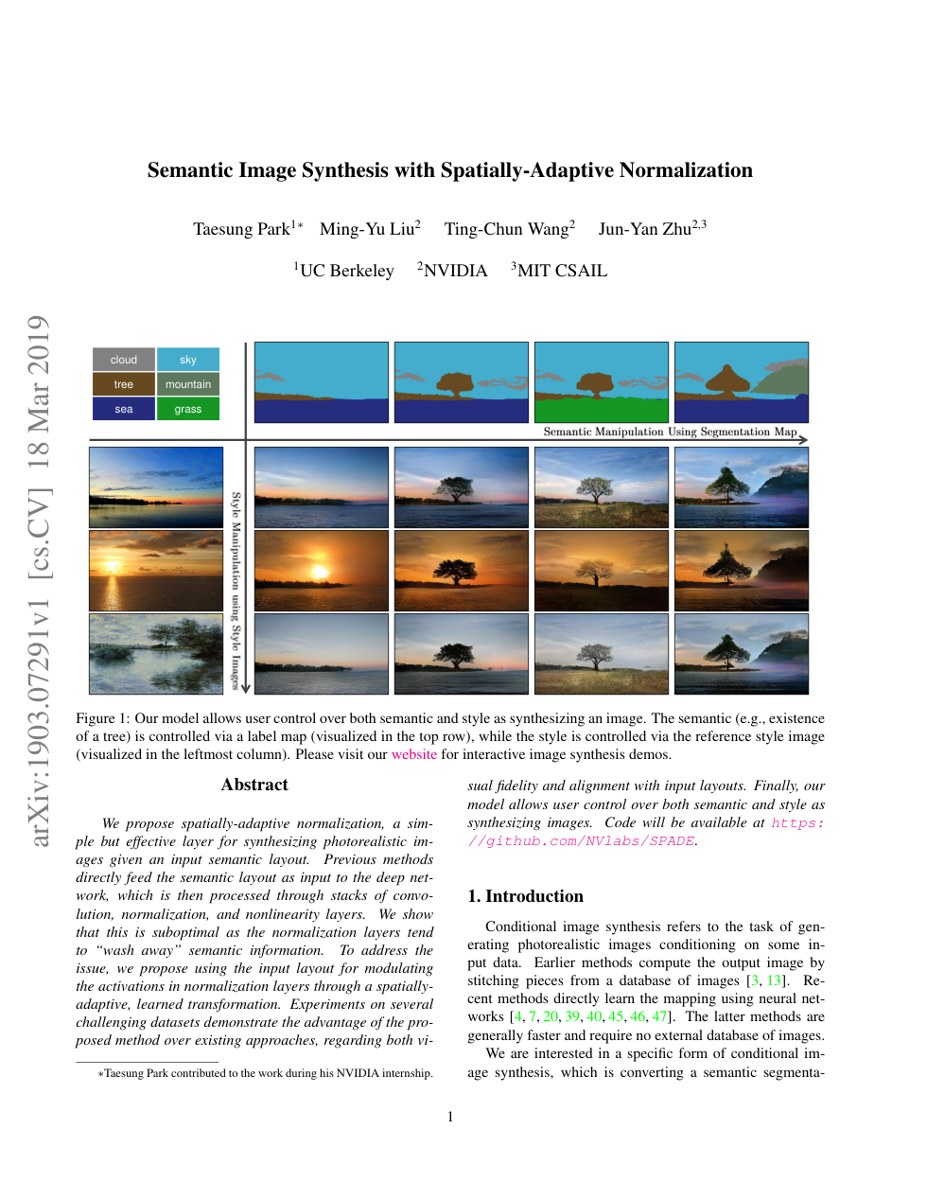
SPADE converts semantic layouts into high-quality images, while NVIDIA's GauGAN demonstration presents its potential as an interactive creative tool. It anticipates later interest in layout control, ControlNet and design-oriented generation, where a user specifies spatial organisation rather than relying on text alone.
 View full image ↗
Page 1 of the linked paper PDF, preserving its original figures and language. The source file identifies the edition; later revision or reprint dates do not replace the node’s historical date.
Taesung Park; Ming-Yu Liu; Ting-Chun Wang; Jun-Yan Zhu / NVIDIA · original paper · Image rights remain with their respective holders; no open licence is asserted
Source · SPADE paper / GauGAN demo ↗RESEARCH ACCOUNT
Keeping spatial layout active throughout synthesis.
ANTI-AI ARCHIVE · Revised 2026-10-02
Method and contribution
SPADE addresses the loss of semantic-layout information in ordinary normalisation layers by using the layout to modulate features at different spatial positions. A user can specify regions such as sky, road or building while the model supplies visual detail. The paper describes conditional synthesis; the GauGAN demonstration translates that mechanism into a more direct drawing interface.
Section sources: SPADE paper / GauGAN demo
Art-historical interpretation
Control operates through spatial categories rather than the placement of every pixel. The connection between sketching, segmentation and synthesis distinguishes compositional labour from automated surface detail. How faithfully a layout is realised remains dependent on the model and its training distribution.
Section sources: SPADE paper / GauGAN demo
Sources for this account
Author or conference abstract and version record read; full proofs and experiments were not independently reproduced.
This account expands the archive within the cited scope. Historical interpretation is not presented as the original author’s statement or as a proven causal influence. The account and translation are AI-assisted, pending independent human review. Section references identify evidence without claiming independent verification of every historical statement.
Continue with a comparative question
Compare the methods, forms of control or presentation contexts of this entry and pix2pix.
Compare the methods, forms of control or presentation contexts of this entry and Adding Conditional Control to Text-to-Image Diffusion Models.
Dates & version record
Date displayed for this node: 2019 · Historical date recorded for the source: 2019
These dates refer to the historical event or recorded version, not this page’s publication date. The original date precision and unresolved questions are retained.
Original sources & further reading
These links lead to the cited paper, article, institution or conference page. External texts retain their source languages.
SPADE paper / GauGAN demo
https://arxiv.org/abs/1903.07291
Current cited URL
Provenance, translation & verification
Timeline entry #106 · Historical node
Research materials & supplement references · 1
AI Art Genealogy Research Master · p. 21 · 067
Date as recorded: 2019
SPADE paper / GauGAN demo ↗
SPADE paper / GauGAN demo
Archive account based on the listed research materials, not a full translation of the linked work. AI-assisted translation; independent human review pending.
The master’s research claims and dates await independent verification.
Cite this node
ANTI-AI ARCHIVE. SPADE paper / GauGAN demo. Art-history node #106. https://salondesrefuses.cn/en/art-history/067
For specific historical claims, also cite the original sources above and include your access date. This account is not a full translation of the linked work.
Adjacent nodes follow chronological order; adjacency does not establish direct influence or causation.