

Introduction
This work is an important node in the revival of deep learning during the 2000s. It helps renew research into learning multilayer representations and creates conditions for later large-scale visual deep learning. Its historical role concerns representation learning rather than the direct production of artworks.
 View full image ↗
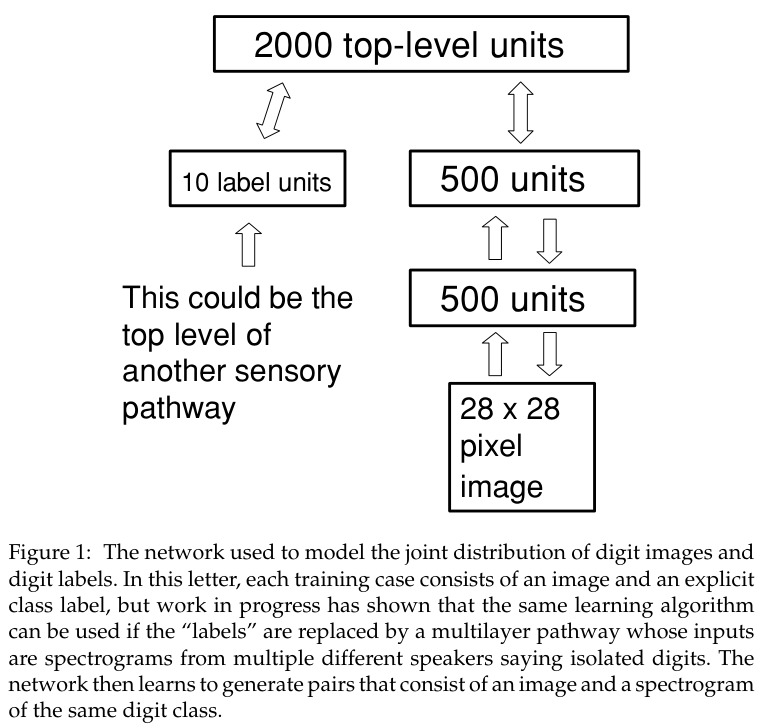
Figure 1 from Hinton, Osindero and Teh’s 2006 deep belief network paper, PDF page 2, showing digit inputs and network layers.
Geoffrey E. Hinton; Simon Osindero; Yee-Whye Teh · Rights in the original image and document remain with their respective holders
Source · A Fast Learning Algorithm for Deep Belief Nets ↗RESEARCH ACCOUNT
Layerwise learning provides an initialisation for deep generative models.
ANTI-AI ARCHIVE · Revised 2026-10-02
Method and contribution
Hinton, Osindero and Teh propose layerwise training of deep belief networks followed by slower fine-tuning. Handwritten digits and labels illustrate a joint generative and classification model. Upper associative memory and lower directed connections play different roles; this architecture should not be equated with every subsequent deep-learning system.
Section sources: A Fast Learning Algorithm for Deep Belief Nets
Art-historical interpretation
Its role in the genealogy is to explain trainable deep representations, not the birth of a particular artwork. Comparison with later synthesis should track actual differences in representation, training and output rather than narrating an inevitable progression towards text-to-image.
Section sources: A Fast Learning Algorithm for Deep Belief Nets
Sources for this account
Abstract, introduction and network description in the authors’ public paper read.
This account expands the archive within the cited scope. Historical interpretation is not presented as the original author’s statement or as a proven causal influence. The account and translation are AI-assisted, pending independent human review. Section references identify evidence without claiming independent verification of every historical statement.
Continue with a comparative question
Compare the methods, forms of control or presentation contexts of this entry and Learning representations by back-propagating errors.
Compare the methods, forms of control or presentation contexts of this entry and AlexNet.
Dates & version record
Date displayed for this node: 2006 · Historical date recorded for the source: 2006
These dates refer to the historical event or recorded version, not this page’s publication date. The original date precision and unresolved questions are retained.
Original sources & further reading
These links lead to the cited paper, article, institution or conference page. External texts retain their source languages.
A Fast Learning Algorithm for Deep Belief Nets
https://doi.org/10.1162/neco.2006.18.7.1527
Current cited URL
Provenance, translation & verification
Timeline entry #073 · Historical node
Research materials & supplement references · 1
AI Art Genealogy Research Master · p. 14 · 039
Date as recorded: 2006
A Fast Learning Algorithm for Deep Belief Nets ↗
A Fast Learning Algorithm for Deep Belief Nets
Archive account based on the listed research materials, not a full translation of the linked work. AI-assisted translation; independent human review pending.
The master’s research claims and dates await independent verification.
Cite this node
ANTI-AI ARCHIVE. A Fast Learning Algorithm for Deep Belief Nets. Art-history node #073. https://salondesrefuses.cn/en/art-history/039
For specific historical claims, also cite the original sources above and include your access date. This account is not a full translation of the linked work.
Adjacent nodes follow chronological order; adjacency does not establish direct influence or causation.