

Introduction
Beginning in 1979, Ars Electronica places art, technology and social questions on a shared public platform. Its continuing presentation of artificial life, robotics, data art and AI art provides long-term cultural infrastructure for practices that otherwise might remain isolated technological experiments.
 View full image ↗
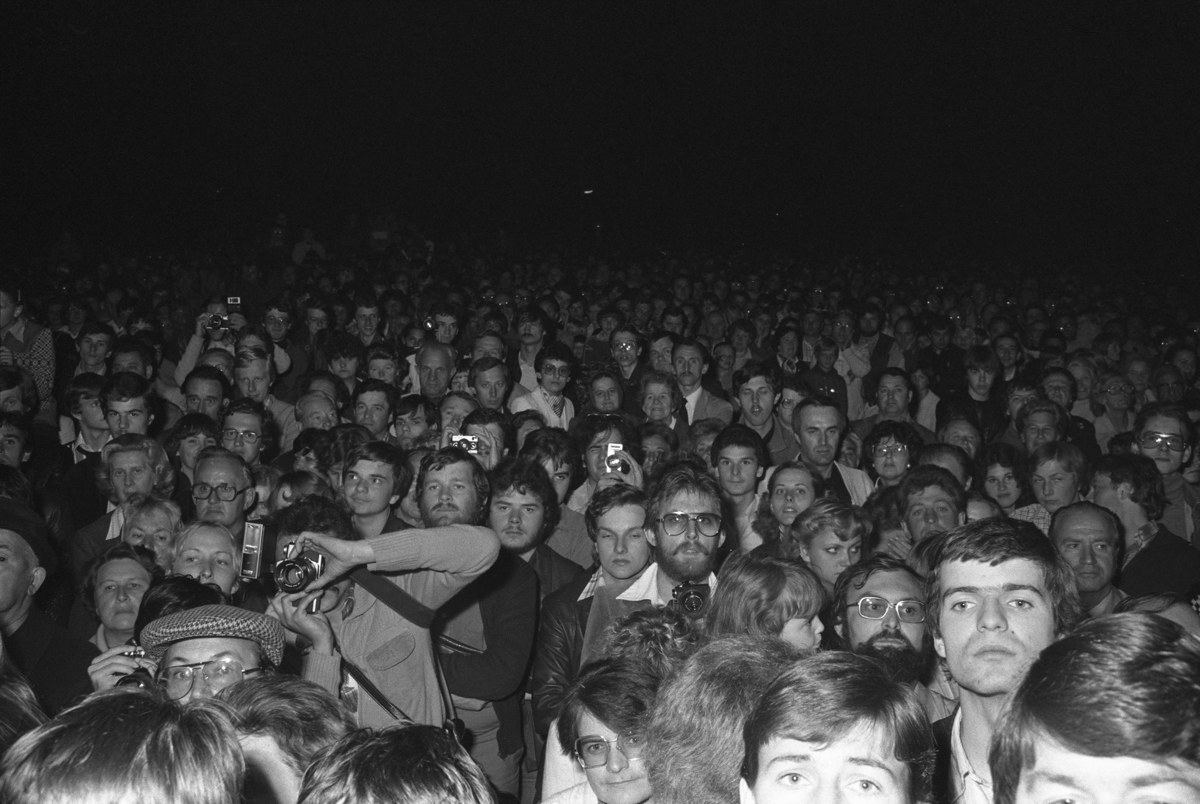
Audience at the first Linz Klangwolke in 1979, reproduced in Ars Electronica’s retrospective on its first festival.
Ars Electronica Archive · Image rights remain with their respective holders; no open licence is asserted
Source · Ars Electronica Festival ↗RESEARCH ACCOUNT
An industrial city builds an art-and-technology festival
ANTI-AI ARCHIVE · Revised 2026-10-02
The urban context of 1979
Ars Electronica places its foundation within Linz’s industrial transformation. Hannes Leopoldseder sought civic support for engaging with changes associated with computing. The first festival in 1979 accompanied the Klangwolke public sound event, giving art-and-technology practice a city-wide stage.
Section sources: Ars Electronica Festival
Art, audiences and continuing support
The institutional account links broad public participation with continuing support. A robot appeared at the first opening, but the festival’s importance exceeds the presentation of a novel machine: it established relations among organisers, the city, artists and audiences that could persist over time.
Section sources: Ars Electronica Festival
Keeping a long institution historically specific
Editorial interpretation: later prizes, laboratories and exhibitions should not all be projected back onto 1979. This founding node concerns public infrastructure. Research into a particular AI work still requires the programme and work records from its own period.
Section sources: Ars Electronica Festival
Sources for this account
Institutional history for the 1970s and 1979 read; programmes of every subsequent edition were not audited.
This account expands the archive within the cited scope. Historical interpretation is not presented as the original author’s statement or as a proven causal influence. The account and translation are AI-assisted, pending independent human review. Section references identify evidence without claiming independent verification of every historical statement.
Continue with a comparative question
Compare the methods, forms of control or presentation contexts of this entry and Computer Arts Society.
Compare the methods, forms of control or presentation contexts of this entry and AI: More than Human.
Dates & version record
Date displayed for this node: 1979 · Historical date recorded for the source: 1979
These dates refer to the historical event or recorded version, not this page’s publication date. The original date precision and unresolved questions are retained.
Original sources & further reading
These links lead to the cited paper, article, institution or conference page. External texts retain their source languages.
Ars Electronica Festival
https://ars.electronica.art/about/en/history/
Current cited URL
Provenance, translation & verification
Timeline entry #043 · Historical node
Research materials & supplement references · 1
AI Art Genealogy Research Master · p. 11 · 028
Date as recorded: 1979
Ars Electronica Festival ↗
Ars Electronica Festival
Archive account based on the listed research materials, not a full translation of the linked work. AI-assisted translation; independent human review pending.
The master’s research claims and dates await independent verification.
Cite this node
ANTI-AI ARCHIVE. Ars Electronica Festival. Art-history node #043. https://salondesrefuses.cn/en/art-history/028
For specific historical claims, also cite the original sources above and include your access date. This account is not a full translation of the linked work.
Adjacent nodes follow chronological order; adjacency does not establish direct influence or causation.