

The archive provides Chinese and English research texts. Translations may be AI-assisted and may not yet have received independent human review. Consult the original-language sources alongside them.
Terence Tao published a statement with 25 initial signatories criticising corporate problem-solving competitions that displace understanding, communication and credit norms, while acknowledging AI's potential to help mathematical research.
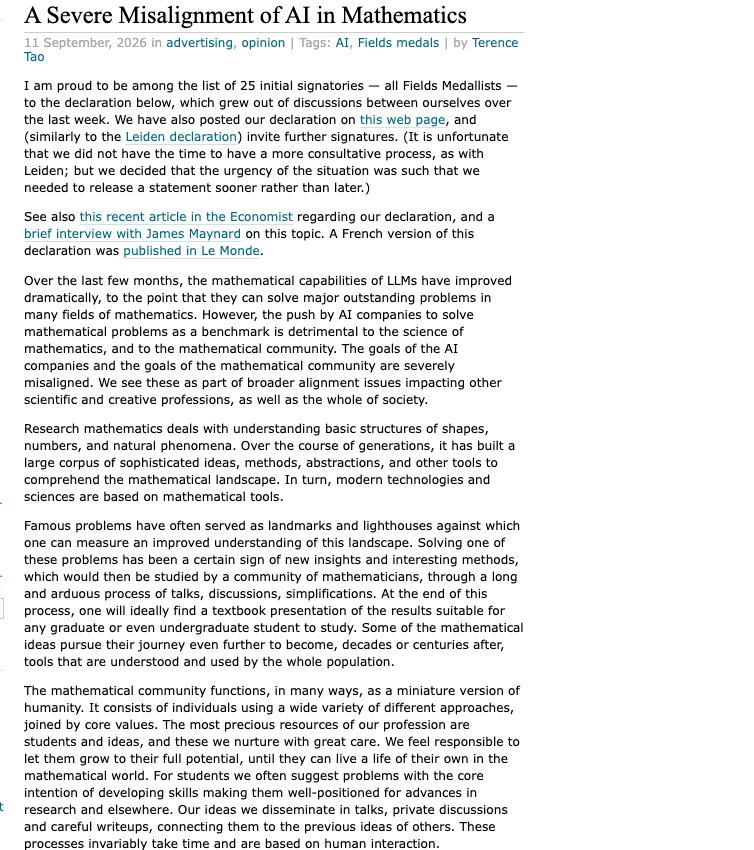 View full image ↗
Source-page excerpt from “A Severe Misalignment of AI in Mathematics”, captured on 1 October 2026. The original-language layout is retained; this is not a snapshot taken on the event date.
Source: Terence Tao / What’s new; rights remain with the original holders.
Source · A Severe Misalignment of AI in Mathematics ↗What changed
Terence Tao published a statement with 25 initial signatories criticising corporate problem-solving competitions that displace understanding, communication and credit norms, while acknowledging AI's potential to help mathematical research.
Neither a ban on all AI use nor independent certification of particular results; 25 is the number of initial signatories.
Editorial research question
Editorial interpretation: the statement explicitly connects mathematical understanding, transmission and attribution with other sciences and creative professions, enabling comparison of knowledge labour across fields.
This is an editorial interpretation or question, separate from factual statements.
Evidence & sources
Terence Tao published a statement with 25 initial signatories criticising corporate problem-solving competitions that displace understanding, communication and credit norms, while acknowledging AI's potential to help mathematical research.
SRC-0277Lines 15–57: statement and 25 initial signatories.
Case
Related documents
DOC-0265A Severe Misalignment of AI in MathematicsDOC-0383A Severe Misalignment of AI in MathematicsCite this record
ANTI-AI ARCHIVE. “Twenty-five Fields medallists issue a joint statement.” evt-0256. Include this page’s URL and your access date when citing.