

The archive provides Chinese and English research texts. Translations may be AI-assisted and may not yet have received independent human review. Consult the original-language sources alongside them.
Section 64.1 provides for advance written notice, good-faith bargaining within a specified period, and potential arbitration payments. Negotiated or arbitrated payments go to health or retirement plans at the union’s election.
 View full image ↗
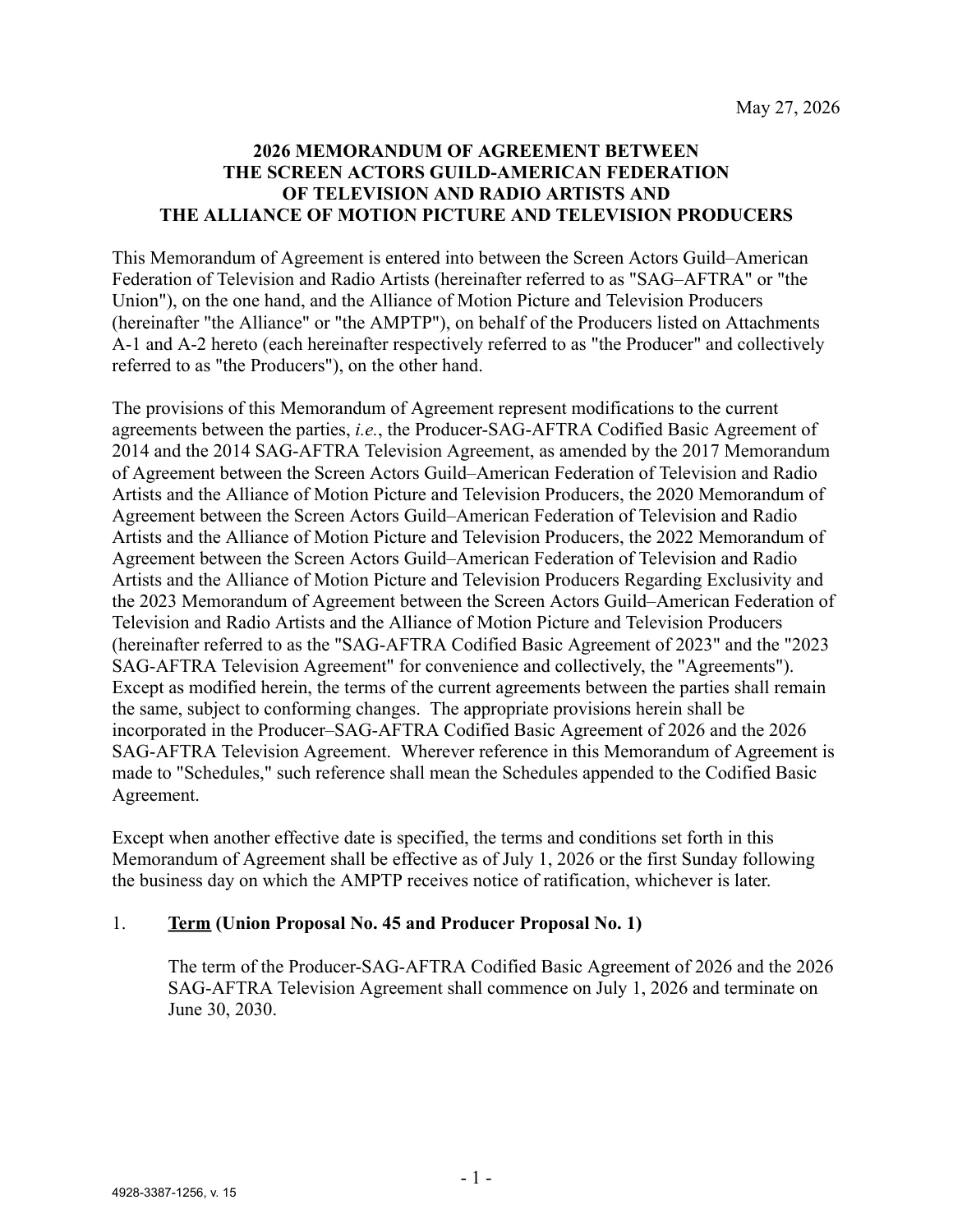
Opening page of the source document associated with “2026 SAG-AFTRA / AMPTP Memorandum of Agreement”. Original page layout retained; follow the source for the full text.
Image source: SAG-AFTRA / AMPTP; rights remain with the original rights holders.
Source · 2026 SAG-AFTRA / AMPTP Memorandum of Agreement ↗What changed
Section 64.1 provides for advance written notice, good-faith bargaining within a specified period, and potential arbitration payments. Negotiated or arbitrated payments go to health or retirement plans at the union’s election.
The date belongs to the document. There is no uniform fixed levy and no blanket ban on synthetic performers. The definition excludes certain digital replicas of real people; exceptions include dangerous human actions and nonhuman characters. Only printed pages 131–133 were checked, not all 145 pages.
Editorial research question
Editorial interpretation: renewal and enforcement of protections following the 2023 strike.
This is an editorial interpretation or question, separate from factual statements.
Evidence & sources
Section 64.1 provides for advance written notice, good-faith bargaining within a specified period, and potential arbitration payments. Negotiated or arbitrated payments go to health or retirement plans at the union’s election.
SRC-0130Printed pages 131–133, section 64.1; strikethroughs and additions were visually checked.
Case
Related documents
DOC-01182026 SAG-AFTRA / AMPTP Memorandum of AgreementCite this record
ANTI-AI ARCHIVE. “2026 memorandum specifies bargaining rules for synthetic performers.” evt-0131. Include this page’s URL and your access date when citing.