

The archive provides Chinese and English research texts. Translations may be AI-assisted and may not yet have received independent human review. Consult the original-language sources alongside them.
SFWA says generated content harms fiction submissions and sales, recommends disclosure of AI contributions and verification of training permissions, and calls for voluntary opt-in collective licensing. These are organisational recommendations, not rules in force.
 View full image ↗
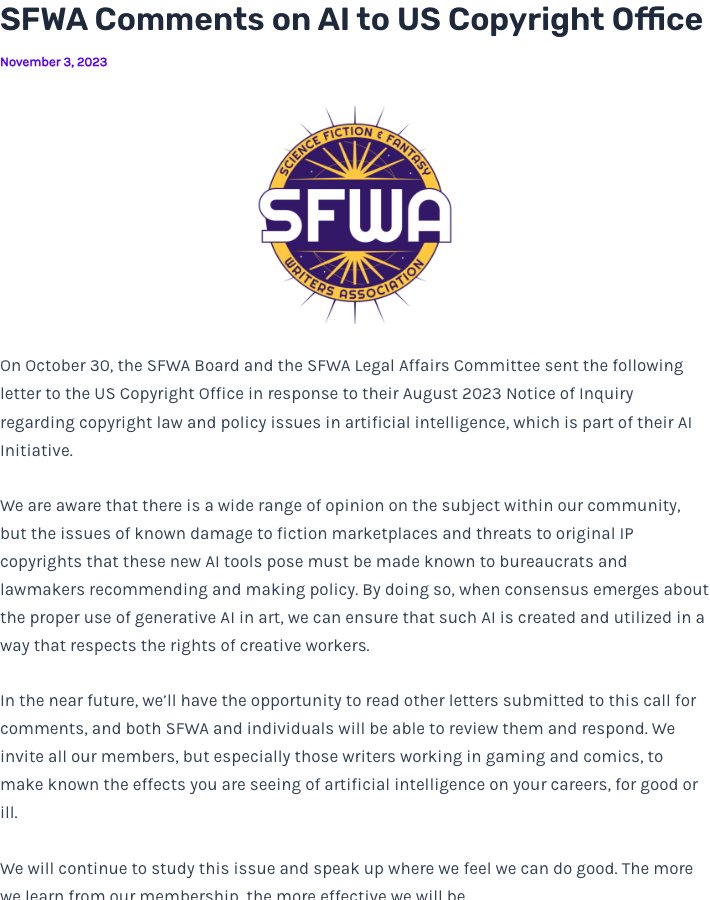
Source-page excerpt from “SFWA Comments on AI to US Copyright Office”, captured on 1 October 2026. The original-language layout is retained; this is not a snapshot taken on the event date.
Source: SFWA; rights remain with the original holders.
Source · SFWA Comments on AI to US Copyright Office ↗What changed
SFWA says generated content harms fiction submissions and sales, recommends disclosure of AI contributions and verification of training permissions, and calls for voluntary opt-in collective licensing. These are organisational recommendations, not rules in force.
The official November 3 page identifies October 30 as the submission date. Market effects are the organisation’s account, not independent market-wide statistics.
Editorial research question
Editorial interpretation: a writers’ organisation brings submission systems, readers’ ability to distinguish works, and training permission into policy argument.
This is an editorial interpretation or question, separate from factual statements.
Evidence & sources
SFWA says generated content harms fiction submissions and sales, recommends disclosure of AI contributions and verification of training permissions, and calls for voluntary opt-in collective licensing. These are organisational recommendations, not rules in force.
SRC-0088Introduction identifying October 30 submission; full TEXT OF LETTER, policy recommendations at lines 114–124
Case
Related documents
DOC-0076SFWA Comments on AI to US Copyright OfficeCite this record
ANTI-AI ARCHIVE. “SFWA submits AI-policy comments to the US Copyright Office.” evt-0091. Include this page’s URL and your access date when citing.