

Introduction
Leonardo launches a new in-house model emphasising aesthetic diversity, prompt adherence and Full HD output.
 View full image ↗
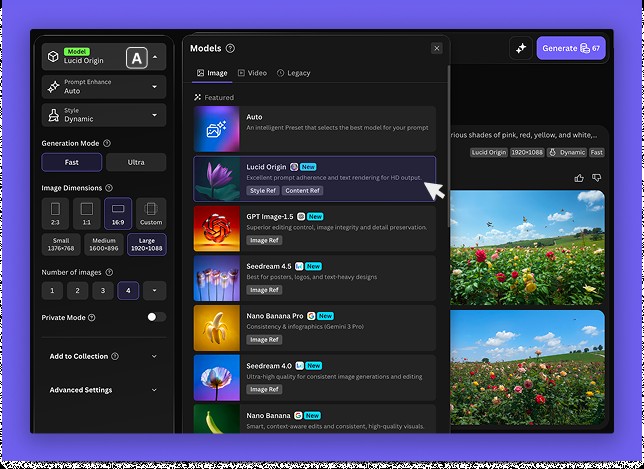
Lucid Origin model-selection and generation interface from Leonardo’s official help centre. The source does not separately date the screenshot.
Leonardo.Ai Help Center · Rights remain with the respective holders; reproduction does not imply an open licence
Source · Lucid Origin | Leonardo.Ai Help Center ↗RESEARCH ACCOUNT
Describing data selection and model blending as aesthetic production.
ANTI-AI ARCHIVE · Revised 2026-10-02
Release and use
Leonardo.Ai published its Lucid Origin announcement on 5 August 2025; the current page records an update in May 2026. It discusses prompt response, text, stylistic range and colour, while describing dataset selection and the blending of model candidates as processes involving human aesthetic judgement. This account uses the updated announcement without treating every present-day product claim as independently established at launch.
Section sources: Lucid Origin – Leonardo.AI’s latest Gen AI model.
Change in creative practice
One historical feature is the developer’s explicit use of curation, taste and intention to describe training. Research can ask how these judgements enter a model and whose visual preferences its defaults represent. A developer’s account of that labour is valuable evidence, but does not by itself settle data provenance or rights questions.
Section sources: Lucid Origin – Leonardo.AI’s latest Gen AI model.
Sources for this account
Official release scope and demonstration descriptions read; vendor performance claims are not treated as independent test results.
This account expands the archive within the cited scope. Historical interpretation is not presented as the original author’s statement or as a proven causal influence. The account and translation are AI-assisted, pending independent human review. Section references identify evidence without claiming independent verification of every historical statement.
Continue with a comparative question
Compare the methods, forms of control or presentation contexts of this entry and FLUX.1 Krea [dev] open weights.
Compare the methods, forms of control or presentation contexts of this entry and Qwen-Image.
Dates & version record
Date displayed for this node: 2025-08-05 · Historical date recorded for the source: 2025-08-05
These dates refer to the historical event or recorded version, not this page’s publication date. The original date precision and unresolved questions are retained.
Original sources & further reading
These links lead to the cited paper, article, institution or conference page. External texts retain their source languages.
This is the archive’s bilingual research abstract. The external link is an original source, not a claim that the publisher offers full text in both languages.
Provenance, translation & verification
Timeline entry #304 · Model / product
Research materials & supplement references · 1
GenAI Visual Release Chronology Research Master · p. 32 · R174
Date as recorded: 2025-08-05
Lucid Origin ↗
Lucid Origin
Archive account based on the listed research materials, not a full translation of the linked work. AI-assisted translation; independent human review pending.
The master’s research claims and dates await independent verification.
Cite this node
ANTI-AI ARCHIVE. Lucid Origin. Art-history node #304. https://salondesrefuses.cn/en/art-history/206
For specific historical claims, also cite the original sources above and include your access date. This account is not a full translation of the linked work.
Adjacent nodes follow chronological order; adjacency does not establish direct influence or causation.