

Introduction
The product shifts toward more controllable scene/subject workflows and viral effect-oriented creation.
 View full image ↗
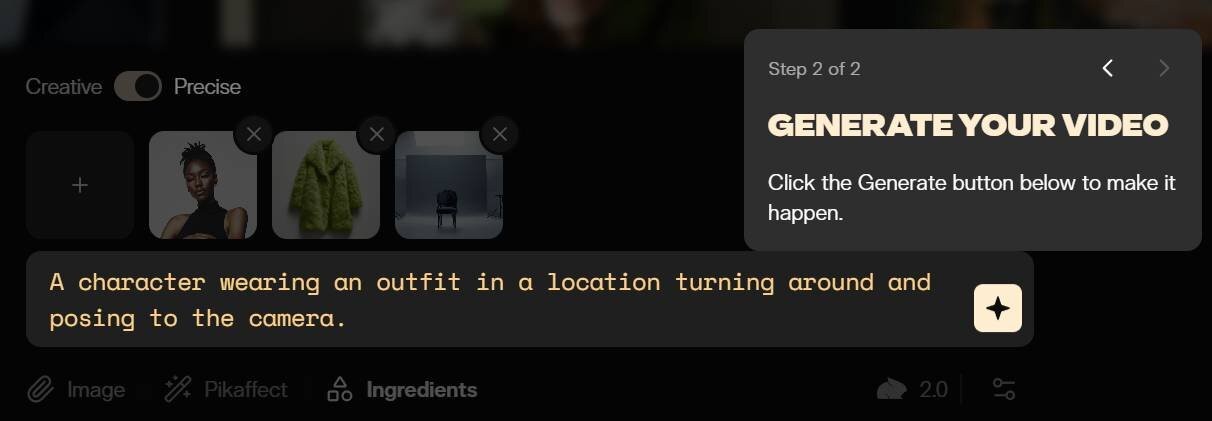
Scene Ingredients test interface in CGWORLD’s Pika 2.0 release report, showing image ingredients and a prompt used for video generation.
Pika interface; test screenshot CGWORLD · Rights remain with the respective holders; reproduction does not imply an open licence
Source · Pika 2.0 introduces Scene Ingredients: generating scenes from images and text prompts ↗RESEARCH ACCOUNT
Subject and scene control in consumer video generation.
ANTI-AI ARCHIVE · Revised 2026-10-02
Release and use
The master places Pika 2.0 in December 2024 and characterises it as a consumer-video update concerned with scene and subject control. Compared with entering a sentence alone, such workflows foreground which people, objects and visual attributes should be retained or combined. The cited homepage has changed with the product. This entry therefore retains month-level dating and does not backdate every current effect, duration or parameter to version 2.0.
Section sources: Pika 2.0
Change in creative practice
A tool update documents changing operations, not the automatic formation of an artistic movement. Its research value lies in creators treating the scene as a set of elements that can be assigned, replaced and recombined. Generative imagery thereby enters into relations with compositing and design workflows.
Section sources: Pika 2.0
Sources for this account
Historical version account follows the research master; the current site does not independently establish the original feature set, and the original announcement has not been verified.
This account expands the archive within the cited scope. Historical interpretation is not presented as the original author’s statement or as a proven causal influence. The account and translation are AI-assisted, pending independent human review. Section references identify evidence without claiming independent verification of every historical statement.
Continue with a comparative question
Compare the methods, forms of control or presentation contexts of this entry and Pika 1.0.
Compare the methods, forms of control or presentation contexts of this entry and Pika 2.1 / 2.2 family.
Dates & version record
Date displayed for this node: 2024-12 · Historical date recorded for the source: 2024-12
Month or year precision follows the master; an exact release date awaits independent verification.
These dates refer to the historical event or recorded version, not this page’s publication date. The original date precision and unresolved questions are retained.
Original sources & further reading
These links lead to the cited paper, article, institution or conference page. External texts retain their source languages.
This is the archive’s bilingual research abstract. The external link is an original source, not a claim that the publisher offers full text in both languages.
Provenance, translation & verification
Timeline entry #266 · Model / product
Research materials & supplement references · 1
GenAI Visual Release Chronology Research Master · p. 26 · R140
Date as recorded: 2024-12
Pika 2.0 ↗
Pika 2.0
Archive account based on the listed research materials, not a full translation of the linked work. AI-assisted translation; independent human review pending.
The master’s research claims and dates await independent verification.
Cite this node
ANTI-AI ARCHIVE. Pika 2.0. Art-history node #266. https://salondesrefuses.cn/en/art-history/191
For specific historical claims, also cite the original sources above and include your access date. This account is not a full translation of the linked work.
Adjacent nodes follow chronological order; adjacency does not establish direct influence or causation.