

Introduction
OpenAI makes its image-generation capabilities available to developers through gpt-image-1. The historical point is a further movement of the interface: native multimodal image generation can be embedded in commerce, design, education, games and organisational workflows, instead of being available only inside a particular chat product.
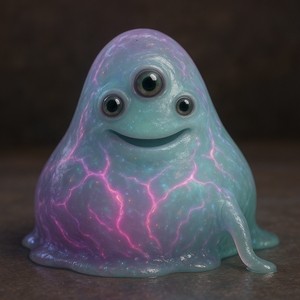 View full image ↗
Translucent three-eyed character from OpenAI’s GPT Image tutorial, preserving the tutorial’s actual generated output as an example of API image generation.
Katia Gil Guzman / OpenAI Cookbook · Rights remain with the respective holders; reproduction does not imply an open licence
Source · Generate images with GPT Image ↗RESEARCH ACCOUNT
Image generation moves from a chat product into other software.
ANTI-AI ARCHIVE · Revised 2026-10-02
Release and use
The 23 April 2025 gpt-image-1 API announcement enables developers to integrate image generation into their own applications. The change concerns access and product boundaries, rather than another release of the same chat feature. Developers organise inputs, interfaces and downstream processing while the provider manages the service.
Section sources: gpt-image-1 API
Change in creative practice
Embedding generation within design, commerce or educational interfaces means users may not directly encounter the model’s brand. Research must trace relationships between software systems to distinguish constraints set by an application designer, a model provider and the person using the image.
Section sources: gpt-image-1 API
Sources for this account
Official release scope and demonstration descriptions read; vendor performance claims are not treated as independent test results.
This account expands the archive within the cited scope. Historical interpretation is not presented as the original author’s statement or as a proven causal influence. The account and translation are AI-assisted, pending independent human review. Section references identify evidence without claiming independent verification of every historical statement.
Continue with a comparative question
Compare the methods, forms of control or presentation contexts of this entry and GPT-4o native image generation.
Compare the methods, forms of control or presentation contexts of this entry and GPT-Image-2 / ChatGPT Images 2.0.
Dates & version record
Date displayed for this node: 2025-04-23 · Historical date recorded for the source: 2025-04-23
These dates refer to the historical event or recorded version, not this page’s publication date. The original date precision and unresolved questions are retained.
Original sources & further reading
These links lead to the cited paper, article, institution or conference page. External texts retain their source languages.
Provenance, translation & verification
Timeline entry #286 · Historical node
Research materials & supplement references · 2
AI Art Genealogy Research Master · p. 38 · 133
Date as recorded: 2025-04-23
gpt-image-1 API ↗
gpt-image-1 API
GenAI Visual Release Chronology Research Master · p. 29 · R157
Date as recorded: 2025-04-23
gpt-image-1 API ↗
gpt-image-1 API
Archive account based on the listed research materials, not a full translation of the linked work. AI-assisted translation; independent human review pending.
The master’s research claims and dates await independent verification.
Cite this node
ANTI-AI ARCHIVE. gpt-image-1 API. Art-history node #286. https://salondesrefuses.cn/en/art-history/133
For specific historical claims, also cite the original sources above and include your access date. This account is not a full translation of the linked work.
Adjacent nodes follow chronological order; adjacency does not establish direct influence or causation.