

Introduction
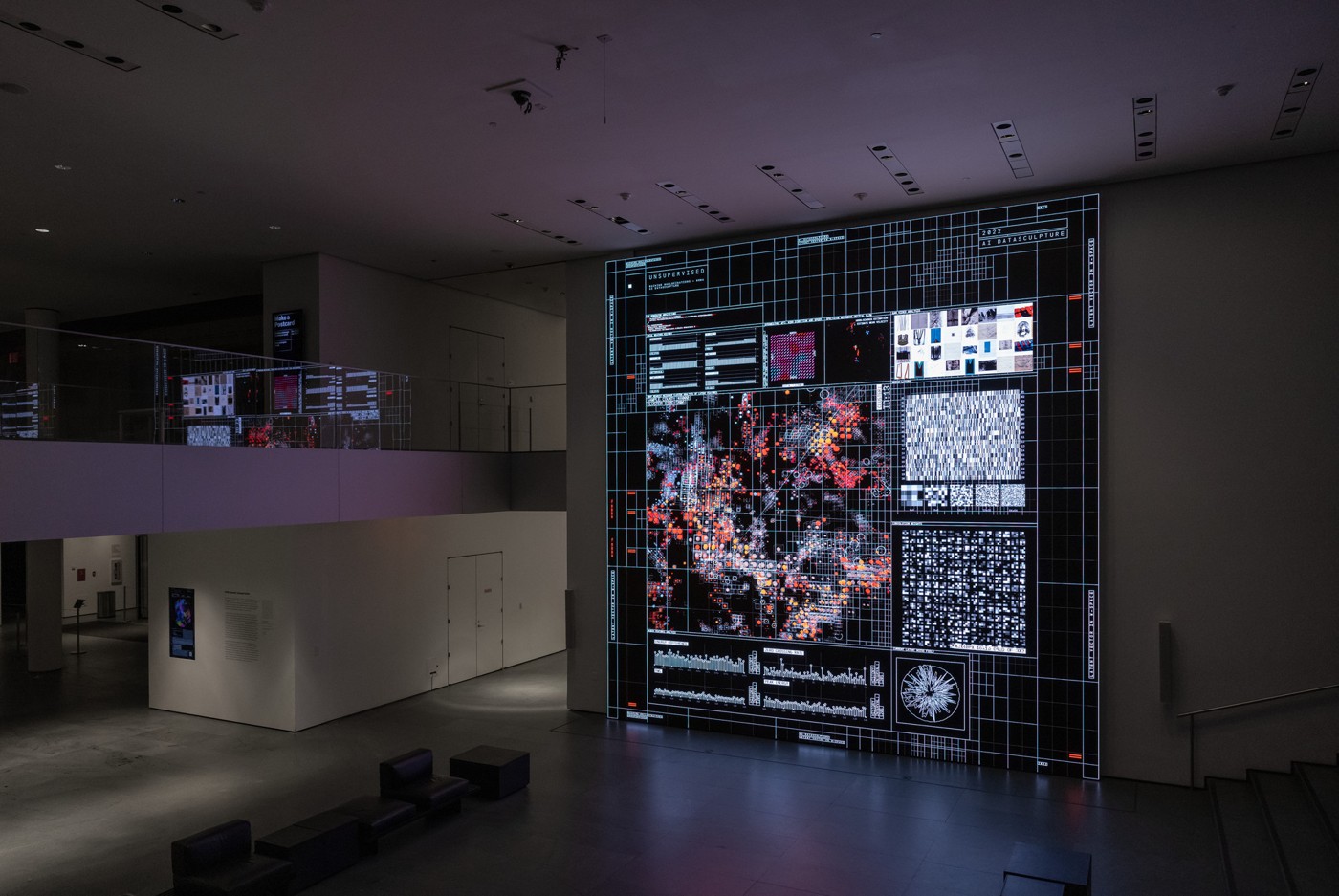
Unsupervised uses data from MoMA's collection to train or drive a generative visual system presented on a large real-time screen. It makes relations among datasets, museum collections and generative models visible as artistic material. The institutional collection participates in both the system's input and the public interpretation of its output.
 View full image ↗
Installation view of Refik Anadol’s Unsupervised at MoMA. The museum records the exhibition as November 19, 2022–October 29, 2023; photograph reference IN2509.17.
Refik Anadol Studio · photograph Denis Doorly / MoMA · Rights in the original image and document remain with their respective holders
Source · Refik Anadol: Unsupervised · installation view IN2509.17 ↗RESEARCH ACCOUNT
A museum collection becomes material for a generative installation.
ANTI-AI ARCHIVE · Revised 2026-10-02
Exhibiting a model at MoMA
Anadol’s Unsupervised draws on publicly available material from MoMA’s collection to produce a changing visual installation within the museum. The exhibition begins in 2022; its run should be distinguished from subsequent acquisition, updates or presentations. The museum explains a response to its collection, not proof that a model genuinely understands modern art history.
Section sources: Unsupervised
Collection, data and authority
The historical question concerns how collecting decisions enter machine visualisation and how a museum frames the result. The installation reorganises an institution’s accumulated categories into a visual experience. Analysis should distinguish source material, the generative mechanism, the artist’s staging decisions and the museum’s interpretive language.
Section sources: Unsupervised
Sources for this account
MoMA exhibition account and dates read; individual training-data provenance was not audited.
This account expands the archive within the cited scope. Historical interpretation is not presented as the original author’s statement or as a proven causal influence. The account and translation are AI-assisted, pending independent human review. Section references identify evidence without claiming independent verification of every historical statement.
Continue with a comparative question
Compare the methods, forms of control or presentation contexts of this entry and Memories of Passersby I.
Compare the methods, forms of control or presentation contexts of this entry and Radical Software: Women, Art & Computing 1960–1991.
Dates & version record
Date displayed for this node: 2022-11 · Historical date recorded for the source: 2022-11
These dates refer to the historical event or recorded version, not this page’s publication date. The original date precision and unresolved questions are retained.
Original sources & further reading
These links lead to the cited paper, article, institution or conference page. External texts retain their source languages.
Provenance, translation & verification
Timeline entry #166 · Historical node
Research materials & supplement references · 2
AI Art Genealogy Research Master · p. 27 · 090
Date as recorded: 2022-11
Unsupervised ↗
Unsupervised
GenAI Visual Release Chronology Research Master · p. 10 · R045
Date as recorded: 2022-11
Unsupervised ↗
Refik Anadol — Unsupervised at MoMA
Archive account based on the listed research materials, not a full translation of the linked work. AI-assisted translation; independent human review pending.
The master’s research claims and dates await independent verification.
Cite this node
ANTI-AI ARCHIVE. Unsupervised. Art-history node #166. https://salondesrefuses.cn/en/art-history/090
For specific historical claims, also cite the original sources above and include your access date. This account is not a full translation of the linked work.
Adjacent nodes follow chronological order; adjacency does not establish direct influence or causation.